lørdag den 24. januar 2015

GIFF day 1: Timbuktu, Mateo, Tokyo Tribe

Hi. I'm at Gothenburg International Film Festival! It's great, the mood is awesome, the theaters are packed, people really seem into it. I'm from Denmark, and have been going to Danish festivals a few times, but they aren't like this. There really is a sense of excitement over here, which makes the whole thing so much better. And also, I have family over here, and they are awesome as well! So so far, the whole thing has been pretty much perfect! The only problem is, I can't really get into all the films I want to see, because they are sold out...

Timbuktu (Abderrahmane Sissako, Mauritania, 2014)

African film rarely get the spotlight, so when a film like this gets nominated for both the Palme d'Or at Cannes as well as an Oscar, it's cause for celebration. And when it's as good as this, it's could actually be pretty important. I really wanted to see this, but all the screenings are completely sold out already. Luckily, an extra screening was arranged, and I made it into that.

Well, honestly, this was more 'important' than 'great'. The film depicts what happens after a group of islamists take over Timbuktu, and it's great at both showing the processes of jihad as well as sharia, and at showing the way people slowly fight against it. There are amazing sequences in it, like a group of kids playing football without a ball as balls have been outlawed. Or a shot of two people struggling in a lake, filmed at a distance with the afternoon sun shining down, making the water glisten and the men into dark shadows. But the main story never really lifts off, and the main family are honestly a bit boring. Much more interesting things are happening on the sidelines, both with the jihadists and their victims.

The film is surprisingly nuanced towards sharia, though. It shows the many horrors coming from the strict laws, but it also shows the violence and turbulence caused by lawlessness. When the young boys play soccer, it's amazing not just because they show such great imagination, but also because they actually manage to agree on who scores at which time. It's a utopian dream of collaboration and compromise. But immediately after that, two men come to blows in a conflict based on their conflicting uses of the sole river in the area. Two kids matter of factly discuss the death of the one kid's father due to him being a fighter. This area has been ravaged by war and violence for a long long time, it's not something the jihadists has brought. But they really don't help it. Make no mistake, they are hypocrites, violent and lustful. The film has no illusions things would be right if they dissapeared.

Great scenes where people play Malian music are followed by horrifying scenes where musicians are publicly whipped. Many characters are great, like Abdelkrim, a jihadist learning to drive his four-wheel Toyota and struggling with a now clandestine smoking addiction. Or a female witch, of sorts, a practitioner of some sort of old African religion, claiming to have been dislocated from Haiti a few years back, and walking the streets un-scarfed confronting the jihadists and getting away with it through force of will. So many great stories are in this. It's just, the spine isn't that interesting, and those scenes can grind the film to a halt. But important filmmaking, definitely, showing new perspectives on a global problem. And those great scenes absolutely lift it above just being 'worthwhile', or some other kind of faint praise. It's good.

Mateo (Maria Gamboa, Columbia, 2014)

When you watch a gangster-film, you don't expect there to be great choreography. So this one kinda took me by surprise.

Young Mateo works for his uncle Walter, the local loanshark, in one of Columbias most dangerous cities. He's doing simple work, collecting money from local merchants, every now and then taking merchandise instead, and not realizing the dangerous mess he's getting himself into. You've seen this film before. Young boys in dangerous cities. It's City of God. It's Gomorrah. It's The Wire season 4. But then Mateo joins a local theater-group, first to not get kicked out of school, then to spy on the participants for his uncle, and then the film becomes somewhat strange. What seemed like a slow build to death and violence instead becomes about trust and solidarity. That is pretty clearly what the theater-group is about: The first thing they practice is looking each other in the eyes and carrying each other up. Mateo knows how to act, when we first see him he moves through streets and poolhalls with practiced swagger, but he don't know how to act along with others. He can never look the leader of the group, a young priest, in the eyes. The young priest preaches standing up to the evil forces, showing solidarity. Mateo's mother works with her friends to build a small farm that will bring more wealth to all of them. They are clearly small solutions to the big problems doing so much damage to Columbia.

It's a gentle film, with beautifully filmed scenes of young people acting, dancing, moving around. The guns almost move out of the film, almost. The camera moves fluidly as well, including some absolutely wild craneshots over rivers I have absolutely no idea how they got the resources to do in a small film like this. At some point I didn't know if I was willing to go along with the tale, the whole theater-beating-thugs thing can seem like complete wish-fullfillment at times. But the ending is suitably dark and ambiguous, which really helps a lot. This was a film a looong way down the bill, one of the films in the 'New Voices' section for debut features, that isn't in the 'Ingmar Bergman International Debut Award' competition, nor in the section for 'Visionaries', which include some very young filmmakers as well. I had no expectations for this film. But I was pleasantly surprised.

Tokyo Tribe (Sion Sono, Japan, 2014)

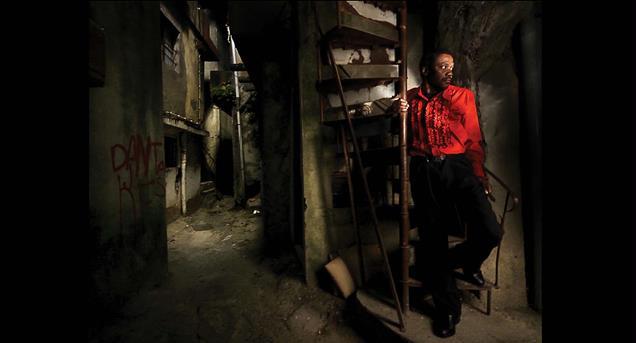
Sion Sono makes a film a year, and every film makes the festival circuit. And they aren't austere, short films, they are packed to the gills with ideas, images, twists, and characters. I watched and liked Land of Hope in 2013, and Why Don't You Play in Hell in 2014. This is his biggest, weirdest, yet, of the ones I've seen. A truckload of crazy characters, in big costumes, on amazingly big and intricate sets where the camera roams for minutes at a time without a cut. And, oh, the film is a hiphop musical, so most of the dialogue is rapped. It's insane, is what it is.

Actually, this time I get how he does it, because the whole thing is based on a manga, called Tokyo Tribe2. Googling images, it's clear that a lot of character and set design is taken straight from the page. A lot of the lyrics are apparantly written by the hiphop-artists playing the characters as well. The plot is apparantly heavily modified from the manga, but it doesn't make any sense at all, so it probably didn't take that much time to put together. Something about a bunch of 'Tribes' in Tokyo, gangs warring for territory, and one of them all of a sudden has a bunch of henchmen so all the other tribes has to band together. And some of them are for love and peace, and others want war and domination, and there is some kind of High Priest from 'Wong Kong' who's daughter has dissapeared and two diminutive teenage karate experts kicking ass and a beatboxing waitress and a swordwielding thug in a thong and a bunch of other weird stuff. It's packed to the gills with wacky details. It's destined to become a cult-film for a long time to come.

A song from the French version of the Anime version of this. Which for some reason exists.

But... I don't think it was as riveting as Why Don't You Play In Hell. The difference is, WDYPIH was a loveletter to cheap filmmaking in all forms, from 8mm amateur film to glossy commercials, and that joy of film was always easy to see in every frame of the film. Tokyo Tribes is an ode to hiphop culture, but... The beats aren't that great, and the rapping isn't that great, and I don't know about Japanese hiphop, but American hiphop actually has a visual grammar from it's videos, and it looks nothing like this film. The visuals of this film are West Side Story meets The Warriors meets Mad Max in a dayglo-neon-cityscape. Don't get me wrong, that is cool. But the different parts at times work against each other, and at times the hip-hop aesthetic seems like stick. Or it could be that Japanese hiphop-culture is as weird as this.

Nevertheless, this one will probably be watched by many people, and that is as it should be. This is weirder than weird, and Sono is a massively accomplished filmmaker. Long, one-take scenes on big sets with masses of extras walking back and forth and several stories playing out at once. Great fights. Beautiful images. It's all cool, I'm down with it, the scratching grandma, the jewel-encrusted katanas, the human furniture, the guy creating a lockpick through breakdancing. This was cool. But do watch some more Sion Sono afterwards, he is really on a roll these years!

Also Seen
I've also seen Michael Noer's (R, Northwest) Key House Mirror which is in competition, and which I will write about elsewhere. But to say it short: It's a big leap forward for the young director, Ghita Nørby is great as an old lady trying to create a life in a nursing home, and I wouldn't be surprised if it won a bunch of awards here and elsewhere. Also, I rewatched J.P. Sniadecki's The Iron Ministry, which I've written about here. Related to Harvard SEL, the experimental group famous for films like Leviathan and Manakamana, it's a great visual portrait of China in motion as seen through it's trains.

tirsdag den 18. november 2014

CPHDOX day 9: The Lack, Horse Money

The Lack (Masbedo, Italy, 2014)


CPHDOX is amazing at blurring the boundaries between documentary, art and fiction, showcasing hybrid films as well as putting stuff in other contexts. But then, at times, because the festival overall is so amazing at considering docs as an artform, the series devoted explicitly to art-films might suffer. When amazing art-cinema like Lav Diaz' Storm Children or Pedro Costa's Horse Money is playing in the main competition, it's reason for aplause, good for not keeping artfilm confined to a ghetto of sorts. But the films left behind might suffer a bit.

The Lack is a fine film, but I'm left with the feeling that it's really regular artfilm-making. Working from ideas I gather was gathered from psycho-analysis, the film showcases six women through four dream-like episodes, where their needs, dreams and frustrations are visualized. It's very beautiful, and the sound is great. The first and the third were filmed in Iceland, the second on the Aeolian islands, as a tribute to Michelangelo Antonioni's L'Avventura, also concerned with the appearence of a 'lack' so to speak, though in that case a lacune left by the dissapearing woman. The first episode showed a woman in a white dress waiting for a man, realizing he'd stood her up once again, then driving into a landscape with a gun and shooting at the dress, which had been gifted to her by the untrustworthy man. As this retelling should make clear, it's not the most subtle thing. The other episodes were better, more poetical. One has a woman named Xiu travelling to an island with a heavy projector in tow, carrying it up a hill and creating a beautiful light. Not subtle, but the final light was very very beautiful, and beauty is what this type of film needs. Third episode, back in Iceland, had two women travelling to a floating glasshouse. Fourth episode concerned therapy explicitly, and included some crazy shots of a naked frightened woman going down a dark tube on a stream of water, like a water-slide, filmed from the inside. I can't explain it, absolutely crazy how on earth they did it.

The directors from the artgroup Masbedo were two men. As you can imagine, a film made by men, about women and what they are lacking, is balancing on a knifes edge. The men talked about wanting to show a different type of woman than the 'Berlusconi'-woman dominant in Italy, but it turns out, being a better feminist than Berlusconi might actually not be enough to impress an audience of young Danish women, who had some quite pointed questions afterwards. And the film is a bit weird. Like, it's quite easy to see it as a film about penis-envy... 'Lack' is a Lacanian term, and it can be used quite subtly and universally without much gendering but... Yeah, pscyho-analysis is weird, man.

Horse Money (Pedro Costa, Portugal, 2014)


One of those films that could perhaps have been in the art-category is Pedro Costa's new weird Horse Money. In any way, I don't think it should be categorized as a documentary. The film has been called the fourth film in what is now known as the 'Fontainhas'-tetralogy, which for it's first three films, Ossos (97), In Vanda's Room (00) and Collosal Youth (06), took place in the now demolished Fontainhas slum in Lissabon. But grouping these films together perhaps minimizes the big differences between the four, and naming them all for Fontainhas glosses over how much the films, especially the last two, are concerned with the immigrant experience in Portugal, and the hangovers from Portuguese colonialism, something also present in Costa's Down to Earth from 95. Actually, In Vanda's Room is the only one that seemed truly documentary to me - though it's also the only one of the four I haven't finished, so perhaps it changes after the first half. At the Q&A, Pedro Costa talked about having worked in the same method for 15 years and 3 films, that is after Ossos. And this method - shooting with a minimal crew and on digital, developing films together with his subjects - aren't as much used for documenting raw reality anymore, but for getting into the heads of the subjects of the films, for basing the narrative on their desires, memories, histories. All in all, I feel we might have to reevaluate what Costa has been trying to do, and I also feel that the old narrative of his work has harmed the reception of this new one. Because this new one isn't really a documentary, it's heavily fictionalized and stylized, and it doesn't have a lot to do with Fontainhas, and yet it builds pretty logically on Colossal Youth. But from some of the confused reviews I've read of this film, it doesn't seem as if the critics were prepared for it anyway.


Alas, the film does have it's share of problems, and some of them derives from it's deviation from the earlier films in the trilogy. The loss of Fontainhas is deeply felt. That claustrophobic neighborhood was an extremely filmable location, where the personality of the group of people who'd build it could be sensed almost everywhere. In Colossal Youth, when focus moved to the new, sleek, white apartments that the government would be giving the inhabitants in return for their demolished homes, you could feel the loss of history, and the absence of anything substantial given in return (if there was any sense that living conditions would improve, obviously it would be worth it, but the sense I get is that nothing was done about the root of the problems, it's just that people were moved from a neighborhood where their squalor had become too visible). Horse Money is shot in studios, in abandoned factories, in doorways and elevators, and the visuals don't work like they used to. Not exactly. Costa still uses light better than pretty much anyone, so most of the film is still an aesthetic delight, but there isn't the same sense of lived life in the pictures.


Further creating problems: The film dives deep into the head of Ventura, the lead character of Colossal Youth as well, where he wandered around and talked with his 'children'. This time he's been out in a hospital or prison or asylum, it isn't exactly clear, and he talks as much with doctors, soldiers and specters of his past. Ventura remains a striking presence, though he's gotten much older since last we saw him, and the traumas and losses in his life is interesting to explore, but while there are some other immigrant persons in the film - a woman named Vitalina, arriving from Cape Verde; Ventura's 'godson' whom he sings with a bit - there isn't the same sense of a communal epic being told as there was in the two earlier films. Further exacerbating this problem is the short runtime by Costra's standards, only 105 minutes, hardly enough to establish the landscape where used to from earlier. (yeah, I know: "Such a boring film, and way too short as well!")


I was a bit dissapointed in this film, but understand me correctly: Pedro Costa is one of the most important filmmakers working today, and my dissapointment only means the film is not as good as Colossal Youth, one of the best films of last decade. Horse Money is still a unique experience, extremely beautiful, and important in the way it gives voice to the outcasts and shines a light on history we might want to forget in Europe. The film shines a light on the fact that the Portuguese Carnation-revolution, which toppled the dictatorship in 1974, was done by the same soldiers who'd comitted dreadful atrocities in Angola, Mozambique and Cape Verde, and that this development might have been an extremely frightul one for the immigrants. In a sequence towards the end Ventura is trapped in an elevator with a soldier in full camo gear, whether he considers Ventura fellow countryman or enemy is hard to tell.

It is a good film, one that needs to be seen and discussed, and one that hopefully will help give Pedro Costa, Ventura, and the rest of the Cape Verde immigrants more exposure. But I'd hoped it might be the film of the year, and it's not.

lørdag den 15. november 2014

CPHDOX day 8: Episode of the Sea, The Fortune You Seek is in Another Cookie, Actress

Episode of the Sea (Lonnie van Brummelen & Siebren de Haan, Holland, 2014)


So I saw my first truly bad film of the festival today. A portrait of the fishing community at Urk, Holland, it was truly tough to get through, and pretty much a complete failure. It began with some women declaiming some stuff in a field, which it was then explained was the old island of Urk, later made landlocked due to official policy, forcing the community to move to the coast. A section followed from a fish factory, with workers cutting the fish. That was ok. Then we moved to a fishing boat. At this point, I began to get worried. Now the film had gone on for too long with too little payoff, and the depiction of fishing life had nothing on Harvad SEL labs masterful Leviathan from a few years back. But then it all turned to crap. The seemingly endless second half consisted mainly of stilted scenes of fishermen talking to each other about stupid EU quotas and bureacracy. It was excruciating. Who on earth would want to see a film about people badly saying dialogue complaining about everything and everyone? The film was completely torpedoed by shots of rolling text explaining this and that, which just destroyed every piece of sympathy I had for the project. The text explained that the filmmakers felt a kinship with the fisherman, since artists in Netherland also had an 'image-problem' and was seen as 'freeloaders'. Well, if this is the level of achievement, then I'm not surprised. Another text explained that the film had been shot on analogue, since it was all supposed to be about materiality, and therefore should be made through a material practice. Unfortunately, as the endresult was completely worthless, every statement on filmmaking in the film just leads me to advocate doing the complete opposite, to avoid turning into something like this. Did I mention the film was in black-and-white? Or did you already guess this?

The Q&A afterwards felt endless as well, I had to run after half an hour with no end in sight. But I'll admit my feelings towards the film changed from anger to sadness. The director admitted that they'd never done sound cinema before, and the whole process had been about troubleshooting. So many problems also seemed to stem from the filmmakers commitment to collaboration with the community. They'd originally wanted to focus on the practice of fishing, and the specifical work done on it, but the fishermen themselves just wanted to complain about bureaucracy. Realizing that people normally didn't care to hear those complaints, the filmmakers decided on trying out a 'Brechtian' scheme to make those complaints seem more fresh, though they just made them slower. The will to give due to every part of the production was also the reason behind the endless end credits. And the lopsided nature of the film, with so little on the boat, and so much complaining also had a lot to due with the filmmakers being nauseus while filming the boat-footage, and much of it therefore being unfit for use. Well, the road to hell is paved with good intentions. This was really, really unfortunate. I have to wonder, though, what ever made the filmmakers think they were on the same page as the strictly Calvinist fishermen, some of whom couldn't even be in the film for religious versions. The director said that the fishermen struggled with modern liberalism, but complaining about state regulations is not normally seen as an anti-liberalist viewpoint. Especially not endlessly railing against environmental regulation. I really, really don't know.

The Fortune You Seek is in Another Cookie (Johannes Gierlinger, Austria, 2014)


That title is a Mario-reference innit? An essay-film, a travelogue from all over the world dealing with 'the pursuit of happiness' in it's many forms. It talked several times about how it was a film that had been made before 30 years ago. A reference to Chris Markers masterpiece Sans Soleil, I think, which it shares quite a lot with, though without being at all on the same level. The man travels all over the world, filming demonstrations, carnivals, uprisings, interviewing scientists, hippies, shamans all looking for truth, discussing art and literature. I would need another viewing to unpack most of it.

I liked a central idea about masks, first mentioned in the section on carnival. The voiceover ruminates on the masked face, how it can only express halftruths. Then we cut to a demonstration where way too many people wear the famed Guy Fawkes mask, creating a carnivalesque atmosphere at what should perhaps be a more serious affair. And then we cut to fighting in the street, where, once again, the young people wear masks to protect their identity while they throw stuff, break stuff, set stuff on fire. Once again, perhaps it's THE MASKS! Perhaps a theatricality has set in, the rituality, political change as performance. It's hard not to think of those anonymous masks and Occupy Wall Street as a completely ritualized form of political attack, when one has seen quite a few documentarys on actual political struggle already.

But then as the film goes on, there are certain other kinds of 'filtering' at he least. The great microscopes looking at the universe looks like a tool for truth, but then it's juxtaposed with art and religion and rituals in the desert, as other ways of finding truths. And it strikes me, perhaps thats like the masks? Tools for looking at the world through other eyes? And then... then I sort of loose the thread for a moment, and it all becomes too much. I'll watch this again at some point, I think. I'll watch a bit more Marker as well. It should be said the TFYSIIAC was quite beautiful to look at, with grainy16MM imagery edited together with a good sense of rhythm. In the crowded genre of the essayfilm, though, you probably need something more than that.

Actress (Robert Greene, US, 2014)


There has been a thing this year, with portraits of the life of actresses. Nitrate Flames focused on the life of Maria Falconetti, famous for Dreyer's Jeanne d'Arc. Olmo & the Seagull portrayed an actor-couple going through a pregnancy. Both of those are small, Scandinavian productions, and I'll write about them elsewhere. This is the big one, the American one with the quasi-famous actress in center. Brandy Burre played Theresa d'Agostino in The Wire, and... that's pretty much what she's known for, though she did theater as well. Then she became a housewife and a mom, and was very happy doing so. But now she wants to get back into acting. Perhaps she wants to get out of her familial role as well?

Yeah, stuff happens. It becomes VERY personal. 'Life intervenes', the director and Burre both repeated in the Q&A afterwards. This was one of the better Q&A's I've been to, with many interesting insights from the two. One big spoilery one from Burre: She had sort of a dilemma, because when do you tell your documentarian that you're having an affair? That whole thing turns the film into an unflinching portrait at the unravelling of an identity. A question from the audience also brought into focus an earlier scene, where Burre sits in her 'toyroom', a big room filled with toys, that she's constantly cleaining and keeping in order. Burre says somethign along the lines of 'This is my creative outlet now'. Looks distressed and unhappy. Then repeats the line, and looks ever so slightly different. It brings into focus the performative aspect of it all - but Burre just explained that she repeated it because Greene had asked her to say something like that, and she was kinda making fun of it. But the performative questions remain. Are we actually getting an unguarded view of the person Brandy Burre, or is she acting? Well, we are, because she is acting. She is, as the title says, an actress, and the performative way she talks to the camera is naturally her. Just as an academic would give longwinded impenetrable talks, or a lawyer would probably be very negotiable, the actress Brandy Burre is always a bit theatrical, using her arms, declaming, fooling around. It's very interesting, and she's very funny to look at. She does not come off as perfect in any way, perhaps not even that likeable, but her explanation, that she stopped acting because she got too much caught up in the role of being an 'actress' with all the stupid stuff that entails, and now has to realize she did exactly the same with the role of 'housewife' as well, is a good one. I also liked her revelation that she was 27 when she played Theresa d'Agostina, which is WAY too young for who the role is supposed to be, and what that taught her about the role of women in the industry.

torsdag den 13. november 2014

CPHDOX day 7: Storm Children - Book One, Three Artfilm Shorts, Sauerbruch Hutton Architects

Storm Children - Book One (Lav Diaz, Phillipines, 2014)

I'm not sure if I saw this film the wrong way, or completely as intended. The first part follows children in rainy weather in a city. It was almost like Monsoon, except that film was in boring hi-fi 4K digital, while this is in glorious black and white. Long static takes. It's so beautiful, with the black water, and the white sky, and the shades and hues of the cityscape caught inbetween. The city seems derelict, lots of trash and debris being fished out by the kids, lots of construction work and rundown buildings, a dog on three legs. Then the film moved to the beach, where the water is grey and the sky was filled with grey clouds as well. A shanty-town has been build up next to a stranded ship, which is weird. I thought it had to be about poverty, and that the ships had been left by shipping firms. The children search for scrap-metal, or swim in the water. At one point a downpour happens, and the world changes yet again, with a fog making the boundary between water and sky unclear, and land now being indistinct blots in the background. I was very moved by this film, which had the patience to simply observe the existence these children had to deal with, and let us make up our own opinions on it. Perhaps the storm was the unfair world economy, the ships equal to the debris and trash if only on a larger scale?


Well, no. The storm was a real storm, Yolanda, the biggest typhoon to ever hit the Phillipines. Countless people died. This is revealed only late into the 2½ hour movie, in what is only the second dialogue at the time. Many of the children has lost entire families, or siblings. The ships were cast ashore by the typhoon, and wiped out whole stretches of houses, killing loads of people instantly. All of a sudden, the whole experience changed. But was this really a 'reveal', or should I have known? A short while before, there is a clip of three foreign backpackers taking pictures of the poor children, smiling and laughing and having a great time, with a big ship looming in the background. Silly fools, I thought, and a moment later I realized I've been as dumb myself. I thought they only saw pretty pictures, while I understood what was going on, but I was very, very wrong.

Nothing can take away from how stunningly beautiful the pictures are, though. I've only seen one other Lav Diaz film before, Norte, at PIX in april this year, and I wasn't as impressed as some. It was impressive, but it wasn't as beautiful as I'd hoped. But that one was Diaz' first colourfilm, and perhaps his last? The eight hours of cinema he has released since then - this one and the 5½ hour From What is Before, which won the Golden Leopard at Locarno this year - has all been in black and white, and I loved the aesthetics in this film. Like, really loved them, so much that I feel very much guilty inside about it. But perhaps that was the point? Perhaps I will know never forget it, because I was tricked into investing myself in the pictures, before I knew what they depicted? No matter what people think, this should be a strong experience for everyone.

Three Artfilm Shorts:
Another grouping of films, this time I'll just deal with them in order.


Beyond Zero: 1914-1918 (Bill Morrison, US, 2014) is a collection of old archival footage from World War I set to music by Aleksandra Vrebalov played by Kronos Quartet. To be perfectly honest, it felt as if the musical performance was the important part, and the filmic portion created to add to that. The footage was very interesting, and there'd definitely been done some artistic choosing with it, like juxtaposing some footage of tanks tinted in blue with footage of planes tinted in warm yellow and red hues. The tank showed it's prowess by mowing down a tree, mainly. A battle scene was made unintelligeble by tear and wear in the almost 100 year old footage. A shot of a fire bled out onscreen. It was all well and good. But the soundtrack seemed like the most important part, and it would obviously have been more served if the Quartet had been there, though of course then it would have been a very different kind of show. The music was interesting, moody and dissonant, with found sounds of old speeches, millitary commandments and hymns. I'll give the soundtrack a listen a few times if it pops up on spotify.


Filmicly speaking, How to Make Money Religiously (Laure Prouvost, France, 2014) was much more interesting. A collage of low-grade digital and video footage, with voiceover, text on screen, and musical ques, it all reminded me of late Godard films (like 3X3D, which I wrote about last spring) and it's an aesthetic I love. It was all very confusing and hard to grasp, but then came the coup: A text said that 'multiplied' viewings was recommended, and then the film began again. But it didn't seem exactly the same, it seemed much more understandable. Or was it just because I'd seen it twice? But no, there were definitely some small diferences, adding up to a somewhat logical narrative of some sort of crime escapade and the money made from that, and all the love and respect that money brought. It was all very toungue in cheek and sarcastic, but it was also very well-made, and I loved the aesthetic. A nice surprise from an artist I didn't know anything about, even though she won the Turner prize last year.


I know about Ben Rivers. His collaboration with Ben Russell, A Spell to Ward Off the Darkness, won the New Vision prize last year, which honestly pissed me off, as it meant the screening I had planned for days all of sudden unexpectedly was sold out. So actually, I know nothing about Ben Rivers. Things (2014) didn't teach me that much more. A portrait of his house in four seasons, it was all well and good, if nothing out of the ordinary. There was a squirrell that attacked a wooden squirrell and started to bite into it. That was fun. The end was great as well, all of a sudden the house was made into a computer game. But, yeah, the big discovery of the screening was Laure Prouvost.

Sauerbruch Hutton Architects (Harun Farocki, Germany, 2013)

2014 has been a quite brutal year for the documentary community, with too many filmmakers dying, at times under tragic circumstances. The death of Farocki was perhaps less than tragic, with the 70-year old filmmaker having managed to make over 90 films in his life. It felt soon to me since I'd only learned about him some months ago, when a few of his films were shown in Copenhagen, and I managed to catch Still Life from 97. I was determined to catch this one, his last, at the festival.

It turned out to be a very straightforward portrait of the titular architecture firm. I'd perhaps hoped for something more, like the juxtaposition between old art and modern commercial photography in Still Life, but on the other hand I'm quite interested in architecture, and as such, this was cool. The firm had a lot of balls in the air, with a university building in Potsdam having trouble with the choice of colour for it's facade, competition proposals being made for other buildings including a 'virtual reality' center, and design work being done on chairs and doorhandles. Most of it was extremely detailoriented. People holding small patterns of colour next to each other talking about november light and stuff like that. What was of particular interest was the way reality reacted to the creativity. Doorhandles had to be of a certain thickness due to the design process. The chair had to be easily constructed, since earlier designs were too complex. Costs were too high on certain proposals. In Potsdam, the contractors didn't want the proposed colours, to the frustration of the firm. In a late scene, the firm went to an engineer with their nearly identical proposals for doorhandles, and the guy immediately chose one of them, as the other one would perhaps at times let the hand slip and get caught in the door. So that was the end of that discussion. This wasn't the greatest of films, and either the camera was very poor, or the equipment the film was shown at couldn't due it justice, but there were some ugly artifacts in the film, but as a cheap portrait of an interesting firm, this was well and good.

onsdag den 12. november 2014

CPHDOX day 5-6: Scenario, Journey to the West, The Mad Half Hour, The Land of Seven Sheep

There are some strange pairings at the festival. I saw a Swedish 15-min short on Moments of Silence paired with a 50 min Taiwanese film on a man walking slowly. I guess both of them was about something speciel entering the everyday. The Swedish short will be reviewed elsewhere. I also went to a showing of two shorts that were still works-in-progress. They'd been financed with money from DOX:LABS. It's a bit difficult and probably also unfair to review works-in-progress, but I've written a bit about them anyway.

Scenario (Philip Widmann & Karsten Krause, Germany, 2014)


Scenario is apparantly born out of an art installation. It shows. Based around a suitcase containing a report on an affair in early seventies Cologne, between a married secretary and her equally married boss. Along with the often explicit description of the affair from the boss' point of view, the film offers neutral, statistical information mostly on the lives of young German women at the time. The woman herself, Monika, remains silent. This becomes pretty obvious as the boss seems less than enlightened on gender-relations -at one point he describes yet another young lover as 'sex-starved' because she moans loudly during sex, ie. actually enjoys it.

The visual side is sparse. Apart from a few short staged sequences and shots of the suitcase, mostly the film consists of shots from Cologne. Modern day Cologne, though it looks older as it's shot on grainy celluloid. There is a wonderful sense of mood, constantly overcast weather, empty space or crowds passing by, never singular persons. It might seem a little dull. But we learn many interesting things about Monika, and yet she remains vague. What she's like in bed. We see the nude-photos her lover took. That she had three abortions and a kid who died five days old. That she would have her period aprox 260 times througout her life after the affair. But without her own words, how can we know her at all? It's like trying to know a society through statistics and pictures of it's crowded streets. Or something.

Journey to the West (Tsai Ming-liang, Taiwan/France, 2014)
I'm absolutely in love with this film, it's one of my favourite films of the year. It's about a monk walking around really slowly! Mainly it's some absolutely stunning pictures, mostly from Marseille. Tsai Ming-liang released Stray Dogs last year,one of the films of the decade, and has been making these films on this monk for a few years. He is a master of the form.


For the unprepared, the film migh be hard to take. There were some walkouts at the screening, especially at the first shot, a close-up of a face, held for what seems like an eternity. But patience pays off, through beauty and humour. A small girl in awe of the monk. A man surprised by the strange creature walking by his window. Two shots uses Norman Fosters Ombriere building to disorienting effect. And there is a cameo from Denis Lavant, the great French actor who played so many roles in Holy Motors, did this in Mauvais Sang and this in Beau Travail. His final appearance in this film is one of the greatest things ever.

I'll admit it took me some googling to figure out what this was.

I'll admit: I cheated a bit. I saw the film on a stream back at the beginning of the year. But it's so much more stunning on the big screen. I want to go to Marseille, just to see the places this was filmed, and perhaps walk slowly down a few stars myself. I'm so unhappy I can't watch this at the second showing on saturday, but Journey to the West will be released along with Stray Dogs by New Wave Films in Europe. That is one hell of a package.

The whole of Walker is on youtube. Journey to the West is a lot like this, but better.

The Mad Half Hour (Leonardo Brzezicki, Argentina, 2014)

Last year I saw Brzezicki's debut feature Night at the PIX-fest, and really loved it. This, being a short film, and a work in progress, was a lesser work, but it was ok. A black and white depiction of a night in Buenos Aires, it had a young man having an existential crisis during a tennis match with his boyfriend, then going out on a night of the town. There was also a group of young women, and an art show. It was ok.

I wanted to see what it added to Night. That film was about a group of young characters travelling out to a house in the woods after a suicide of a mutual friend, who'd created a series of sound-art on tape. This had another young man losing the will to live, though not killing himself. It had an artist, who created a sound-piece with strings of nylon. It had the characters travelling into a wooded landscape all of sudden, where they acted like feral animals. There were some repeated motives. I'm not sure this film really added up to much on it's own, but the director is one to watch. He can do something with sound and grass, and hopefully he'll find a more substantive story and the money to tell it at some point.

The Land of Seven Sheep (Wiktoria Szymanska & Martin Boege, Poland and Mexico, 2014)
This is now in black and white.

I have even less of an idea what to make of this. Funnily enough, it was also in black and white, and was also about travelling into a wooded area (of Mexico, I think, though I guess it could be some part of Poland I don't know about, or somewhere else entirely) A young girl spending a vacation at the house of an elderly man, mostly spending her time with the sheep. Very beautiful pictures, the young girl and the lambs were all very cute. Actually, it wasn't as much black and white, as it was completely desaturated of color, but there were some traces of red and blue at times. But at one point, the young girl ran through some puddles of water as she followed the sheep, and it struck me how uncannily like the beginning of Carlos Reygadas Post Tenebra Lux the whole thing was. And yeah, this short film didn't tell me that much that Reygadas didn't tell me more poetically in the short segment of his film. But, you know, work-in-progress short films are a bit like demos. There is definitely promise in these two directors, the film was beautiful. If they get another film at a festival near me, I'll check it out. But I'm not gonna prioritize watching the finished version of this one, I don't think.

mandag den 10. november 2014

CPHDOX day 3-4: The Iron Ministry, Maidan, The Second Game, CERN

This weekend was a weekend of big-name directors. Some very great stuff here. Some things that was a bit tough to get through.

The Iron Ministry (J.P. Sniadecki, US, 2014)

This film, on chinese trains, seemed tailored to me. I love long train travel. I'm deeply interested in China. And I looove the Harvard Sensory Ethnography Lab, the group of ethnographers/filmmakers, who has also given us Sweetgrass, Leviathan and Manakamana. This is less formalistic than some of those, just a bunch of footage from Chinese trains, filmed all over the country over three years, with handheld digital cameras, but I love the style. Yet another soundscape by Ernst Karel, who quite honestly is one of the modern masters of sound. Chatter, pop-music from phones, the incessant clattering from the trains, an edited version could be released as a found-sound album and be very good at that. And the footage is great as well, from the opening disorienting closeups of details from the train to the many walkthroughs of overfilled carriages.

The film is also filled with discussions of modern China. The trains are filled with migrant workers, obviously, traversing the country in search of better lives, or to go home to their families. There is a scene where two Chinese Muslims discuss China's politics towards minorites - the Han chinese bystanders insist that Mao Zedong was great at that (which, incidentally, is kinda true. The five stars in the red Chinese flag symbolizes not only the five social classes, but also the five biggest minorities. The Manchu dynasty was obviously discriminating against everyone but the Manchu's, and the nationalists were pretty (Han)nationalistic. But Mao massacred everyone kinda equally. The country has been awful against Tibetans and Uighur Muslims lately, but it's not entirely wrong to give some props to the communists on this point) But the conductors on the train, constantly checking for identity papers, says something else. There is a bravura scene with a small kid (though sadly, no cat) who impersonates the information given out, asking that people with bombs make sure they go off in most crowded areas, to help with the countries population control. Once again, I simply loved this film.

Maidan (Sergei Loznitsa, Ukraine, 2014)

Maidan is a glorious examination of the mundane realities of revolution-making (PARKLIFE!) Yeah, it's a bit pretentious. It's a rigid longtake-style look at what happened on Maidan square during the recent Ukrainian revolution. When people started camping out last november, Loznitsa turned up with a camera. And as events developed, he continued shooting. The results are amazing and unique. I've never seen a revolution in such obsessive detail. Some might say Loznitsa actually does not portray the revolution, as he only films what happens on the square, never includes the politics, diplomacy, foreign powers, etc. But that would be to look at the film the wrong way. It is not a depiction of Revolution as historical event, but of Revolution as continuous practice.

Loznitsa films the singing, the drumming, the foodmaking. Later on, as events take a turn for the worse, he films the digging up of cobblestones, the medics gathering the wounded,  and the distribution of gasmasks. I've never seen that depicted before. All the little details. I might have been a bit more inclined in looking at all the buildup, since I'd seen Battle for Ukraine just a few days before, which talked a bit about how much money had obviously gone into the Orange Revolution, to organize it all. The same thing is obvious at Maidan. The stage is nicely build. There is a projector projecting speeches up on a nearby facede, and fireworks and laserlights. Somebody organized and paid for this.

Some might get bored by the strict film language with long static shots. The camera only moves a few times, mostly when it's too close to teargas. But I could easily have spent another hour with this, I was engrossed. The long takes allows one to search the crowd, find the interesting faces. In some of the overhead shots, there are people protecting a fallen man and dragging him towards medical help, while in the other direction people are dragging materials for baricades. As the city burns, the camera sometimes move away, and captures the frightening mix of black smoke and orange fires overwhelming the streets. It's scary, but in it's own way beautiful as well. The police stand still with their shields up, as they are pelted with missiles, and then all of a sudden break rank and attack. Once again, I also need to mention the soundscape, which has been edited masterfully. Shouting mixes with gunfire/explosions, and the noise from the speaker at the stage asking medics to go where they are needed. In the final scenes, the sounds of hundreds of thousands of voices chanting: 'Glory, glory, glory' is goosebumb-inducing. Like, this is important filmmaking, this is documentation of the finest order, this could very well become pensum.

Endnote: Seeing this film and Battle for Ukraine brings to mind the insane amount of street-uprisings there has been since Serbia 2000. And so, when people lament that Occupy Wall Street didn't really lead to anything, it's basically typical Western-centrism. OWS should be seen in the context of the rest of the world also taking to the streets, not as the beginning of something new. And if the Nobel comitee was really brave, they'd give the Peace Prize to CANVAS and OTPOR and whatever else those groups are called, that has been educating revolutionaries in the practices. Those ten million kroner could do a lot of stuff. Many uprisings only lead hardline autocrats to further the bloodshed, which also sadly seems to be what happened in Ukraine, but, well, Obama has hardly been a dove as well, so how much worse could it be?

The Second Game (Corneliu Porumboiu, Romania, 2014)

This is a nichefilm. The tv-footage from an 88 football game between Steua and Dinamo Bucharest, only overlaid with a commentary from the filmmaker and his father, who refereed the game back then. Perhaps you're very interested in Romanain football? I've seen a Romanian team play exactly once before, in their World Cup quarterfinal against Sweden in 94, in Sweden, with my Swedish family. I was seven. I rooted for Sweden. On the other hand, I am a big fan of Porumboius work, especially his earlier films. I've blogged before on both Police, Adjective and When Evening Falls on Bucharest. And as such, I found the film to have some interest in the way it commented on the typical Porumboiuian themes.

Porumboiu has kinda used refereeing as a thematic detail before. His Police, Adjective uses the communal regulating of footvolleyball as a contrast to the authoritarian practice of the police. While the police will wreck a young pot-dealers life because the law says so, the four men on the field in a game hash out the law themselves, to play the best game. Perhaps he got this idea from his father, Adrian Porumboiu? Adrian talks at great lenght on how he chose to use the 'Advantage' rule excessively, to keep the quite violent game from too many interruptions. At one point, he even ignored a second yellow card for throwing the ball away, since it would be stupid to ruin the balance of the game over something so dumb as that. He was in some ways an anti-authoritarian referee. But was that the smartest way to referee the game? At one point, a striker from Steua is thrown to the ground in the penalty-area, but the ball goes to another player from the team, who hits the riposte from six feet away. Adrian admits he got critiqued for that call. How really to know when to bend the rules? Further complicating this, the whole league was amazingly corrupt and unfair at the time. The two teams were run by the army and the secret police, respectively. They both had loads of 'satelite' teams in the league, whom they'd always beat 2-0. And both teams tried to bribe the judge, as Adrian says, if they got anything on a judge, he would be their slave. It is not hard to see how the bending of the rules to make the game 'flow' could be distorted into corruption and partisanhood.

For those themes, I'm happy I saw the film. It's really boring, though. Nothing much happens in the game, very few shots at goal. Adrian is happy at how energetic - read: violent - the players are. The visuals are striking, old video, heavy snows, but they don't by themselves withold interest through 90 minutes. And the two commentators take long breaks throughout the match, where they don't have much to comment on. There are some funny things, though. Adrian has become a bit of a crank in his old age, it seems, and repeatedly mentions how nobody would want to watch the match again. Corneliu compares the match to one of his films, since it's overlong and nothing happens. Yeah, it's a niche product.

CERN (Nikolaus Geyrhalter, Austria, 2014)


I like Geyrhalter. His Abendland is a masterpiece of documentary filmmaking, and his latest Donau Hospital was an incisive portrait of a modern institution. But this one failed to move me. Obviously a portrait of the CERN labs, where the Higgs Boson was recently found. It's where the internet was invented, it's where the fundamental reality of nature is discovered. It is a pretty impressive place. But the film lacked the visual greatness of the other of his films I've seen, and instead it was mostly filled with CERN employees talking about their jobs and their lives. Much of it was ok interesting, though I'm guessing you need to have a somewhat firm grasp on physics to get suitably impressed by the revelation that the superconducters are cooled down to only 4 Kelvin, and other stuff like that. I love trying to pretend I can understand modern physics, but I've given up on the technical details, which is most of what they talk about. Also, there was something wrong with the screener copy at first, and the film began rather abruptly, and I can't shake the feeling that we missed something crucial. It all feels so slight.

Perhaps it's just that I don't really care for the kind of physics they talk about. I can't help but feel that they feel 'wrong', somehow. When they say that Dark Matter and Dark Energy has to be in the universe in large quantities, because otherwise space does not develop as it should, well, I can't help but think it sounds inelegant. Kinda like the 'aether' of pre-Einsteinian physics. I mean, they are probably right, but when I read about relativity or quantum mechanics, I don't understand it, but I can at times grasp at the beautiful simplicity in the way it solves hard questions. So the speed of light (distance over time) is always constant for some weird reason? Well, distance and time has to be malleable. Etc. I can't see the beauty in Dark Energy, Higgs Bosons and The Large Hadron Collider. I'd hoped this film would bring some visual beauty into it, as that has often been what Geyrhalter does, but not this time. So I'm dissapointed by it, though it's probably just me who are dumb and too much of a humanist.

lørdag den 8. november 2014

CPHDOX day 2: Battle for Ukraine, The Postman's White Nights, Monsoon

That Andrei Konchalovsky would have two films at this years DOX-fest would probably come as a surprise for many film-lovers a few years back. The 77-year old director of the Sylvester Stallone / Kurt Russell buddy-cop feature Tango & Cash has had quite a carreer, working on Tarkovsky's early features like Andrey Rublev, but he hasn't made that much noise recently. He got some kind of a comeback earlier this year, though, at the Venice Film Festival, where his The Postman's White Nights got much positive attention, was a favorite to win the big prize for a moment, and ended up winning the Silver Lion. I watched both of his films today.

Battle for Ukraine (Andrei Konchalovsky, Russia, 2012)

First up was this documentary from 2012. Just looking at that title, there should be little doubt as to why this film would be interesting this year. But of course, being two years old, this doc does not offer any insight into what happened at Maidan and afterwards - for that, I'm hoping Loznitsa's Maidan can live up to the hype. Watching this film, it's not hard to see why it wasn't included at the fest earlier. It's not a particularly special film, and it sorta seemed to be part of a series of documentaries, perhaps made for tv. The visuals are plain, the truckload of guests are filmed talking to the camera, often in front of a bluescreen playing visuals connected to what they say. It's all well and good and informative, but nothing special.

What was really interesting, though, was to see how the recent Battle for Ukraine has changed not just the present and the future, but also the past. There is a bit of grim humor when we reach the Budapest Agreement of 1994, where Ukraine gave up it's nuclear missiles in exchange for promises that neither US or Russia would ever attack the country, and a talking head says that they gave up their missiles in exchange of nothing, really. Yup, that seems about right nowadays. But in general, as the film concludes with the Orange revolution in 2004, it seeks it's explanation of this Battle for Ukraine in the long run-up to that crisis. It surprised me how little I knew about that. After Maidan, the stories of Ukraine I've seen always now begin with the Orange revolution, and the resulting divide, they don't climax with it.
Kuchma and Konchalovsky

But this film does, so the main part of the film is the story of Leonid Kuchma, President of Ukraine 1994-2005. The man who brought the country out of the economic crisis that followed independence, and was a hero to the nation. But who then became a different president after his reelection in 99, in the words of a talking head taking the country from 'weak democracy to autocracy'. There is a scandal where the bodyguard Mykola Melnychenko bugged the president's office and released tapes of Kuchma aproving sales of radar-systems to Saddam Hussein and perhaps even approving the murder of journalist Georgiy Gongadze. There was the ostracizing from the west, as George W Bush's USA wouldn't want anything to do with a country selling systems to Iraq on the eve of the second war, and Kuchma's following turn towards Putin. The film includes talking heads from all over the political spectrum, who points fingers in every direction, so it also becomes clear just how much the political scene changed at the turn of the century, as Putin followed Jeltsin (who is also in the film, mainly being a drunk fool) and Bush II followed Clinton I. And Kuchma II followed Kuchma I. I wonder how many other important national elections one could point to in those years. We think of 9/11 as having changed everything, but there was a new guard of more agressive politicians, who'd gotten elected earlier than that. I wonder what kind of silly drug was in the air, to make it all happen. Anyways, this was an informative doc, that made me a lot more knowledgable on one of the defining conflicts of our age. So that was ok.

The Postman's White Nights (Andrei Konchakovsky, Russia, 2014)

But I'll admit that this kind of thing is more to my liking. This is hardly a documentary, though it's filmed with amateur actors, and does give an idea of life at Lake Kenozero in Arkhangelsk. It follows a postman called Lyokha (which I'm assuming is short for Aleksey, since that name is in the Russian title, and is also the name of the actor) who travels around the lake, carrying suplies for the elderly villagers, being lonely, keeping his sobriety going for two years now. He fancies his old schoolmate Irina, but has more of a connection to her young son Timka. That is basically the important strokes in this film.


I love the visual style of this film. Shot on digital, using natural lighting. And the light in Arkhangelsk is quite incredible, especially during those white nights. To help the non-professional cast, Konchakovsky often hid the camera in dialogue scenes, which gives the film a special guerilla look, which reminded me a bit of Tsai Ming-liangs very, very great Stray Dogs. Other films focusing on non-professionals on the fringes of society, with this kind of visuals, and even this films weird mix of most mundane everyday with light surrealism include the work of Apichatbong Weerasethakul or even Pedro Costa. So yeah, this film is part of a group of film, which in my view are the most important thing happening in world cinema so far this decade. And therefore, it is obviously very much worth watching. But, well, if it's part of that club, then it's pretty clearly the least overwhelmingly masterful. It's fine. It's delightful. But it's no Colossal Youth or Uncle Boonmee who can Recall His Past Lives.


But perhaps it's more mainstream, perhaps it could aclimate the audience to this style? That would be great. Godard once said that to make a film you need a girl and a gun, and great artfilms were made on that premise. But today, I feel that if you want to make a popular arthouse film you need a kid and a cat. And this film has fine examples of both. Timur Bondarenko gives a great performance as young Timka, especially in a scene where Lyokha takes him on the lake to find a witch. And the cat! The cat is the most amazing cat I've seen in a long time. It's a mystery cat, a special effect. Every white night it's there, and then it's gone again, and it's very surreal. Not because of any cgi or other effectery, but because the cat is so striking with grey fur and piercing yellow eyes. That cat alone is worth the prize of admission, that cat will have you talking for days, that cat could play Behemoth in an adaptation of The Master and Margherita. It might even be a reference to that novel. As in Bulgakov's masterpiece, the buildings are emptying of people (though through people leaving the desolate villages rather than through purges), and weird things are going on. The weirdness also includes the local drunk The Bun, who all of a sudden has his own scenes where he rambles in the darkness about visitings from the other side, and another shock in the second half of the film is Lyokha and Timka leaving the countryside and going to the city, all of a sudden introducing malls and even a missile factory into the film. It's weird like that. I really, really recommend this film, though it's not a masterpiece. A Silver Lion seems about right.

Monsoon (Sturla Gunnarsson, Canada, 2014)

I don't really want to dismiss this film, it's not bad, but I definitely feel like I was promised much more than I got. The programme promised a 'breathtaking film' 'shot in 4K' whose 'visuals are nothing short of overwhelming', adding up to a 'transcendental film experience of the really rare kind' and a 'film that leaves you with a feeling of having looked at our little planet from an almost cosmic perspective.' What I got honestly felt more like a BBC-Nature Special. I just realized 4K can really make me think that it would look good on bluray on my hi-def telly. And there were way too many talking heads.

I guess a 'promo' is different from a trailer, because there are many things in this clip which wasn't in the film, including those bloody elephants!

The film focused on the people. The inhabitants in the south, living on ground below sea-level, protected from the rising water by feeble levees. The fishermen of Goa, having to put their lives in danger by sailing out during the storms. The farmers in areas hurt by drought. The animals of the national parks, being forced to higher grounds filled with lurking poachers. A bookie betting on whether or not a day will bring rain. It was all very fine and thougtful, showing water as life, but also as danger. There were no transcendental visuals, though. The slow-mo rain-passages were ok, but the music was kitchy techno with indian vibes. A fine documentary about the forces of nature, but I still feel cheated. Just a bit.

Just to be clear, I'm just teasing. I've written these kind of festival blurbs as well. And I wrote stuff where people afterwards said 'Really? Lifechanging?'. It happens.