Viser opslag med etiketten Music. Vis alle opslag
Viser opslag med etiketten Music. Vis alle opslag
tirsdag den 27. september 2011
Gotye - Somebody That I Used to Know
I first discovered this video on a music board. Underneath the video, the person who had posted it had written something along the lines of: 'Weird, this is not normally the kind of music I listen to.' When I heard this song my first thought was: 'This sounds like a mix of Sting and Phil Collins' After listening to this song over and over afterwards, I began to think about how weird these responses actually were. It sometimes seems to me, that obssesive music-listeners such as myself and so many other bloggers, reviewers, critics and music-board-discussioners might actually be the ones who understand music the least. When you hear this number, obviously your not supposed to think about how it fits in with all the other stuff in your record collection, or which other bands it reminds you off. You're supposed to think of people that you used to know...
Music can communicate in a weird way. In this song, almost nothing of the communication to the listener depends on the lyrics. From the title and the opening lines: 'Now and then I think of when we were together' there is not a single line that is anything special, with several of them actually being quite cringeworthy, the lowpoint for me being 'But that was love and it's an ache I still remember' But something happens in the delivery. The way Gotye whispers the explanatory verses highlights their insignificance, and makes his emotional outpouring in the chorus that much more effective. He seems to understand pretty clearly what happened, it was all inevitable and probably for the best. 'BUT YOU DIDN'T HAVE TO CUT ME OFF!' And what a marvel that chorus is. The drawn out 'cu-u-ut me off' and 'sto-o-op so low' (they are another example of an emotional outburst being shown through the melody jumping up, what I recently described as a 'scream', though that term isn't really accurate) that contrasts the next lines, where as many syllables as possible are crammed together to provide evidence for the wrongdoings of the ex. It's not poetry, but it is a pretty convincing picture of the mix of emotions and attempts of finding that one bulletproof explanation that would clearly put the guilt on the other part, that so often goes on after a breakup. So who cares about poetry? And then Kimbra enters the picture and obliterates the image of the wronged guy with the lines 'Now and then I think of all the times you screwed me over'
And then there is the musical context. This is what makes the song so universal, I think. As I heard this song more and more, it reminded me of more and more people I used to know. Breakups, potential relationships that never were, friends with whom I grew apart, dead relatives. Actually, the lyrics are quite specific, and describe a circumstance I've never been in, the line 'Have your friends collect your records and then change your number' especially describing something I can't really relate to. But while the lyrics paint a picture of a single breakup, the arrangement makes the song seem much more universal. That unrelenting guitarloop that provides the foundation for the song, the allmost childlike hook-line on the xylophone, the marching drums that enters the song during Kimbra's guest-verse. All of it creates a picture of inevitability, of life marching forward and onward, leaving situations forever changed, the past impossible to recreate, and making once extremely important people into, yup, somebody that you used to know. This is one of those weird creations, not just a song, definitely not poetry set to music. It's more like a carefully sculpted soundscape in which a small play takes place. The play creates a believable personal story, and the soundscape makes that story seem universal. Both parts are equally important.
Though this song is probably pretty obscure in most parts of the world, it was a huge hit in Australia, Belgium and the Netherlands. As with many popular songs, it might therefore be treated to different versions, liveversions, remixes, demos and acoustic versions. While some of these imaginary versions might be very, very good, to some extent they would be evidence of a misunderstood attitude towards pop. At times, people talk about 'stripping' a song to it's 'core', removing all the ornamentary arrangements from it to check if the melody and lyrics can stand on their own. Yet, in this song they really can't. Play this song on an acoustic guitar, and you're left with an average description of a breakup. But this isn't supposed to be looked at this way. This is not a core and stuff on the surface. This is a lot of different but equal parts, that relates to each other, sometimes supporting each other, sometimes opposing each other (i.e., they are in dialogue). It is a glorious, contradictory mess, that utterly fails to coalesce into a single statement. Which is part of the reason it's so great.
Here is an article on the creation of the song. Not surprisingly, it took a lot of effort to get it just right.


onsdag den 21. september 2011
Dialogism vs Dialectism
At times, I need to write down the theoretical boring stuff, that somewhat are at the foundation of most of what I write. Write them down again, that is. Phrasing and rephrasing will hopefully help me get to the core of these things. Plus, as far as I can see, hardly anyone ever reads these theoretical posts anyway, so the risk of someone being bored by the repetition is hardly that large. I tried to explain something with my introduction to this blog, now I'm kinda trying to explain it again. And it probably won't be the last time either...
This time, it's because I read an interesting piece on Modern Classical Music some time ago. Actually, I found it because Simon Reynolds wrote about it. If you need a primer on what I think is perhaps the most essential discussion facing the art-world at the moment, go read it. It's on the question of heterogenity and 'too much freedom'. To put it simply and less eloquent than Reynolds and Davidson: The artists of today has too many choices, too much inspiration, so their art ends up eclectic but somehow inessential. It's all new and exciting, but it doesn't really do anything. This is all fair game, and I agree, that a lot of modern art, litterature, music and film seem to be new for new-ness sake, without anything essential to say. Where I think they are unfair, though, is what Davidson indicates when he ends his piece by saying: What they badly need is a machine to rage against and a set of bracing creative constraints. I think this is unfair, because it's a conclusion that doesn't follow from his earlier points. Davidson doesn't write a lot about what is missing, but the one time he does, he states on two works, that: Both works abound in sonic beauty, yet they lack, say, Messiaen’s violent awe at a landscape’s revelations. But this isn't describing something Messiaen was against, this is something he was in awe of, it would be more precise to describe it as something he was for.
And I find this emblematic when a lot of - older - people write about what I kinda think is my generation (warning, I'm going to set up a strawman here...). They say we aren't against anything, without really backing it up. It's unfair, because it paints us as lazy. How, with the state of affairs of today, can we be so passive? Neoliberalism, two wars, economical breakdown, tea party, so many things to be against, and we are not fighting against any of it. Well, back in their days, they were truly political and trying to change the world. But as I said, it's not that we lack things to be against, what we lack is true, strong alternatives. We lack something to be for. And obviously, I'm for a lot of things. I'm for love, truth, treating other people decently, warm cups of tea, Romanian Cinema, writing about stuff on the internet. Yet most of what I'm for is either rather vague or rather personal... Hardly any of it can function as the basis for what many in the elder generation is looking for: Collective Action. I think young people of today is for and against as many things as their predecessors, but since each has their own little thing going, it hardly looks like a lot.
Mikhail Bakhtin, the guy I spoke about in the introduction, also used the word Dialogism to explain himself. In his great essay Discourse in the Novel, he explained the way novels work. They are heterogeneus, mixing together all different kinds of words, speech, language. But a novel does not mix things to make the linguistic strands do battle with each other, but just to have them relate to each other. This way, the novel in itself works against authoritarianism, which is always trying to make language as homogenous as possible. Therefore dialogism is naturally opposed to any kind of authoritarian power, it will perhaps always be a force of freedom of possibility. Yet what Bakhtin never stated explixitly - and probably couldn't have done if he wanted to, he was writing this in Soviet Russia, after all - is that Dialogism is also seemingly opposed to Dialectism. Dialectism was described by Hegel as being the force behind history. A thesis meets it's antithesis and they melt together into a synthesis of the two. Karl Marx then wrote a political version of that, where the proletariat and the bourgoisie was supposed to struggle, and then a communist society would be born out of that (this is obviously massively simplified). But in that way, dialogism undercuts the mindset and philosphy behind marxism and class-struggle.
At times, it feels like that's what these - older - commentators abhor in the new generation. To be perfectly frank, it often seems as if they are angry/dissapointed that we are ambivalent about marxism. Yet we do still believe in socialism, I do at least, it's just that I feel that if it becomes the only allowed alternative to the establishment, well then that is almost just as suffocating. I don't believe in dialectism anymore, and I don't really believe in any big ideas. And I don't believe in importance. What I believe in is small but great ideas. And feelings. Some people think that dialogism amounts to little more than postmodernist relativism, just taking all kinds of stuff and mixing them together. And while that is definitely a danger, it doesn't have to be that way.
Last year, my two favorite albums was Slow Six - Tomorrow Becomes You and Yellow Swans - Going Places. The first of these could have been included in Davidsons piece: They are from New York, they are classically trained, and they play a somewhat new hybrid of a lot of things. Going Places was a very abstract noise record, that was first on Popmatters list of 'Best Experimental Records 2010'. Yet, if you go to these two records looking for importance, forward thinking and avant-garde newness, well then you'll probably leave dissapointed. Slow Six are basically Do Make Say Think with violins instead of guitars, and while that - and the influence from Steve Reich - make them somewhat original, the album would hardly be anything special if that was all they had. No, what I love about this album is that it seems to describe love and longing quite profoundly, in a somewhat original way. The pieces switch between being polyrythmic and in weird meters, and more 'normal' parts. They sort of switch between playing against each other and with each other, for me illustrating a struggle for people to find and fall in sync with each other. And Yellow Swans is all about leaving the known world behind, and finding your footing again somewhere else, illustrated by songtitles such as Opt Out and New Life.
What these albums do, is to Opt Out in the search for originality and avantgarde importance. They are not grounded in any kind of idea of the 'future', they are not grounded in any struggle against anything. They are grounded in feelings, and the elements on the album have been chosen to best support these feelings. This is art without creative constraints or rage against anything. This is mixing and matching bits and pieces, all in service of something grounded in feelings. That might be a basis for dialogic art to grow out of, though these records are probably too homogenous to be there yet. All in all, though, this is something I'm very much for.
Bakhtin's essay on 'Discourse in the Novel' can be found in the collection 'The Dialogic Imagination: Four Essays by M.M. Bakhtin', 1981, Texas University Press. Edited by Michael Holquist and translated by Caryl Emerson and Michael Holquist. It can be bought here, here or here.
This time, it's because I read an interesting piece on Modern Classical Music some time ago. Actually, I found it because Simon Reynolds wrote about it. If you need a primer on what I think is perhaps the most essential discussion facing the art-world at the moment, go read it. It's on the question of heterogenity and 'too much freedom'. To put it simply and less eloquent than Reynolds and Davidson: The artists of today has too many choices, too much inspiration, so their art ends up eclectic but somehow inessential. It's all new and exciting, but it doesn't really do anything. This is all fair game, and I agree, that a lot of modern art, litterature, music and film seem to be new for new-ness sake, without anything essential to say. Where I think they are unfair, though, is what Davidson indicates when he ends his piece by saying: What they badly need is a machine to rage against and a set of bracing creative constraints. I think this is unfair, because it's a conclusion that doesn't follow from his earlier points. Davidson doesn't write a lot about what is missing, but the one time he does, he states on two works, that: Both works abound in sonic beauty, yet they lack, say, Messiaen’s violent awe at a landscape’s revelations. But this isn't describing something Messiaen was against, this is something he was in awe of, it would be more precise to describe it as something he was for.
And I find this emblematic when a lot of - older - people write about what I kinda think is my generation (warning, I'm going to set up a strawman here...). They say we aren't against anything, without really backing it up. It's unfair, because it paints us as lazy. How, with the state of affairs of today, can we be so passive? Neoliberalism, two wars, economical breakdown, tea party, so many things to be against, and we are not fighting against any of it. Well, back in their days, they were truly political and trying to change the world. But as I said, it's not that we lack things to be against, what we lack is true, strong alternatives. We lack something to be for. And obviously, I'm for a lot of things. I'm for love, truth, treating other people decently, warm cups of tea, Romanian Cinema, writing about stuff on the internet. Yet most of what I'm for is either rather vague or rather personal... Hardly any of it can function as the basis for what many in the elder generation is looking for: Collective Action. I think young people of today is for and against as many things as their predecessors, but since each has their own little thing going, it hardly looks like a lot.
Mikhail Bakhtin, the guy I spoke about in the introduction, also used the word Dialogism to explain himself. In his great essay Discourse in the Novel, he explained the way novels work. They are heterogeneus, mixing together all different kinds of words, speech, language. But a novel does not mix things to make the linguistic strands do battle with each other, but just to have them relate to each other. This way, the novel in itself works against authoritarianism, which is always trying to make language as homogenous as possible. Therefore dialogism is naturally opposed to any kind of authoritarian power, it will perhaps always be a force of freedom of possibility. Yet what Bakhtin never stated explixitly - and probably couldn't have done if he wanted to, he was writing this in Soviet Russia, after all - is that Dialogism is also seemingly opposed to Dialectism. Dialectism was described by Hegel as being the force behind history. A thesis meets it's antithesis and they melt together into a synthesis of the two. Karl Marx then wrote a political version of that, where the proletariat and the bourgoisie was supposed to struggle, and then a communist society would be born out of that (this is obviously massively simplified). But in that way, dialogism undercuts the mindset and philosphy behind marxism and class-struggle.
At times, it feels like that's what these - older - commentators abhor in the new generation. To be perfectly frank, it often seems as if they are angry/dissapointed that we are ambivalent about marxism. Yet we do still believe in socialism, I do at least, it's just that I feel that if it becomes the only allowed alternative to the establishment, well then that is almost just as suffocating. I don't believe in dialectism anymore, and I don't really believe in any big ideas. And I don't believe in importance. What I believe in is small but great ideas. And feelings. Some people think that dialogism amounts to little more than postmodernist relativism, just taking all kinds of stuff and mixing them together. And while that is definitely a danger, it doesn't have to be that way.
Last year, my two favorite albums was Slow Six - Tomorrow Becomes You and Yellow Swans - Going Places. The first of these could have been included in Davidsons piece: They are from New York, they are classically trained, and they play a somewhat new hybrid of a lot of things. Going Places was a very abstract noise record, that was first on Popmatters list of 'Best Experimental Records 2010'. Yet, if you go to these two records looking for importance, forward thinking and avant-garde newness, well then you'll probably leave dissapointed. Slow Six are basically Do Make Say Think with violins instead of guitars, and while that - and the influence from Steve Reich - make them somewhat original, the album would hardly be anything special if that was all they had. No, what I love about this album is that it seems to describe love and longing quite profoundly, in a somewhat original way. The pieces switch between being polyrythmic and in weird meters, and more 'normal' parts. They sort of switch between playing against each other and with each other, for me illustrating a struggle for people to find and fall in sync with each other. And Yellow Swans is all about leaving the known world behind, and finding your footing again somewhere else, illustrated by songtitles such as Opt Out and New Life.
What these albums do, is to Opt Out in the search for originality and avantgarde importance. They are not grounded in any kind of idea of the 'future', they are not grounded in any struggle against anything. They are grounded in feelings, and the elements on the album have been chosen to best support these feelings. This is art without creative constraints or rage against anything. This is mixing and matching bits and pieces, all in service of something grounded in feelings. That might be a basis for dialogic art to grow out of, though these records are probably too homogenous to be there yet. All in all, though, this is something I'm very much for.
Bakhtin's essay on 'Discourse in the Novel' can be found in the collection 'The Dialogic Imagination: Four Essays by M.M. Bakhtin', 1981, Texas University Press. Edited by Michael Holquist and translated by Caryl Emerson and Michael Holquist. It can be bought here, here or here.
mandag den 8. august 2011
Sufjan Stevens - Illinoise : An Attempt at a Reconsideratione

In 2005, a young singer-songwriter made the first real misstep of his career. His albums were normally created around concepts, but until then, he had mostly managed to anchor these concepts in something personal, such as his homestate Michigan or his Christian faith. But when he made that aformentioned album about Michigan, he had stated that he was going to devote an abum to every state in the US, and so he dutifully set about creating an album on Illinois. As such, for the first time the concept seemed impersonal, it seemed to be something he felt obligated to do, rather than something he truly felt about, and the resulting album seemed researched and studied rather than felt, it felt much too constructed, and in the end, it simply rang false. Yet something weird happened: This album, his first one that would have to be called a failure, became his big breakthrough album. The critics, led by an internet publication coincidentally located in the state he was singing about, all declared it a masterpiece, and his fame increased tremendously. To the credit of this young artist, he didn't do what most would probably had done, which was to continue making albums that had proven popular even if it wasn't artistically succesful. Instead, he took a prolonged break, worked on other stuff, reworked an older album, which reminded people of how anomalous his breakthrough record actually was, and then returned with an album that was a complete departure from his popular style, plus statements saying that his 50 State Project was always kind of a joke. But, while the artist himself has seemingly recognized the lackluster results coming out of the undertaking, the public at large still hasn't realized this, with the aforementioned internet publication placing the album as the highest charting release of 2005 on their recently made list of albums from the last decade. Well then, this is an attempt at a reexamination. It will probably completely reverse the discourse on this album all over the world. Or it might be read by like, 20 people, and then be hidden on page 11 of Google, following blogs gushing over why Chicago is the best song ever. One of those two. Oh, in case the title of this post didn't tip you off, the album in question is Sufjan Stevens' Come On: Feel the Illinoise from 2005.
Actually, I've kinda already explained that the problem is the studied and impersonal nature of the record, but just to give an example: The second half of the title-track-suite is called 'The Ghost of Carl Sandburg Visits Me In a Dream', and it opens with the lyrics 'I cried myself to sleep last night / And the ghost of Carl, he approached my window' Well, if this album wasn't a concept album on Illinois, I might believe this, but now it just seems incredibly coincidental. No, he probably wasn't visited by Carl Sandburg, he probably read his books as research. And so, he probably didn't cry himself to sleep as well, he is just really exagerating. It just rings false. Perhaps, Stevens was aware of this problem, the song repeats the question 'Are you writing from the heart?' And no, coming after a quirky and funny rumination on progress and the Word Fair in Chicago in 1893, he seems to write more from books than from his heart.
The biggest misstep on the album, however, is the following song, John Wayne Gacy, Jr, about the infamous mass murderer. Well, when you are going to make art out of a tragedy, and in a best case scenario make money out of that art as well, honesty and purpose becomes even more important. If a song about seeing the ghost of Carl Sandburg rings false, it just seems silly. When the same thing happens to a song about killing young men, it unfortunately seems like exploitation. And the song on Gacy rings false. Again, it suffers from being located on a concept album about Illinois, that alone means the concreteness of the tragedy is disminished. But when Stevens actually tries to describe the humanity of his victims, he does it with the vague and inconcrete lines: 'Twenty-seven people, even more / They were boys with their cars, summer jobs / Oh my God' That high pitched Oh my God is probably the worst moment in his entire carreer, completely unearned and phony, fake outrage invoking more anger than anguish in me. When Jeff Mangum set out to make In the Aeroplane Over the Sea, he managed to make his ruminations on the murder of Anne Frank seem personal and from the heart, even though he alowed the creepishness of the concept to take center stage. This is the opposite of that. It reminds me of rubbish Oscar-bate based around Holocaust or mental illness, or something else that will make the studios and the stars seem more human. It's just horrible. And the ending of the song is even worse. After describing the murderer and the murders, Stevens reaches this conclusion: 'And in my best behavior / I am really just like him / Look beneath the floorboards / For the secrets I have hid' So many themes are touched upon in this song, and Stevens thinks the lesson we should take away from this, is that secrets are bad. This is such a weird conclusion, it both seems so safe in how it skirts away from for example the repressed homosexuality of Gacy, the mood concerning homosexuality at the time, which probably made Gacy repress himself that much more, the death penalty etc. And yet it is also infuriating in it's equating between secrecy and murder.
But two duds does not a failed album make. No, the problem with this album is, that the framework means, that the whole ends up less than the sum of it's parts. To illustrate, take Casimir Pulaski Day. It's a great song, an absolutely heartbreaking description of the death of a girlfriend from cancer, and how it makes the narrator question why God would let it happen. The last line, when the instrumentation cuts out and Stevens sing 'And he takes and he takes and he takes' is immensely powerful. It's a wonderful song, and it has absolutely nothing to do with Illinois, except that the woman dies on the titular state holiday. Well, the song is meant to inspire heartbreak and religious introspection, but I'll bet the most common response is to go on wikipedia and read about the Polish general mentioned in the title. The framework ends up hurting the song ever so slightly, it might not seem like much, but on the other hand the ties to the concepts doesn't add anything. The detail that the death takes place on this date does not make the story seem more real, on the contrary, it seems awfully coincidental. But again, on it's own, it is a great song. In context, it suffers. Just like that, I'm not saying Illinois doesn't include some great music, some great songs, an abundance of great ideas. But as an Album, it fails. Again, that might seem like stating the obvious, seeing as the album contains 22 tracks in 74 minutes, but this is Indie-rock we're talking about, a genre that has always prided itself on being album oriented, being both grander and yet more personal than glossy popmusic, and so it seems weird that an impersonal concept album that so obviously fails as a concept album just gets a free pass. I too, of course, adore Chicago and Decatur and some of the other stuff, they belong on a list of the best tracks of the decade, but the album itself has nothing to do on such a list.
Well, enough with the moderation. On with the thrashing and the implying. On to the thorny issue of Representation. The idea that, when you set out to make an album about a whole state, you have a responsibility to represent people of all kinds, ethnicities, sexuality, religious inclination, and not just paint an entire state like white surbubanites, with a few dead poets thrown into the mix for kicks. And, well, I actually don't really agree with this idea. I mean, I'm criticizing the album for being impersonal, it would be hypocritical to then on the other hand criticizing the album for not including enough other personalities... So for me, the hardly significant amount of blackness, in both the music and the lyrics, seems more archaic and weird than offending to me. But here we are, just 6 years later, and Illinois has been used as the foundation for the career of the first black president of the US, and is the homestate of the biggest rapper in the world (Kanye), and this album represents the feel of the state through banjo and Reich'ian minimalism. I've never been to the state, but it does strike me as odd. Of course, the archaicness is by design, the album is mostly concerned with stories from the past, and while the front cover invites us to 'Feel the Illinoise', that seems more toungue-in-cheek than a claim to accurately capture the spirit of the state.
This video shows how diminished the song can become: It's all just mentions and allusions, signifying nothing. I love those harmonies, though...
No, actually the album becomes much more problematic when Stevens actually touches on problems and issues, for nearly all of the time he leaves it at just touching them, and immediately skirts away to safer pastures. I've mentioned how John Wayne Gacy, Jr ends up blaming secrecy for the murders, but there are other examples. Take the second track, the instrumental 'The Black Hawk War, Or, How To Demolish An Entire Civilization And Still Feel Good About Yourself In The Morning, Or, We Apologize For The Inconvenience But You're Going To Have To Leave Now, Or I Have Fought The Big Knives And Will Continue To Fight Them' It's the ony mention on how the state is actually based on getting rid of it's original inhabitants, and it's played for laugh. Never mind that the track seems almost triumphant - it seems to describe a birth, the birth of the album, the birth of the state, and it seems to build on the first song, which describes something indeterminate and formless. In other words, it's way too clever for it's own good - the problem is, that the Native American experience is actually excluded from the rest of the album, and just mentioning them in a songtitle - no matter how long - just smacks of tokenism. The same problem arises when the next to last song is entitled: 'Riffs and Variations on a Single Note for Jelly Roll, Earl Hines, Louis Armstrong, Baby Dodds, and the King of Swing, to Name a Few' All fair and good, but actually incorporating their experience and their music into the album would have shown much more respect. Another example was apparantly changed before release, as I found reference in a review on Uncut to a track that was called 'To The Workers Of The Rock River Valley Region, I Have An Idea Concerning Your Predicament, And It Involves An Inner Tube, Bath Mats, And 21 Able-Bodied Men', which on the final tracklist has been cut after 'predicament'. Which is for the best, as it yet again just skirts over real problems and uses them for a joke. The problems in the aforementioned region seems to be outsourcing of industrial labor and high unemployment, but the more realisticaly titled 'To the Workers of the Rock River Valley Region, I Have an Idea Concerning Your Predicament, and it Involves Higher Taxes for the Richest, Socialized Health-Care, and Massive Investments In Public Education' would probably have been somewhat divisive. Also, while I really like that the upbeat Jacksonville, which seemingly praises the spirit of progress and of America, is followed by a ruminative coda, which to me seems to reflect on the fact that America, while undoubtedly in the running for best country in the world, still is fraught with problems, conflicts, and peope living on the margins. But then it is called 'A Short Reprise For Mary Todd, Who Went Insane, But For Very Good Reasons'. Mary Todd was the widow of Abraham Lincoln, and it just seems offensive to me to actually invoke the history of the Civil War, with all the horrific stuff connected to it, and seemingly asking us to remember the plight of the white women of that time. In this instance, black history is completely kept out of sight. To sum up, the word that best describes how Stevens deals with political and social issues in Illinois is perhaps 'escapism'. He mentions them, and then immediately skirts away, or plays it for laughs. It would actually have been better for me, if he just kept to describing his own childhood and relationship with the state, instead of touching on these issues now and then, but doing nothing with them.
But why, if this album is bookish, studied, impersonal, escapistic, and filled with unfortunate politics, why has it become a touchstone on the indiescene in the last decade? Well, parts of the discourse sorrounding the album is just wrong. In the blurb on the album in Pitchforks list of Albums of the Decade, the conclusion reads: 'Stevens' self-confidence manifests itself in having enough belief in his own voice to tell everyone else's story-- all geographical namedrops aside, Illinois could've been relocated anywhere and it would still be nothing short of universal.' With this, the studiedness and the impersonaity of the album suddenly becomes a strength. And well, it's just wrong. This album simply couldn't have been relocated to Denmark, for instance, it sounds extremely American, the serial-killers, the bible study, the banjo and the sense of expanse. Nope, this is a midwest abum through and through, and it suffers from sitting between the two chairs of the personal and the universal, without actually achieving either. But then why is this album so popular?
In The Recognitions, William Gaddis' massive proto-postmodern tome on Art, Falseness and Boho's - definitely one of the best books I've never managed to finish - several characters mouth musings on the same theme, first stated as: 'Most people are clever because they don't know how to be honest' (p. 252) This is of course exceedingly true of the indierock scene, where a knowledge of styles and diffusive, allusive lyrics are very common. It is perhaps the cleverest music style, and unfortunately often the least honest. At times the contradictions in the music makes it capture the times, and makes it that much more relatable, at times it makes it able to rise above the clichés and prejudices of the day. At other times it just seems phony. Illinois rings false in my ears, but it still seems like the most purely enjoyable of Stevens' recordings. Michigan is filled with real anguish concerning the plight of the working class in a postindustrial age, and I feel uncomfortable with the Christianity on Seven Swans. Those two albums are uncomfortable listens. A few songs aside, Illinois makes me feel sophisticated and clever. But is that really the best indie-rock can aspire two? That Illinois, the only feel-good failure in the discography of this great, inventive singer-songwriter, has become the consensual pick for Stevens' magnum opus, unfortunately speaks volumes about the problems of the scene as a whole. At least in my humble, yet perhaps obsessive, opinion.
torsdag den 28. april 2011
White Mind / Black Feet: Race and Reason on TV on the Radio's Dear Science,

So, last week I posted a piece on the rift between rebellion and complacency in indie rock in general, and on Contra in particular. That piece was a translation of an older piece in Danish. There was a slight difference though, in the original piece, I mentioned TV on the Radio as another band, who wrote about the split between logic and emotions, sort of. But I felt like I wanted to work a bit more on that part of it, and look on one of my favorite albums from the last decade: Dear Science, To begin with, I want to apologize in advance, if people see this post as clumsy or condenscending or anything. Diplo once said: Having white kids talk about race on the internet is the dumbest thing in the world To make it even dumber, I'm talking in a language I'm not completely fluent in... So apologies in advance, please let me know in the comments, if I offend anyone or anything.
Well, if I'm claiming that the album could be about a fight between rational/irrational, then the title definitely speaks to that. It is the header of a letter to science, Rationality par excellence. We don't know what the letterwriter wants to say to science. It might be an appraisal, or a condemnation, or an inquiry, or anything really. But the title invokes some sort of unfinished dialogue with rationality. The album is perhaps the rest of this dialogue. Well, at times. One would have to contort some of the lyrics a lot to make them fit this theme (well, Owls are symbols of Athena, Godess of wisdom, and Storks... have long feet, so they are like dancing or something...). But at times the theme pops up. Often, it is conflated with questions about race.
TV on the Radio has a different problem with the rational/irrational schism, that I wrote about, than most other indie bands today. Still today, in this enlightened day and age, and within this elitist, snobbish, indie-loving subculture, the fact that they are black connotes that they are probably more 'funky' and 'soulful'. They are probably more in touch with their emotions, and... you know... bodies... This was to me an unfortunate, and no doubt unintended, subtext of Sasha Frere-Jones article A Paler Shade of White, from a few years ago - at one point he states that Wilco could stand to be more syncopated, as if that's what black music amounts too. It's also ironic that David Sitek are sometimes seen as some sort of production wizard, as if he's the 'mind' of the band, and it's not just because his production and mixing are actually one of the least rational parts of the package – though I've learned to love the jumbled, overstuffed and slightly out of control way his productions sound. The production geniuses in music has actually mainly been black, from King Tubby to The Bomb Squad to J Dilla... TV on the Radio never shone away from tackling problems related to racism and prejudice (and they didn't shy away from subverting prejudice either, Wolf Like Me could definitely be read as being about the white fear of black sexuality), but on their first couple of albums, what they incorporated of black influences was often something leftfield and slightly archaic like barbershop or jazz. It was first with Dear Science that they made numbers that could be considered 'funky'. Crying, Golden Age, Red Dress. These songs didn't sound like earlier tracks from the band, but they sounded perhaps more like what a stereotypical 'black' rockband should sound like. I've seen it lamented in some quarters, as if TV on the Radio had somehow succumbed to society's perception of how they should sound. But some of the lyrics shows that the band is very occupied with conceptions and connotations of race. There are the obvious ones, such as Family Tree, about a black man lynched because of his love, presumably white (and with it's dead narrator and two mothers 'raven haired' and 'silver haired' it somehow reminds me of Paul Celans Todesfuge). There is Golden Age, which isn't directly about race, but in the fall when Obama won the election seemed to sing to a promise of a post-racial America. But the three examples I want to use deals not so much with racism as with conceptions of race and what it does to ones self-perception.
First off, there is Crying. It is the first 'funky' song on the album, after the more rockish Halfway Home. It combines funk and soul, of course, but in it's lyrics and form, it is composed like a Spiritual. A song of lamentations, the people are crying and whying and stuff. But it also inverts the form of the Lamentation-song, people are 'calling God's name in vain' they suffer like the Lord with 'Coloured glasses. Can't see for the thorns' and in the end they should do something, anything, even 'Take this car. Drive it straight into the wall. Build it back up from the floor. And stop our cryin' It is a Lamentation song about the futility of Lamentation songs. But the lyric I wanted to focus on was 'Mary and David smoked dung in the trenches / While Zions behaviour never gets mentioned' The first many times I heard this song, I thought it was a comment on the behaviour of Israel. It probably is, but in it's context, it's much more than that. The songs of Lament in the Bible are exactly song by the children of Zion, in their exile in Babylon. The African slaves of course identified with the plight of the Israelites in Egypt and Babylon, and used used their songs to describe their own troubles. Today, the whole Zion/Babylon dichotomy is huge in Reggae, especially. So when TVotR point fingers at Zion in a song that seems inspired by Spirituals, it is a reminder that people should look inwards at themselves. Israelites. African Americans. And everyone else. Crying over how unfair the world, even though it is important to point out injustices, can hide our own transgressions.
Unfortunately, Red Dress isn't on youtube in it's album version. Go buy the album. It is a masterpiece.
Second example. Red Dress. It is probably the best lyrics on the album – and they mention 'the whore of Babylon'. What I especially love about them, is how the Red Dress / White Robes thing is reinvented in every chorus. The first verse is about defiance and joy in a cruel world. So the chorus says that we should put our Red Dress on instead of our White Robes, and dance away. But right before the second chorus, the lyrics mention 'blood of the saints shot down in the square'. So this time the Red Dress is actually a bloodied Robe. The time has come for sacrifice. And then there is the brilliant third verse. 'When the man cracks the whip / and you'll all shake your hip / and you'll all dance to this / without making a fist. / And I know it sounds mundane / but it's a stone cold shame / how they got you tame / and they got me tame' So now in the last verse, the Red Dress has become what keeps black people in their place, supplanting the white robes of the Klan, presumably. And yet this is a funk song, making people shake their hips and dance. As with Crying, it points to the problems of the genre it uses. It's a funk song partly about the problems with funk songs. It tells of the problems, but it shows the power.
Final example is the final song. It's a plottwist! After the world seems to go to hell in DLZ, due to the wrongdoings of some 'death professor' the band seems to find some glimmer of hope. In sex. In lust. This might be seen as completely succumbing to an African stereotype, not helped by the funk of it, the African sounding horns of Antibalas, and lyrics like: 'I hunger for you like a cannibal'... But another view would be, that they defeat the cliché by their defiant ignorance of it. Wouldn't not being able to sing about whatever you want, be succumbing to racism? If you have to be a counterexample to a stereotype, then you are still defined by the stereotype. I can't think of final lyrics more fitting than ''Yes dear, of course there are miracles / under your sighs and moans. / I'm gonna take you / I'm gonna take you / I'm gonna take you home' And not just because the first song was called 'Halfway Home'. They find a good irrationality, the miracle, in sexuality, and replace the crying and whying with moaning and sighing. After these lines, the only thing that remains is to allow for the marching drums and triumphant horns to get to the finish line. Brilliant.
So the lyrics are rational, but it is juxtaposed with emotional music. In a much more knowing way than on Contra. And in the end the band chooses life. And sex. It is a really great album, one of my favorites of the decade.
R.I.P. Gerard Smith, who died last week only 34 years old. Much too young. It is a tragedy, first and foremost for his friends and family, of course, but the whole world will miss his contributions to this band, and music in general.
fredag den 22. april 2011
The 'Unformulable' on Vampire Weekends Contra (10)

I like Vampire Weekend. I really do. But I think there lyrics are strange at times. Not that they are specifically bad, but sometimes they don't fit together with the accompaniment. It creates a weird chasm or something like that. But, as I will try and explain, this chasm between what Ezra Koenig 'says', and what the band actually 'does' might in fact be a huge part of their allure. I find that divide very typical of post-millenial life. And of a lot of post-millenial indierock as well. But I'll get to that in a bit. I have to warn though, these readings probably overinterprets a lot, and misinterprets at times... But I find that much more fun than under-interpreting...
Let's begin with song number two: White Sky. It's an incredibly sweet song, probably the song on the album with the strongest influence from Afro-pop. Just delicious. And as the P4K Track-of-2010 list states: 'And that's not even counting the simple, ecstatic pleasures of one of the year's best wordless choruses' But I don't think the wordless chorus is just meant to be 'pleasurable'. I actually think there is a specific point to it. The verses are about finding the sublime in the everyday, well stated in the lines: 'A little stairway, a little piece of carpet / a pair of mirrors that are facing one another / Out in both directions, a thousand little Julia's / that come together in the middle of Manhattan' The second verse is about the banalization of modern art, juxtaposed with a skatepark (not enterily sure how that fits with anything), third verse is about questioning the ordinary. And then the bridge says: 'You waited since lunch / It all comes at once' and the thing that comes is unspeakable. THAT is why the chorus is wordless. It's a song that juxtaposes everyday banality with the unusual, the controlled and rational with the uncontrollable. The feeling that comes to you can't be formulated, and can only be represented by the wordless. There is a world down here, of which we can speak, and there is the White / Wide Sky. It's a song about the Sublime, but I wouldn't call it a Sublime song... But it's very sweet.
Next song: Holiday. Again, a song about a world outside of the normal, this time described as a longing for vacation. But there are a few lines that are key to the album: 'A vegetarian since the invasion / She'd never seen the word: 'Bombs' / She'd never seen the word: 'Bombs' blown up to 96 point Futura / She'd never seen an AK / in a yellowy Day-Glo display / A T-shirt so lovely it turned all the history books grey'. Again, there is the logical, the rational, but it can't compete with the sensoral, the sensual. Texts are fine, but it is images that shakes her.
The final example will be song number six: Run. It's a typical let's-run-away-from-it-all song. But again, there is no worded chorus. Instead, a mariachi-fanfare is summoned every time Ezra Koenig sings: 'It struck me that the two of us could RUN' This makes me think two things: 1) It expresses hope and life, but it remains very flimsy and unsubstantial, showing that the plan for escape is probably not that well thought out. 2) This is probably an over-interpretation, but my guess would be that the runners are headed for Mexico... But again, there is a focus on the unuttered, but in a different way. This feeling is not too sublime, but too vague to be formulated.
So the texts focus on the irrational, the fleeting. So far so good. But here is the problem: The music never, ever makes an impression of irrationallity... In general, I probably prefer music that sounds a bit more uncontrolled and desperate, but that is a question of preference. But there is a weird disconnect between the lyrics, focused on how things should not always be drawn out and explained, saying that sensoral impressions are stronger than logical explanations, while the songs are so exquisitely composed and drawn up. It always sounds like they are in complete control... To use their own example: Most of the time, they sound much more like a history book than like a T-shirt... It's nice, sweet, oftentimes great, but there is a weird dichotomy between music and lyrics, form and content if you like.
Is that a problem? Well, I think some people get really annoyed. There has always been something self-contradictory in lyrics like 'Who gives a shit about an Oxford Comma?' Well, no one did until you wrote a song about it, guys... So my answer would probably be you four... But I must admit, to me, that dichotomy makes the music that much more relatable. I know the feeling of sitting in my room and writing long essays about how important it is to really 'live' and 'feel' and how great stuff like 'the sublime' or 'jouissance' is... I think that a lot of young people have a wish to change the world, but end up spending their time reading books and watching films about the third world. We buy Fair Trade, and we have all the right intentions, and yet we don't really rebel... To me, this band actually describe the feeling of being young in a Post-Marxist world farily well, where there isn't anymore any other plausible substitute for society as we know it... As they sing in Cousins, with biting sarcasm: 'Dad was a risk-taker / His was a Shoe-maker / You, Greatest Hits 2006 little listmaker' Rebellion and social mobility, that was fulfilled by the previous generation. Now we sit around, and are actually quite comfortable, and we don't really know what to do with all the inequality still left in the world. But then we try to change the world through writing about music on the internet, as they sarcastically point out (and yup, I feel hit, to say the least...) But my counterpoint would be, that there really isn't anything world-changing about their well-composed, worldly influenced indie-pop.
And I think this dichotomy between rebellion and comfort is a part of a lot of successfull indiebands in this new millenium. M.I.A. was grilled over this question last year. Or what about the tourist-pop of Beirut? Or take Animal Collective. In this case, the dichotomy might be more obvious than any other place, although it's not intended to be. But Panda Bear has always been much more cosy and harmonic and nice, while Avey Tare is far more noisy and impulsive. The band has sung about not going to college and has made noise-records – Here Comes the Indian is a masterpiece, and still their best – but has also made nice and sweet music, about childhood or buying a house for your family. I prefer the Avey Tare part, but I feel like I'm in the minority on this question... Or Fleet Foxes, who have lyrics that are actually quite discomforting and has a potential for disturbing people, but then drowns them in a pond of harmless indie-folk-muzak. This split between rational / irrational has of course always been a part of music, but I would claim that it has become more central since the fall of the wall... But prove me wrong if the comment section if you like.
onsdag den 16. marts 2011
Of Montreal - Hissing Fauna, are you the Destroyer? : Gender and Sexuality 2

And another translation of an old piece, this time on one of the most widely wellliked albums of the last decade. The features of Hissing Fauna are wellknown. Cheerful, bouncy dancepop hiding dark, disturbing, depressed lyrics. The story behind the album is wellknown as well: Traveling to Norway to provide healthcare for his little daughter, Kevin Barnes, singer and central songwriter of Of Montreal, got a severe depression – understandably, Norway is a sad place... - which drove him and his wife apart. The album was written after his wife left him, but luckily the couple got together again just before it was released, ensuring a happy ending and a less depressed mood on the ensuing albums. The tale as it is told on the album is slightly different, though. Themes of multiple personalities and gender and sexuality has been added. Kevin goes to Norway, becomes depressed, and other elements of his personality begins to bubble up inside of him. His wife leaves him, and on the central, 12 min monolith The Past Is a Grotesque Animal, he suffers a mental breakdown, after which he takes on the personality of Georgie Fruit, a middle-aged, transsexual, black man. The rest of the album follows Fruit, as he dances through town, trying to immerse himself in an orgy of transsexual promiscuity.
Lets repeat that part: He has a MENTAL BREAKDOWN and becomes transsexual and promiscuous. And this breakdown is caused by the dissolve of his heteronormative life. Not the most progressive view on sexuality, to say the least. On the second half of the album, we have some really dark lyrics. How about: 'Eva, I'm sorry, but you will never have me / To me you're just a faggy girl / and I need a lover with soulpower' (Bunny Ain't No Kind of Rider) Or: 'There's that girl that left me bitter / Want to pay another girl to just walk up to her and hit her / But I can't I can't I can't'. (She's a Rejector) So we've got the coupling of 'queer' sexuality with first of all mental instability, but also with violence against women, and a use of the word 'faggy' as a put-down. I can't understand why it hasn't been focused on more by the media or the blogosphere, it seems unfortunate at first glance, to say the least. Where Magnetic Fields emptied gender roles of any and all connotations, and used that strategy to talk about prejudice, then Kevin Barnes uses 'perverse' sexuality to show the abnormal, the sick, the disturbing parts of his mind.
And this was what I had planned to write, when I first started writing this piece, a long time ago. Magnetic Fields = Good, Of Montreal = Bad. But during the research phase, I had to read the lyrics more carefully, and that made me reconsider my opinion. The point behind the queerness was a bit more complicated than I originally thought. I found a possible explanation in a key passage from the aforementioned The Past Is a Grotesque Animal: 'I fell in love with the first cute girl that I met / who could apreciate Georges Bataille / Standing at a Swedish festival / discussing Story of the Eye' I do not know a lot about Georges Bataille or Story of the Eye, but wiki is your friend and... it is perverse to say the least. Eros and Thanatos are mixed, as the main couple copulate while people expire apparently. Blood and semen and pee is mixed, and eyes are inserted into stuff... And this is what brought Kevin Barnes and his wife Nina Barnes together in the first place... This is a central piece of information, it shows their heteronormative relationship to be founded on a common interest in perversity! Paradoxically, perhaps... So then, the second part of the album could be seen as trying to regain heteronormativity, through a reconnection with perversity! And it is an important detail, that he doesn't dare to live out the perversity! As the lyric says, he can't he can't he can't! It is a failed attempt at rediscovering perversity. Now, I don't know enough about Marquis de Sade and Bataille and stuff like that, but the second part of the album seems to be inspired by their books, as the narrator tries to describe the unhealthy part in him by emerging himself in perversity. And that he fails to do so becomes a bit sad, he doesn't dare to go through with it.
Would it have been a problem if the album had just simply coupled mental instability with diverting from normative sexuality? Not really. It is important to remember, that the album at most only claims to be a description of the specific breakdown of Kevin Barnes. Therefore, it never proposes that all promiscuous or transsexual people are mentally unstable. Or the other way around, that all mentally unstable people are promiscuous or transgendered... And besides, I can think of few things more boring, than a description of a mental breakdown, that has been sanitized to be more politically correct. And besides besides, the detail with Georges Bataille shows that there was never any heteronormativity to begin with. But I honestly think it is a problem, when discussions of the album glosses over the complicated lyrics on it dealing with sexuality and perversity. Because it IS an unhealthy view on gender and sexuality, it seems to me as if it is meant to be, and is meant to show how badly unstable Kevin Barnes has become. And that it passes without much comment into the public sphere seems to suggest that this theme is something that reviewers/bloggers are perhaps not really focusing on. There was a discussion some time ago (less time ago when the Danish version of this post was posted, it is still an interesting essay), on a difference in the ways race is presented by Coco Rosie and Vampire Weekend, and in some ways, their strategies mirror the strategies I have claimed to be central to Magnetic Fields and Of Montreal. Like Vampire Weekend does with race, so does Magnetic Fields treat gender and sexuality as if there is no problems related to them, thereby perhaps normalizing both things in society. And Coco Rosie as well as Of Montreal draws attention to how messy and problematic the common discourse on race and gender and sexuality still remains. But the problem is, not a lot of attention has actually been drawn to the gender/sexuality question, at least in the case of Of Montreal. I haven't seen a lot at least. And if that is the case, then it might point to a blind spot in our culture as a whole.
[Part I: Magnetic Fields - 69 Love Songs]
tirsdag den 15. marts 2011
Magnetic Fields - 69 Love Songs : Gender & Sexuality 1

This is not a defense of 69 Love Songs. This is not a re-review. I happen to think that this albums is one of the best albums ever, but this post is not trying to establish why this is a great album. This album is one of the least reviewable ones there is, to look at it and decide what the ratio of good to bad songs is, is kinda missing the point. I have a hard time figuring someone who won't find at least a few songs they will love, and a few songs they will think of as filler.
But some of the specialness with this record stems from how it portrays gender and sexuality. Throughout the record, the sound shifts, the genre shifts, the gender roles shifts, we have happy songs, sad songs, platonic love songs, explicitly unplatonic lovesongs, lovesongs from boy to girl, girl to boy, boy to boy, girl to girl, a single boy to dog one, although luckily that's one of the platonic ones, and a whole lot of songs where the gender of singer and sung-to is indeterminate. It all becomes overwhelming and confusing. And in this way it manages to question our normative genderroles. If not in society as a whole, then at least in popular culture and in the normal lovesong. This is a discussion of how the album does that, a discussion of how Gender and Sexuality functions throughout these 3 discs and 69 songs. And oh, this is a translation of a blogpost originally written in Danish. Sorry if the syntax is a bit weird here and there, I'm working on my translating skills.
As I said, the album is overwhelming. There is so many songs, and no clearcut development. The placing of the first and last song seems alphabetically determined, from Absolutely Cuckoo to Zebra, and while the first song is about the early stages of love (the precise opening lines are 'Don't fall in love with me yet / we've only recently met) the last one is about a lover who has been given everything, but remains unfulfilled (which could be seen as a slightly aggressive, though kinda humorous, attack on the listener...).But there is no narrative, the album seems made for the CD-age, for the shuffle button or the creation of personal mixtapes. It is therefore a bit difficult to figure out where to start, but let me begin with a song from CD 3: Acoustic Guitar. Seems like a simple lovesong, although lesbian. Girl wants guitar to play well, so she can get girl back. But doesn't this subject seem to fit better, if the voice of the girl is meant to sound like a young man? The idea of a suffering artist, trying to get the girl through his artistic ability, that is normally a role associated with men. And why determine the gender based on the voice? In The Night You Can't Remember, the male voice is definitely meant to portray a woman, as she gets pregnant during the story... And in The Luckiest Guy on the Lower East Side, the deep voice is supposed to be a young infatuated man (probably about 16, he is the only one of his friends with a car) but he really sounds less like a young man than the singer of Acoustic Guitar. It's probably just a traditional boy-girl lovesong, just performed by a woman.
But if that is the case, then we should probably reconsider several other songs. Like Come Back From San Francisko. Once again, it is a woman singing, the song is aimed at someone meeting 'pretty boys in discos'. If the singer is a woman, well then the addressee is bi-sexual, boy or girl, hard to tell. But it probably makes more sense if it is once again the voice of a young man, and all the involved are gay men. Again in Reno Dakota where the woman sings 'Have I annoyed you / or is there a boy who / well he's just a whore' It makes more sense if they are all supposed to be boys.
But why talk about 'sense' in situations such as these? Because we have certain preconceptions of gender roles. Boys play guitar, boys dance in discos in San Francisco. Once you realize this, the role of gender becomes kinda muddled in a lot of songs. On of the most wellknown songs is The Book of Love, which is mainly about the features of aforementioned lovebook. But, while the singer is a bass, in the chorus he inhibits the role of the receptor in the relationship, traditionally associated with women: 'I love it when you sing to me / you could sing me anything' and 'I love it when you give me things /you aught to give me wedding rings' Why not just place a woman in the narrating role of this song? But on the other hand, why not just a man who likes to receive presents? And who knows whether the giftgiver is male or female, the song never offers any kind of answer to that question. But a lot of songs really don't, yet we always just presume that they are heterosexual lovesongs. I have read several 'alternative' interpretations of love songs, proposing that they are actually about love of heroin, but very few ones that propose the song to be about homosexual love, or even just love from girl to boy instead of the more common opposite.
The theme of gender as construction, and gender as performance, runs through the record, constantly being varied and repositioned. And at this point, I would like to offer a ridiculous overinterpretation based on a drawn out explanation of a bad joke. Bear with me. It's about that boy-dog lovesong, Fido Your Leach Is Too Long. Every verse ends with the joke, that we presuppose the singer will use a dirty word: 'You scare me out of my wits / when you do that shit/-zu, Fido! Your leash is too long' and 'I don't care what you fo(ck)/-xhounds do, 'cos your leash is too long' It's an old joke, but under the circumstances it could be seen as attaning a more significant meaning. The humor arrives from the fact that we prematurely judge what the next line is supposed to be. We become prejudgmental! As we finish the sentence before we have all the facts, so does we in everyday life 'finish' the views we hold of people before we have all the information! It is completely human, piecing together a mental composite image out of all the signs we receive, we do it in language, we do it all the time everyday, without contemplating it. We cannot function in a highly complex information society without doing it all the time! Judging that the weather must be cold because people are wearing lots of clothing, judging that the driver of a big SUV must be environmentally insensitive, judging that a gay guy must be overtly effeminate, or a gay girl must be really butch and hate men. In essence, it is all graduations on the scale of prejudice! Though of course, the consequences are completly different. I don't want to make it sound like Stephen Merrit + co trivializes prejudice. But they do show how common it is, and how hard it would be to completely get rid of it.
So what are we supposed to do to fight prejudice based on gender or sexuality? Well, the record does not hold the answer. In the end it just presents a lot of different people and doesn't judge them differently whether they choose to live up to normative genderroles or subvert them. How you present yourself is always a performance, the amount of acting you want to do is up to you. One moment in A Chicken With It's Head Cut Off it says Let's Just Be Lovers, and the next one we should pretend to be bunny rabbits... The message I get from the record is that love is always a mix of Just Being and Pretending. As long as you are aware of this, and tries to be the least judgmental person you can be, then it'll probably work out. Kind of an old school hippie vibe.
In that way, 69 Love Songs end up questioning our genderroles and conceptions of sexuality. Not by drawing attention to how arbitrary and oldfashioned they are, but simply by discretely destabilizing them, through several songs that doesn't really make sense. As a good friend of mine – who blogs about music in Norwegian – pointed out, the title of the album points to a sexual position that gay and straight couples alike are able to perform. And so would any pairing of boy and girl be able to 'perform' the scenarios sketched out by these oftentimes brilliant songs. As I said, I don't want to argue whether this album is a masterpiece or a classic or whatever. But it has a rather unique and nuanced view on gender, for a rockalbum.
[Part II: Of Montreal - Hissing Fauna, Are You the Destroyer?]
tirsdag den 8. marts 2011
Neutral Milk Hotel - In the Aeroplane Over the Sea
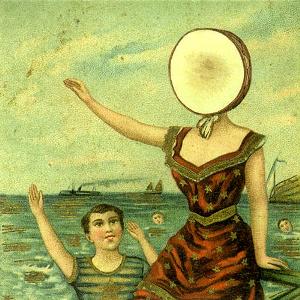
In my opinion, In the Aeroplane Over the Sea needs to be reconsidered. But not quite like this... Or this... Or this... The thing is, I think the complaint about a certain kind of indie, which Simon Reynolds has dubbed cutesy-poo, is entirely well founded. And I think a lot of people, fans and detractors alike, would put NMH in that category. But I think they are all wrong.
Let's begin with the first suite, The King of Carrot Flowers pt 1-3. It's about lost youth, well more than that, it's about the process of losing youth. It uses common tropes: Once we were young and created our own kingdoms in the woods. But your parents marriage disintegrated. And we discovered sex. And we discovered how pathetic our parents were... The image of the father imagining ways of killing himself: 'Each one a little more than he could dare to try' shows to me one of the most pathetic figures of lost authority. Yeah, all in all, we grew up... Well, where does the narrator turn after he has lost the original authoritarian figures in his live? We quickly get an answer, as he bellows: 'I love you Jesus Christ!!! Jesus Christ I love you, yes I do!!!' And then the music changes from nice and folksy to noisy, distorted, and uncomfortable. In my mind, this shows a narrator adrift in the world, clinging to the straw of religion to avoid being confronted with the horrors of a world.
What is most well known about the record, is that it is inspired by the diaries of Anne Frank. Does that mean, that the narrator embraces the horror and evil of his world? Well, no. It is just a further deferral. When he sings 'I which I could save her in some kind of timemachine' it is not noble or deep or anything. It is pathetic. There are countless people suffering in the world today, I recently read that 5 mil children died of hunger or malnutrition last year. Quite conceivably, he could save several of those kids, without needing any kind of scientific miracle machine. But he has closed his eyes to the world, and chosen to focus solely on a tragedy of the past. It keeps being a defense mechanism. I consider it disturbing and uncomfortable. And the music plays up that angle as well, being noisy and heavily compressed. It sounds awful, which is a point I think most people gloss over, talking about it being an unfortunate victim of the 'loudness war' or stuff like that. No. It is not meant to sound good. The sound mirrors the content, which is loud and ugly.
The nineties, when Neutral Milk Hotel and the rest of the Elephant Six collective made their most enduring records, was a weird decade. Not that I remember, I had just turned 13 at the turn of the millennium. But looking back at the culture of the day, I sea a weird mix of unproductive irony and directionless rage. The wall had fallen down, the cold war had ended with the west triumphant, the 'end of history' had been declared. And yet the world kept on being a so-so place. When bands were political, like Public Enemy or the Norwegian Black Metal bands, it was a churning rage, pointed in any and all directions at once. People were attacked in interviews – PE – or in real life – BM – without it really seeming productive. And then there was the American indiescene, with ironic slackers like Pavement or Beck, who didn't seem to have anything to say to begin with. Neutral Milk Hotel gets lumped together with these other 'ironists', as there surface of 'feyness' and 'quirkiness' is seen as somehow hiding how superficial and shallow they actually are. But there are two kinds of surfaceness. One hides the fact that there is nothing underneath, just a vacuum of vapidness and selfimportance. But the other kind hides SOMETHING. It's a focus on the surface for the sake of not having to bother with the real pain deep below the surface. To this group belong Neutral Milk Hotel. When The Impostume first talked about NMH, he mentioned Dave Eggers as being kind of similar. But Dave Eggers belong to the first group, along with a lot of other American writers, chief among them Jonathan Safran Foer. It is another writer whom NMH reminds me of: David Foster Wallace. Now, it is easy to say, that the biographies of both Jeff Mangum and Foster Wallace show them both to be much troubled individuals, not easily fitting in to the description of them as being 'fey' or 'quirky' impostors (I actually once saw a pillaging of Foster Wallaces writing being capped off with the notion that he probably laughed all the way to the bank. I wish he had...). But don't get lost in biography, look at the art! It is not happy or fey or anything, it is sad and disturbing. Foster Wallaces last short story includes an artist forming the letters HELP out of his own feces. How could we not catch up on that? At the end of In the Aeroplane Over the Sea, the Two-Headed Boy finds a real girl: 'She is all you could need / She will feed you tomatoes and radio wires and retire to sheets safe and clean / But don't hate her when she gets up to leave'. You know who would never leave you? Some perfect imaginary girl you've created out of a dead girls diaries... In this way, Anne Frank enters a long line of 'angelic' girls, being used by male writers as symbols of goodness and innocence, and denied their own messy humanity in the process. She is in good company, the lineage probably starts with Dantes Beatrice.
I love this album. It really speaks to me. But it speaks to all the worst parts of me. The part that would read about a hunger catastrophe in Africa, and would immediately go on facebook to air my rage at the capitalist system, instead of finding some charity to send money and actually help. The part that withdraws into the safe world of art and culture, whenever I get confronted with parts of the world I dislike. The part that plays really deep at social gatherings, and claims to be profoundly moved by TS Elliots The Waste Land – another work that uses allusions and intellectual games, to hide the real pain. And I kinda suspect it speaks to a lot of people in the same way. And I kinda suspect a lot of people aren't willing to admit this fact. The album has in my view become sanitized over the years, into this cute, clever, deep, work. But it is a poor example of this kind of work. And it was never meant to be to begin with. As I said at the top, it needs to be reconsidered. The common view is really safe and boring compared to what it really is: Brave. Emotionally naked. Disturbing. Often embarrassing. Noisy. Off putting. Singular. Great.
Abonner på:
Opslag (Atom)