Viser opslag med etiketten Iran. Vis alle opslag

mandag den 26. januar 2015

GIFF day 3: Alive, Life May Be, Field of Dogs

Alive (Park Jung-bum, South Korea, 2014)

A threehour Korean drama about poor people struggling to get by, from a director I didn't know before. Well, of course! It's from Locarno! I had one, major problem with this film, but first: The good things. This was a very wellwritten film. Park Jung-bum both wrote, directed and played the main character, and especially first and third role was nicely done. A threehour movie has room for plot, and in this one it just rolled along. So much so that I'll admit to losing the thread after 20 minutes, and only really fully understanding what was going on an hour later. Park plays Jung-chul, who lost his parents in a landslide that also destroyed most of his house, which he's trying to restore. The disaster also turned his sister, Soo-yun insane, so she can no longer take care of her daughter Ha-na. To begin with, Jung-chul and his friends loses their paycheck from their construction jobs, as another man takes off with all their money. After a brawl with the supervisors, who don't think it's their problem, they have to find another job. Jung-chul then finds a job making soy-bricks or something (apparantly, they are making tofu?), and then the film also follows the life of his new boss and the boss' daughter, and at this point I got the tiniest bit confused, as a whole bunch of plotthreads are layed down. But wow, when they return! It seemed theatrical, the way fortunes kept being returned and revelations kept coming. Perhaps Chekovian? But instead of Chekov's gun, there's an open window, and a removed frontdoor, which all of a sudden returns and turns the film upside down.

Yeah, it was also welldirected, with many scenes being done in long takes with handheld cameras following characters around. A bit like the Dardennes, perhaps? The view on laborers without solidarity seemed Dardennian as well, spectres of Rosetta or Two Days, One Night. After Jung-chul is hired, the boss fires two older workers who could only work half as fast. Jung-chul then convinces the boss to hire his friends as well, resulting in the rest of the old crew being let go. There are no unions, no way to stand up to the more well off. It's everyone for themselves, and when fortunes turn, it's time for payback. But now about the problem with the aesthetics: Allow me to talk about color-grading for a bit. Almost every film is digitally color-graded these days, and at times it can be great. But there's also the cliché of the film being made too look only teal and orange, resulting in a boring and uninteresting pallette. I hated the colors in this film as well. We're talking winter in a rural area, so everything is all white sky and white snow, with grey concrete and a bit of black earth. And then so many people wore beige as well, for some reason. There were only a few splashes of color, which can really work, when a stripe of green or red bring light into the grays. Nuri Bilge Ceylan's Winter Sleep kinda uses color that way. But here, all the colors were dark and drab and almost sickly. At one point, a character stands in a purple sweater against a yellow wall. Now, those are complementary colors, had they been lighter it could have been cool and sixties'ish. But an earthly yellow-orange contrasted with dark reddish purple. It looked sickly. So much of the film looked sickly and unwell, including the people. Perhaps it's a Korean thing, because Kim Ki-duk's Pieta looked the same way. With that film, the combination of super-pretentious themes and ugly images made me angry. Here, I was just sad that the images weren't more pretty.

Life May Be (Mark Cousins & Mania Akbari, England/Iran, 2014)

I'm not going to write a whole lot on this one, as it was essayistic and discoursive. Filmmakers Mark Cousin and Mania Akbari exchange filmic letters. I came for Mark Cousin, filmhistorian and maker of the very great series Story of Film: An Odyssey. Yet I wasn't surprised that his contributions were quite overshadowed by those from Mania Akbari, who it turns out I knew about, as she played the main character in Abbas Kiarostami's masterpiece Ten. In Cousin's first letter he talks about Akbari, who she is, that she has directed a bunch of films herself, that she's in exile. Cousin's is a great filmcritic, and as he namedrops Scorcese, Bergman, Miklos Jancso, Bela Tarr, and several more, he makes Akbari's films seem like absolutely must-sees. Visually, he just parks the camera on a hillside watching as fog rolls down a mountain and over a lake for about fifteen minutes perhaps? It's beautiful, like James Benning, only perhaps not quite as good. But then Akbari starts talking about her house in Iran, life in exile in cities all over Europe, artpieces seen and thoughts thought. It's a jolt of energy. Cousin's picks up on the naked people in the artworks, and starts discoursing on the greatness of being naked, and then Akbari makes almost a feminist shortfilm of her waxing her legs and bathing her body, before she runs naked through the streets of London. Cousin's response seems stunned and overwhelmed. I need to watch some more Akbari, she seems amazing! And I don't think Ten will ever be quite the same film.

Field of Dogs (Lech Majewski, Poland, 2014)
Remember this one? The visionary retelling of Dante's Divine Comedy I talked about wanting to see yesterday? Caught it today. Twas quite good. It wasn't really a retelling of Dante, though. The main character listened to Dante on tape, and long segments of the incredible Italian original was recited, with English translation onscreen as well. But the film was about a young former scholar who'd been in carcrash that killed two of his friends, and who now always fell asleep and had weird dreams. But he was a scholar of symbolist poetry, not Dante, and the dreams were more symbolic creations rather than something taken from the Comedy.

It's probably easier to watch the trailer, than for me to explain all the imagery...

So, Eastern-European symbolism, and as the trailer shows: Churches and floating bodies. It has to be Tarkovskian, right? Well, not quite. An important difference is that Eastern Europe is of course not just Eastern Europe, and that Poland is catholic while Russia is orthodox means a lot. Religion in this film is less austere, less iconographic than in Tarkovsky. It's more kitschy and romantic. The style also combines highbrow and lowbrow, discussions of Heidegger and Seneca with imagery from supermarkets and informercials. The whole film is on digital, and not afraid of looking like it. There's also a bunch of CGI, though I couldn't tell you how much. When a chuch is flooded, the water is obviously fake. But are the people? Is the church? When the young man dreams of sitting on a chair on a beach with a bikini-clad babe in his lap, the beach is obviously fake. But then it cuts to the chair standing on a mountain-side, that looks real enough. And then there are the animals, the doves, the snake and the oxen. The doves seemed fine, the big yellow snake that crawls around the supermarked had to be fake, and those two oxen that plow up an aisle had to be fake as well, right? But animal wranglers are credited for every animal at the end.


In the end, the film is unique, but I don't know if I'd call it 'visionary'. Majewski definitely sees images others don't, but I'm not sure how many other would even want to attempt something like this? The film also takes place in 2010, during which time Poland was flooded, the president of Poland Lech Kaczynski was killed in a planecrash, and the ash-cloud from Iceland enveloped the airwaves. It all adds to the apocalyptic mood. And it's as a moodpiece unlike few other that the film is worth seeing.

Also Seen:
Some more competition films, Amir Escandaris visceral documentary on grafitti-artists from Sao Paolo, Pixadores, and in Nordic Competition, Danish director Samanou Acheche's very fine and poetic debut In Your Arms, on assisted suicide.

søndag den 25. januar 2015

GIFF day 2: La Sapienza, Goodbye to Language, Daughter... Mother... Daughter...

La Sapienza (Eugène Green, France/Italy, 2014)

My plan this morning was to go and see Dominik Graf's three-hour Schiller-biopic, Beloved Sisters. But it turned out I misread the programme, and when I was ready to leave it had already been playing for an hour. I had a Plan B: Field of Dogs, according to the program a visionary retelling of Dante's Divine Comedy. But that one was sold out. So instead I went and saw this one, which played at the local business school, 100 m from where I was. There were a lot of tickets, and it was about architecture, which interests me. So that seemed a fine Plan C.

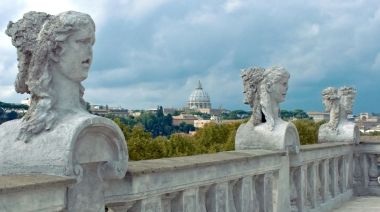
It was an amazing experience. The plot of the film is simple: A French architect named Alexandre travels to Rome with his wife to look at architecture by the great Borromini. On the way there, in Schwitzerland, they run into a young brother and sister. He wants to study architecture and she is sick. The rest of the film is the men looking at churches and the women talking. But the style... The style was like the rigorous modernist cinema of old, except in digital, and with a deadpan humour that never allowed things to get too serious. The actors walked around and declamated their lines like in the cinema of the great French filmmaker Robert Bresson. Many shots of only feet and hands of people also seemed Bressonesque. The rigourously composed symmetrical shots and long discussions with actors at times looking directly into the camera reminded me of the late-late-late period from 106-year-old-and-still-going filmmaker Manoel de Oliveira. With it's discussions of architecture and multilingual characters especially Oliveiras very great A Talking Picture (2003). And a large percentage of the images is just the camera looking at architecture, filming modern appartment buildings and factories from a distance, and contrasting it with loving closeups of the detailed, light-filled beauty of the old churches.


There is a tiny problem: The film depicts people fed up with functionalistic, modernist life and compares that to the baroque beauty found in Roman architecture, but the style of the film is kinda modernist and functionalistic as well. That is in and of itself not the biggest problem, and the film does critique it's own style as it goes along, slowly accumulating enough over-the-top characters, details and weird interludes, to carry on a sense of baroque-ness. And as the characters achieves the titular 'sapience' (which is a word for wisdom in some way, I don't really know) the style changes, becoming more rounded. But there was another big film recently about intellectuals looking for meaning amongst the old buildings of Rome: Paolo Sorrentino's The Great Beauty. And while La Sapienza works with the same outmoded, modernist form that he critiques, Sorrention's cinema seems to strive towards a new cinematic language, perhaps more fitting to the critique. The GIFF-programmers wittingly describe La Sapienza as a 'rectangle-drama', a great description of a certain type of cinema. In contrast, Sorrentino's film is all curves, broken lines, movements, fluidity. When Alexandre describes a facade by his beloved Borromini as being 'always in motion', his description sounds more like Sorrentino than the static shot we get from Green. And also, Sorrentino's film was one of the biggest arthouse successes in recent years, and even won a Foreign Language Oscar, one of the few times that prize has gone to a truly brilliant film. There is no way Eugene Green's film will get even close to that attention. So in a way, this whole film might be a bit... superfluous...

But on the other hand. I watched this film with many, many people in a big theater, and the people laughed, smiled, and had a good time. Two of the other three showings are already sold out. I was also surprised to find, that director Eugene Green is an old and experienced artist, having worked extensively in theater and only directed four theatrical features before, but those films premiering at Cannes and Locarno. It took no more than ten minutes before I mentally made a note of checking everything else I could find by this weird and idiosyncratic director. I had no idea what I was getting. I will perhaps never get the chance to watch this or the rest of the directors filmography again, at least not on the big screen. This was a unique experience, one I didn't anticipate at all. And surprises like this are the reason I love film festivals so very very much!

Goodbye to Language (Jean-Luc Godard, France, 2014)


Ah, Godard. Trying to handle a late-period Godard film after only one viewing is a foolish task. And this one was in 3D, so there were twice as many layers. I'm mainly confused, and grasping at straws, trying to connect as much of this montage of sounds, words, works cited and images into something adding up to something. I saw and wrote about his first 3D short Les Trois Dés-Astres last year at PIX, so I might begin there. That one depicted 3D as a disaster for cinema, yet another in a lineage of failures for the medium (ranging from the Holocaut to the domination of Hollywood, because those two things can obviously be compared). Perhaps Goodbye to Language is about saying goodbye to the old language of film? The screen flashes Ah, Dieux at times, and the final time I understood it to be a pun on Adieu, but perhaps also on Un, Deux (if you say it with an accent?) There are of course a bunch of clips from old films, but not really anyone I recognized. And the main story is something about a woman and a man, and another woman and a man, and the women are naked a lot of the time, and the men are disparaging and don't really think much of the women. 'Women can't create evil', they say (or something to that effect). Then there's a scene with Mary Shelley, writing Frankenstein, reminding us that a woman wrote perhaps the first piece of horror-fiction. So there is that. I don't know, I don't at all get what the plot was about. There was a great dog named Roxy, though, I liked the dog!

So much stuff on language. Over the end credits, a couple is 'speaking' in dog-language with a baby. There are a bunch of philosophical quotes on language. The two parts of the film are called 'Nature' and 'Metaphor', perhaps suggesting that the second part turns the first part into an understandable language? Except the two parts apparantly mirror each other quite a lot, and none of them are easy to figure out. There's a discussion of language and atrocity, one of the women tells a story of an SS officer yelling at a kid at the entrance to the gas chamber, that 'There is no why'. In the beginning of the film, a professor comments on the subtitle of Solshenitsyn's The Gulag Archipelago: A Literary Investigation. What lies beyond language is atrocity. Horror. But also childhood, and nature, shown on screen through the many many scenes featuring the dog Roxy. There is also a scene where a painter tries to explain how to show depth through water colour, mirroring the way Godard himself tries to figure out the grammar of this weird new technology.

And Godard struggles with turning 3D into a language. As with many of his more recent films, he uses low-grade video and digital, and those blurry images create sheets of colour when the image is given depth. The film checks out the ticks of this new medium, for instance filming out of the windshield of a car on a rainy night, which creates floating specks of neon-light where the water-drops mirror streetlight. There are a couple of times where the filmmakers must have turned one of the two cameras needed to film in 3D to the side, making the image simply split, and forcing me to blink each eye to watch two films at once, until the camera turns back and the image connects again. There are other sequences where the effect simply doesn't work for me, where the foreground is too far away from the background, and all of a sudden what was a couple tablelegs turns into a ghostly seethrough presence. And at times there are only abstract dots and lines onscreen. Basic filmic grammar is also broken, as the camera turns upside down, the shadow of the cameraman is seen on the ground, the plot is achronological, etc.

Haven't got a clue. I read the book Jean-Luc Godard: Cinema Historian by Michael Witt recently, and that book noted how perhaps Godard should be thought of as a mixed-media artist than a filmmaker, since for the longest time he has been working with collages of existing media, as well as video, installation, text, sound, etc. This film definitely blurs the limits of the new 3D medium, and is to a large extent about those limits. That is what I got from it on the first try. That, and an ever so slight headache.

Daughter... Mother... Daughter... (Panahbarkhoda Rezaee, Iran, 2014)


When watching a bunch of films over a short period, there will probably always be some that don't get full attention. I was tired, and the Godard mindfuck kept swirling round my brain. Also, this was a sloooow film, without dialogue, but with a beautiful soundtrack of music, nature sounds, and poetic narration in Iranian. Always the sounds of birds cheeping, water running, and a train passing by from time to time. It was hypnotic in a way. It put the person next to me to sleep several times throughout the seventy minutes.

It was a film on boredom, on being trapped in a life without any hope for a future. Grandmother spins yarn all the time, spinning spinning spinning. Mother walks around the wheat-fields, longing for her husband who took the train to get away. Daugher is sick and struggling to breathe, lying in bed all day, listening to the sounds of nature, dreaming of seeing the sky. There is a son, but he also leaves early on. The women are stuck - as many women probably are in Iran. Most of the film is longheld shots of each woman standing or sitting or laying alone, and then the narrator says something about them. We never hear any names. At times the women watch tv together, and we get old black and white clips, or perhaps it's new clips made to look old, I don't know. Death is never far from the family, and at times the women look ghostly covered as they are completely in black, walking the barren landscape. A shot of light streaming over the mountains is amazing, perhaps showing grace. There is only a single shot where the women interact, where the mother strokes the hair of the daughter, and then they cry. It's very cathartic, after having watched so much film without anybody showing any emotion at all.

This was artfilm. Very lowbudget I think. High res digital pictures, no cameramovements at all, all sound added afterwards, only four people in the film. I love seeing such a small and personal projects, and I liked listening to the Iranian poesy. Had it been much longer than 70 minutes, it would probably have been too much, though... Also, googling the director, his name is apparantly spelled a bunch of different ways in the west, and his other features have names like A Cradle for Mother and even Daugher... Father... Daughter... Now I'm intrigued, and would like to see if his films might make more sense through accumulation.

Note on language, apropos Godard: I like Iranian cinema, I've seen quite a lot of Iranian films, which means I've seen a bunch of Iranian writing rolling over screen at the beginning and end of a film, and it has always seemed like curves and not like words. But all of a sudden, tonight, in the blink of an eye, I could make out letters. Not that I understood anything, it just looked like a language all of sudden. Weird how that works.

Also Seen:
Another film from competion, Susanna Lenken's debut feature My Skinny Sister, which I will write about elsewhere. A fine debut, a great depiction of two young sisters.

onsdag den 9. juli 2014

Closed Curtain (Pardé, Jafar Panahi, Iran, 2013)

(This is a translation of what I wrote after seeing the film at the 2013 Copenhagen PIX festival)

Jafar Panahi has in a pretty short time, and to some extent through no fault of his own, become one of the most important directors in the world. For many years, he was a bit in the shadow of his countryman Abbas Kiarostami, making fine and realistic films on the troubles of the Iranians. Films like The Mirror toyed with a meta-layer, but mainly, Panahi made subtle but powerful social realism, with films like The Circle and Crimson Gold being much more explicitly political than Kiarostami's more poetic ouvre. After the failed 'Green Revolution' in Iran in 2009, the regime under Ahmadinejad tightened it's grip on it's artists, and while Kiarostami afterwards went abroad and made his recent films in Italy and Japan, Panahi was thrown in house arrest and hit with a 20 year ban on film-making. Therefore, it was a powerful gesture when in 2011 his film This is Not a Film was smuggled into Cannes on a USB-stick hidden in a pastry. On top of that, the film was pretty much a masterpiece, a portrait of Panahi himself while he waited in his appartment for the final ruling in the case against him, and tried to uphold his identity as a creating film-artist.

One important thing: For such a minimal production, this is an incredibly beautiful film.

Closed Curtain is in some ways the diametrically opposed film to This Is Not a Film. Where that film was presented like a documentary, and filmed minimalistically on a handheld camera, Closed Curtain is demonstratively a construction, filmicly and narratively. The film opens patiently, with a long shot taken out of the window from a villa at the Caspian Sea. We follow the main character, an unnamed writer, as he drives up to the villa in a taxi, walks from the taxi to the house, opens the door outside the frame of the window, goes back to the taxi to pay the driver, and walks back into the house, where he closes the curtains.Only then does the camera leave the window, and follows the man to his bag, where we find the reason he has fled for the villa: He has smuggled a dog with him in his bag, as dogs has been outlawed by the regime. The whole first part of the film is only the man and his dog - dog-lovers will love this film! - in a villa with heavy, black curtains for all windows, and it is filmed in steady, well-composed shots. The camera turns around, but never moves. But then the film receives the first of many shocks: The writer suddenly discovers that a young couple has intruded into the villa, and the film is suddenly handheld and shaky. The young man quickly leaves, but the woman stays behind, and we find out she is depressive and suicidal. It could seem as if the camera has become unstable due to the young woman, but even after she's dissapeared without a trace, the style stays shaken. Only after a series of shocks, where the woman reapears in impossible ways, tear down the curtains, and the director Jafar Panahi himself all of a sudden steps into the film from an alcove, does the film find a calmness again: Panahi's calmness. The rest of the film is torn between a plane where Panahi is in the villa, and a plane where the writer and the young woman is in the villa, and the two planes are filmed in different ways. I won't reveal all the surprising twists from the last half-hour, I was exhausted and couldn't really remember them all clearly. The film got a Silver Bear for Best Script at Berlin last year, and it really is an amazingly constructed film.


But most of all it's an extraordinary brave film. Where This Is Not a Film tried to circumvent the ban from the regime, by claiming that it wasn't a film, and that anyway it couldn't be proved that Panahi was the one making it, Closed Curtain is an insistent roar against the rules. Thereby, the film is an attack, not just on censorship, but on the earlier reaction of Panahi himself. While the film from 2011 insinuated that Panahi was holding a camera, but never presented any conclusive proof, in Closed Curtain he demonstratively holds a camera in his hand in one of the best meta-twists of the film: In an earlier scene, the writer has told a camera-phone how he behaved in an even earlier scene in the film, and when Panahi finds that film on his iPhone, the camera has obviously caught himself filming the scene we saw earlier (yeah, it's complicated...) And where TINAF had a melancholic ending, with Panahi being left behind at the entrance of his apartment complex, because he couldn't move outside, CC on the other hand ends with him leaving the depressive and doubting woman behind, and driving away with the creating writer, thereby openly breaking his housearrest. It's a confusing, layered and mindbogglingly strong film, which enriches and is in turn itself enriched, through the interplay with the earlier film. In my opinion, Panahi is so far the most important director of the decade, not just as a political martyr, or because his films are so brave and weighty, but because these two film together are better than what any other director has acomlished these last five years.


mandag den 7. april 2014

CPHPIX day 4: Manuscripts Don't Burn, Éden, Der Samurai

This festival ebbs and flows. Yesterday I saw two films I've been wanting to see for a long time, one of which was a massive masterpiece. Today I saw three films I'd just sorta thought seemed okay. They were, all of them. I don't think I have a lot to say on any of them.

Manuscripts Don't Burn (Mohammad Rasoulof, Iran, 2013)


Iranian cinema is insanely good. At this point, everybody probably knows this. Lately, however, it's changed. The Green Revolution in 2009 led to more repression, leading to censorship, exile, and an unmooring of style. Mohammad Rasoulof was apparantly arrested at the same time as the more famous Jafar Panahi, and both were given bans on filmmaking, but while Panahi responded by making a brilliant diptych of allegorical films on art/non-art, freedom, et al, Rasoulof chose to make a much more direct film, a thriller on the crimes of the Iranian police state. I aplaud this film, it's brave and 'important'. I was fairly bored by a large part of it, I must admit.

The first half was pretty dull. To begin with, it just seems as if we follow different sides in the war on art, the henchmen, the boss, and the artists themselves. A plotpoint regarding an old - apparantly real-life - case on the attempted murder of a busload of dissidents keep popping up. So far, so good. I was settling in to this being a multi-plot film, with only slight connective tissue between the stories. Everyone in this film deals with sickness in some way, a sick child here, an old and infirm man there, some unspecified pills being taken there. Which paints a picture of a sick society, which is, well, meh, but fair enough. If only the style wasn't so extremely one-note and dull, mainly made up of handheld fly-on-the-wall shots. I got really bored. But then, a few things changed.

Some stylistic flourishes crept into the film. Voiceovers over poetic pictures. People talking while their mouths remained shot. Beautiful shots of snowfilled landscapes, roads, Teheran by night, creating a sense of dread and despair. At least once, this sense of style fell over into drab symbolism, but still, it created some energy. But more importantly, it turned out that the plot was actually extremely well constructed. I don't want to spoil it, but there's a temporal twist to it, which is revealed in a side-plot that earlier seemed like non-sequiturs, but once their implications for the plot became clear, my stomach sank. As the screws are fastened at the end, Rasoulof turns to a few long-takes without mercy, some of whom will stay with me for a long time.

In the end though, this still wasn't really a great film. It is a bit boring, and a bit simplistic. If that seems like a dumb way to critisize such a brave and angry movie then consider this: In the film, a piece of art upsets the the system so much that they take extreme measures to bury it. What is so damaging about this piece of art? The film makes explicitly clear, that it is it's documentary features that the regime wants to supress. It tells a true story, naming names. Well, now, I ask you: If Rasoulof then wanted to hit the regime where it hurts why didn't he make a documentary? Why all the made up stuff about henchmen, and sick kids, and nagging caretakers? It doesn't really add that much, and it takes away from the accusations. All in all it's a bit of a weird film: A piece of Iranian art on the impossibility to make art in Iran, it does sort of invalidate itself. But that might be sophistery. The main problem with the film remains that it is too dull to fully connect, especially in the beginning.

Éden (Bruno Safadi, Brazil, 2012)


This was fun. Someone sent the wrong copy to the festival, so there was no subtitles. That's the second time one of my screenings has gone wrong, that's twice too many. As there was nothing else on that I wanted to catch, and as the film was very visual, I decided to stay. I did not get all of the plot, though.

There was a woman, Karine, and she was pregnant. And sad. Then she went to a church. Then she talked to another pregnant woman in a weird yellow robe. Then she returned to the church, and apparantly became part of it, and began wearing her own kind of weird robe. A couple of flashbacks revealed the father of the child, and the man who killed him. Then the woman in the yellow robe gave birth. Then Karine went to see the newborn in the night, and heard a noise, and hid, and then the leader of the church, and the woman in yellow, and the guy who killed Karine's lover talked about something which I did not get. Then Karine left the church. I was told afterwards, after asking someone to explain the plot, that she was angry the pastor would leave it to the murderer to decide whether he would turn himself into the police or not. That whole plot-strand seemed pretty coincidental to me.

I did get the visuals, though. The film began with Karine laying in an empty, boat-shaped pool, with a look of despair. These pools played a large symbolic role. Karine saw three births in these pools: Of her love with her father-to-be, as they cavorted in swimsuits in a night-time, neon-lit intermezzo which reminded me a bit of Michael Mann. Her baptism into the church, and in the end, the birth of her child, which more importantly for the film seemed to mean her birth into motherhood. The birthing scene was long and intercut with scenes of an eclipse, and in the end Karine held her baby and smiled into the camera. I think I got the point.

I like the graininess.

It was a beautiful film, with the look of analog - though obviously it was a digital copy - and an impressive soundtrack. The whole experience was bewildering, though. How did the festival not notice that they had a copy without subtitles? Well, maybe it was KDM-coded and they couldn't watch it before the screening, but what kind of imbecile distribution company sends a wrong copy with KDM-coding? That's a sure way to get festivals to stop dealing with you.

Der Samurai (Till Kleinert, Germany, 2014)


There are way too many genre-films at the festival. There is the section called Thrills and Kills, there is a focus on War Films, another theme called We Made It, filled with fanmade versions of Robocop, Rambo etc, a retro on William Friedkin, and several of the directors called Lone Stars seems to have gotten the term from how much violence they put into their films. And even then, this lo-fi, apparantly crowdfunded queer-horror film sneaks into the catch-all World Views section. Why isn't this in Thrills and Kills? I suspect it's due to it's obvious filmic and thematic qualities, but then why do they curate a section where the films has to lack depth and flair to fit in? I don't get it.

Nevertheless, this is a fine film. It's not horror, though. It's a guy in a dress with a sword. The Samurai of the title. A young cop, Jacob Wolski, who is obviously a closeted guy man, tries to stop him. You can all guess how it goes. Blood, shocks, shadows. It's beautifully filmed, the colours pop, and there's some touching stuff in it. The Samurai tries to seduce Jacob, and tells him a story of how they could have met and danced at a party. But the story we see, what Jacob is able of imagining, is him flirting with a guy and the whole town laughing at him. Where Horror normally is the abnormal, the unexplainable, in this small-town setting it is simply what is different. I.e. queer-ness. 

I don't think I get the subtext: Jacob feeds a wolf, and his surname sounds like wolf, and a woman calls him Lonely Wolf. And the Samurai at times seems like a wolf. Did Jacob's queerness call down the terror on the town? That doesn't seem that progressive? Or was it his repression of his sexuality which caused it to explode? The Samurai keeps wanting Jacob to follow his lead, and Jacob seems immensely fascinated, but always pulls back. In the end, The Ark's It Takes a Fool to Remain Sane plays on the soundtrack, and it's used thrillingly. It feels like a smart point. I can't explain it, though. Lacan wrote about Le Non-Dupes Errent, those who aren't duped are wrong. Jacob isn't duped. He knows he is gay, but he also knows it wont be accepted by his surroundings. And he lives with that. Perhaps his unwillingness to transgress creates this ultimate transgression. In the end, he is cured of his non-foolishness. Or something.

I couldn't get the trailer to work, so here is the music video to The Ark's It Takes a Fool to Remain Sane

It's a very fine little film, which deserves to become a cult-curiosity. It's hardly more than that. Glad to have seen it, can't wait to see something more substantial today, when Jia Zhangke's A Touch of Sin screens.