There are some strange pairings at the festival. I saw a Swedish 15-min short on Moments of Silence paired with a 50 min Taiwanese film on a man walking slowly. I guess both of them was about something speciel entering the everyday. The Swedish short will be reviewed elsewhere. I also went to a showing of two shorts that were still works-in-progress. They'd been financed with money from DOX:LABS. It's a bit difficult and probably also unfair to review works-in-progress, but I've written a bit about them anyway. Scenario (Philip Widmann & Karsten Krause, Germany, 2014)
Scenario is apparantly born out of an art installation. It shows. Based around a suitcase containing a report on an affair in early seventies Cologne, between a married secretary and her equally married boss. Along with the often explicit description of the affair from the boss' point of view, the film offers neutral, statistical information mostly on the lives of young German women at the time. The woman herself, Monika, remains silent. This becomes pretty obvious as the boss seems less than enlightened on gender-relations -at one point he describes yet another young lover as 'sex-starved' because she moans loudly during sex, ie. actually enjoys it.
The visual side is sparse. Apart from a few short staged sequences and shots of the suitcase, mostly the film consists of shots from Cologne. Modern day Cologne, though it looks older as it's shot on grainy celluloid. There is a wonderful sense of mood, constantly overcast weather, empty space or crowds passing by, never singular persons. It might seem a little dull. But we learn many interesting things about Monika, and yet she remains vague. What she's like in bed. We see the nude-photos her lover took. That she had three abortions and a kid who died five days old. That she would have her period aprox 260 times througout her life after the affair. But without her own words, how can we know her at all? It's like trying to know a society through statistics and pictures of it's crowded streets. Or something.
Journey to the West (Tsai Ming-liang, Taiwan/France, 2014)
I'm absolutely in love with this film, it's one of my favourite films of the year. It's about a monk walking around really slowly! Mainly it's some absolutely stunning pictures, mostly from Marseille. Tsai Ming-liang released Stray Dogs last year,one of the films of the decade, and has been making these films on this monk for a few years. He is a master of the form.
For the unprepared, the film migh be hard to take. There were some walkouts at the screening, especially at the first shot, a close-up of a face, held for what seems like an eternity. But patience pays off, through beauty and humour. A small girl in awe of the monk. A man surprised by the strange creature walking by his window. Two shots uses Norman Fosters Ombriere building to disorienting effect. And there is a cameo from Denis Lavant, the great French actor who played so many roles in Holy Motors, did this in Mauvais Sang and this in Beau Travail. His final appearance in this film is one of the greatest things ever.
I'll admit it took me some googling to figure out what this was.
I'll admit: I cheated a bit. I saw the film on a stream back at the beginning of the year. But it's so much more stunning on the big screen. I want to go to Marseille, just to see the places this was filmed, and perhaps walk slowly down a few stars myself. I'm so unhappy I can't watch this at the second showing on saturday, but Journey to the West will be released along with Stray Dogs by New Wave Films in Europe. That is one hell of a package.
The whole of Walker is on youtube. Journey to the West is a lot like this, but better.
The Mad Half Hour (Leonardo Brzezicki, Argentina, 2014)
Last year I saw Brzezicki's debut feature Night at the PIX-fest, and really loved it. This, being a short film, and a work in progress, was a lesser work, but it was ok. A black and white depiction of a night in Buenos Aires, it had a young man having an existential crisis during a tennis match with his boyfriend, then going out on a night of the town. There was also a group of young women, and an art show. It was ok.
I wanted to see what it added to Night. That film was about a group of young characters travelling out to a house in the woods after a suicide of a mutual friend, who'd created a series of sound-art on tape. This had another young man losing the will to live, though not killing himself. It had an artist, who created a sound-piece with strings of nylon. It had the characters travelling into a wooded landscape all of sudden, where they acted like feral animals. There were some repeated motives. I'm not sure this film really added up to much on it's own, but the director is one to watch. He can do something with sound and grass, and hopefully he'll find a more substantive story and the money to tell it at some point.
The Land of Seven Sheep (Wiktoria Szymanska & Martin Boege, Poland and Mexico, 2014)
This is now in black and white.
I have even less of an idea what to make of this. Funnily enough, it was also in black and white, and was also about travelling into a wooded area (of Mexico, I think, though I guess it could be some part of Poland I don't know about, or somewhere else entirely) A young girl spending a vacation at the house of an elderly man, mostly spending her time with the sheep. Very beautiful pictures, the young girl and the lambs were all very cute. Actually, it wasn't as much black and white, as it was completely desaturated of color, but there were some traces of red and blue at times. But at one point, the young girl ran through some puddles of water as she followed the sheep, and it struck me how uncannily like the beginning of Carlos Reygadas Post Tenebra Lux the whole thing was. And yeah, this short film didn't tell me that much that Reygadas didn't tell me more poetically in the short segment of his film. But, you know, work-in-progress short films are a bit like demos. There is definitely promise in these two directors, the film was beautiful. If they get another film at a festival near me, I'll check it out. But I'm not gonna prioritize watching the finished version of this one, I don't think.
With today's two writeups, I'm going to mention Deleuze for both. Because why not.
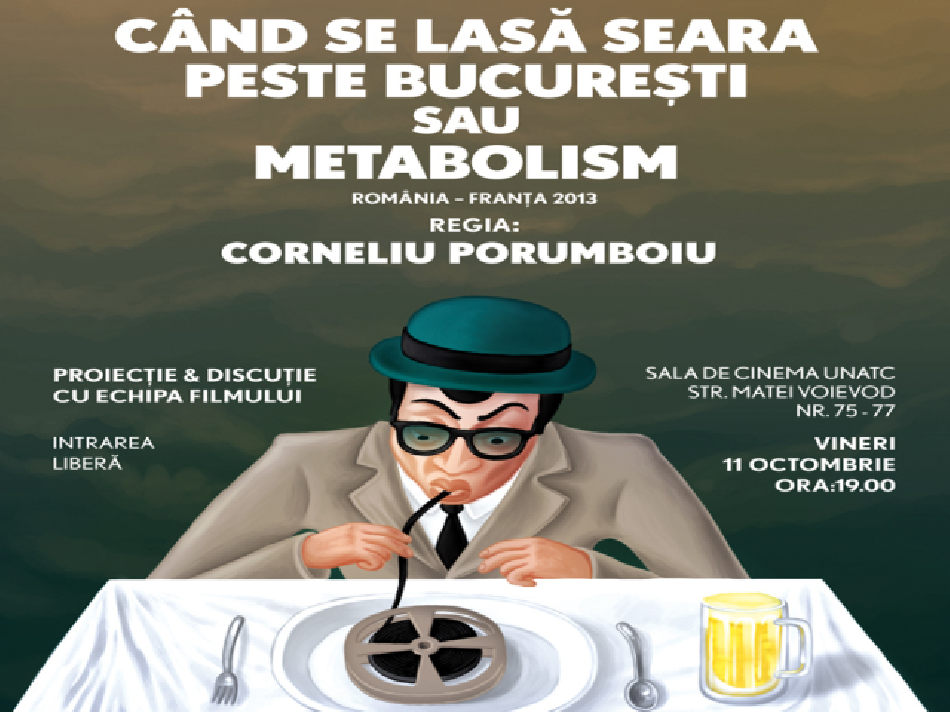
When Evening Falls on Bucharest or Metabolism (Corneliu Porumboiu, Romania, 2013)
I am a fan of Corneliu Poromboiu. His 12:08 East of Bucharest would be one of my starters choices for people wanting to get into world cinema, and I've written extensively on Police, Adjective before. He is one of the most inquisitive directors working today, constantly examining the meanings of time, words, spaces, etc. When Evening Falls... is an interesting addition to his ouvre, as it adds a bundle of questions on it's own. But as a film in itself, it was a slight dissapointment.
The film concerns the director Paul having an affair with his actress Alina. Most of the film is them talking. In the first scene, shot in one take from the inside of a car, Paul explains to Alina the importance of filming on 35 mm. With 35 mm you could only shoot for 11 minutes, while on digital, you can shoot for much longer. The new rules impact the way you make movies. I've seen reviews taken this exchange, and implying that the film supports this view. But as hopefully anyone can see, it's a bit of a bullshit argument, since nearly no films have shotlengths of over 11 min, so if that's the main difference, then the change to digital would hardly mean that much. As it is, the relationship between the form of the film, and the content, is more complex than simply form following function.
There is a later argument, which is usuable as an example. In this, Paul explains, that since the Chinese eat with chopsticks, then their food becomes more sophisticated than European food, as everything has to be in smaller pieces. This is what Deleuze and Guattari calls Assemblages. Chinese food is not just food, it is an assemblage with how you eat it, and further on how people eat are an assemblage with their cultural outlook on life. When Paul positions that his film is informed by it's use of 35 mm, then he is proposing an assemblage between an almost mystical quality inherent in celluloid, and his directorial choices. However, we, the audience, see through this explanation: He is putting a superfluous nude scene into the film due to his lust for Alina. His film is Assembled to his Libido. Towards the end of the film, after several bouts of lovemaking, Paul proclaims that he has to cut down on Alina's role, to make the political points of the film clearer. After all, something has to change in Romania. This is the surpreme artistic ideological assemblage: The mystical power of 35 mm -> flowing through Paul -> causing societal change. But then again: In reality he just wants to get laid.
This stuff, I found funny. I also found it funny to make a film about connections, and then use a quite rigid long-take aesthetic. Since normally, long-takes are supposed to be inherently impressive, not really in their connections. Paul explains the importance of the long-take in capturing reality, but the film shows how much stays out of the realm of the camera, most explicitly with the unseen person constantly phoning Alina - probably her romanic partner. In this way, we see how the filmed space is assembled to, and derives it's power from, the unfilmed space surrounding it. Also, scenes in the film do connect internally. There are a number of car scenes, there are two dinner scenes, the nude scene they rehearse is mirrored askance in a funny way later on. It doesn't really add up, though. There are fewer than 20 shots in the film, which isn't really enough to create a good Assemblage. Also, with this austere style, Porumboiu loses the short scenes which were really usually the strongest moments of his films: There is nothing comparable to the footvolleyball in Police, Adjective or the streetlights in 12:08. A further minus: The arguments of the film are pretty lopsided. His earlier films were polyphonic: There were several characters with different opinions debating in 12:08, and Police, Adjective concluded with a very famous discussion on grammar. In this new one, the discussion is constantly between Paul and Alina, and at one point Alina admits that since he is directing her, she does not feel it is an equal relationship. Therefore, Paul dominates the film. His main opponent is the style and plot of the film itself, which does undercut him quite a lot. Especially the penultimate shot of the film, mentioned a lot in writeups, funny and surprising. But that only undermines the arguments, it doesn't really bring forth an argument itself.
I like the fact that they've switched the titles in France.
This was a bit of a dissapointment. As I've said, Porumboiu might be one of the most inquisitive directors in cinema, but this time he has failed to bring his inquisition to any interesting endpoint. I like his argument, but I don't feel he takes it anywhere particularly interesting. Also, while the long-take style is cool, and many scenes are beautiful, as a whole, the style is not strong enough to support the film on it's own. And an addendum: Porumpoiu claims to have been inspired by Hong Sang-soo - whose latest I wrote about earlier this festival - on this film, which sorta makes sense. But Hong has made six films in the time since Porumboiu made his last. Hong can afford to make minor films, they Assemble into a lot. A minor Porumboiu is still interesting, and I would recommend everyone to get aquainted with his filmography. But after waiting four years, I wanted something grander and more assertive. Hopefully, the next one will come soon!
When Evening Falls on Bucharest or Metabolism is shown again Wed 4/9 at 21:30
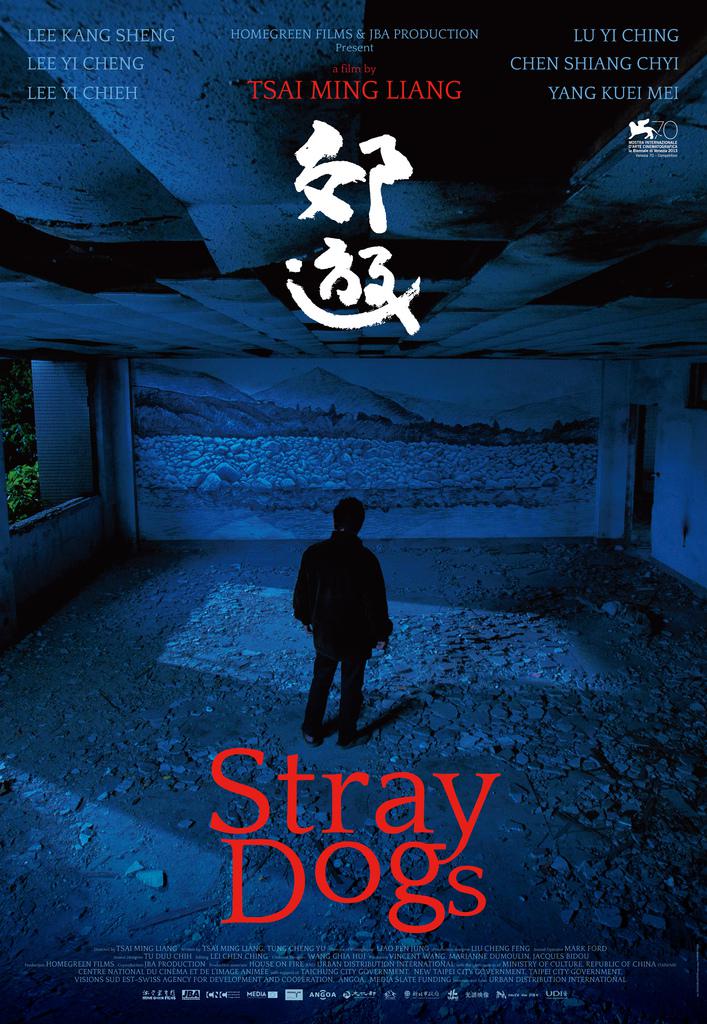
Stray Dogs (Tsai Ming-liang, Taiwan, 2013)
First of all: This was a massive masterpiece, and everyone should go see it. As soon as possible. Tsai Ming-liang is one of the grand masters of cinema, who has made personal and important features for over twenty years, winning the Golden Lion in 1994 for Vive l'Amour. This latest of his debuted at Venice last fall, where it won the Grand Jury Prize, sort of the second place. I tried to catch all of his films in preparation to this one, but didn't manage to see them all. I did see a few of his later ones, I Don't Want to Sleep Alone and the two shorts Walker and Journey to the West, which I'll discuss a bit below.
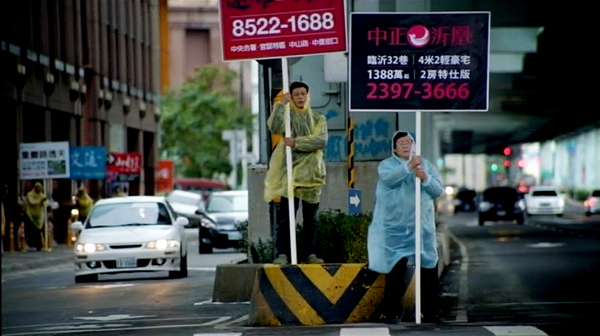
This was mainly a film about Taipei. Tsai's muse Lee Kang-sheng plays a single father, who makes his money holding a sign on the street, advertising for new appartments. But this isn't really a plotbased film, it's all about the images. And what images! The film is a breakthrough in digital cinema. It is completely unapologetic about it's digital-ness, at times it looks cheap like a soap opera. But Tsai manages to make this aesthetic look like a conscious aestethic in itself, and not just the cheap solution due to lack of 35 mm. The cheapness is furthered by some slightly wobbly camera-movements, and scenes that seem like they are shot guerilla-style. Lee parks his kids at a supermarket every day, and the camera captures them from afar, as if it is hiding. But then a shot is taken down below from a refrigerated counter, and the supermarket is mentioned as a sponsor in the credits. The shots of Lee with his sign looks guerilla style as well, but it is obviously very set up. The sign-men stand with their backs to a one-way street, so they are obviously set up for the benefit of the camera - and Tsai doesn't care that we can figure this out.
What are those guys in the back doing? Nobody can see their signs that way...
The sense of guerilla-ness is important though: This is Nomadic cinema. Yup, yet another Deleuzian term. For Deleuze, the Nomad is the person opening the stratified space, living between the lines. Sort of like a stray dog. In the city, the closest thing to a Nomad would be the homeless, which is what Lee and family are. They are using the city in a different way, using supermarkets as daycare, public bathrooms as their own, and abandoned buildings as their home. This has been a theme in some of Tsai's latest films: I Don't Want to Sleep Alone concerned a Taiwanese immigrant in Kuala Lumpur - Lee again - and his trials in creating his own spaces. The two short films Walker and Journey to the West are different, concerning a monk walking slowly, but with this ritualistic way of being, the monk creates a new temporality in the city for him to use.
But while the nomadic theme has been taken up earlier by Tsai, this is the first of his films where I get the feeling of a Nomadic image. The camera is a Nomad itself, as mentioned diving into refrigerated counters, but also hiding in corners and climbing on top of sinks. Oh, the compositions of this film! They are completely askew and offkilter, mirroring the way the characters has to find their spaces in the creaks and nannies of the city. One shot is a closeup of Lee singing an old patriotic song about the empire, but his face is a bit too much to the left of the frame, and the right is taken up by an overpass curving quite weirdly. The lines and planes of this film does not look like the lines and planes of your common film. In one of the very best scenes, Lee finds his way into a modern luxury appartment, and while it seems completely believable as a real appartment, Tsai manages to make it look 100% like a funhouse.
This is essential filmmaking, along with the Walker-shorts a good bet for the most essential filmmaking of the decade. The best film I've seen since Weerasethakul's Uncle Boonmee. I've never seen images like this. What Tsai manages to do with Taipei is complete comparable to what Rossellini did with opened Rome, or Antonioni with Sicily or Milano. This will hopefully serve as a beacon on cinema's voyage into digital. Yes, it's that good. And I haven't even mentioned the colours! Or the cabbage! Or the one short dive into melodrama: Tsai is not afraid to provide lacunes in his style, which Porumboiu's latest so sorely lacks. Or the, well, inscrutability of so much of what goes on. Which means I can't wait to see it again, and strongly considers catching it again at the festival. But I feel like I must mention the duration of the shots: This is slow cinema. Not a lot happen. As I find it completely captivating, it doesn't bother me one bit. But it's slow. Here's the thing, though, and SPOILERS for the ending of the film, so you might want to skip this last paragraph:
The penultimate shot of the film is held for 13 min on Lee and the mysterious mother figure, who is played by three different women. The woman is in front, Lee is in the back, slightly out of focus, and they are staring at something, which we can guess is probably a mural we've seen earlier. Lee drinks a bit. Then, after an eternity, he moves forward and puts his head on her shoulder. Slight pause, then CUT to the couple seen from behind, with the mural in front of them. If this was a normal, very good film, then this would be the end. Duration causing tension, and the release feeling almost trascendental. I Don't Want to Sleep Alone ends in a sorta similar manner. But this time, the scene doesn't end. They keep standing and looking at the mural... and then... the woman leaves! I was devastated, the sight of Lee's back, alone in the room, is one of the saddest things I've ever seen. And basically everything in this film is as surprising and impactful as this ending.
Again and to sum up: This is a must-see masterpiece of modern filmmaking. To be watched and re-watched for decades to come.
Stray Dogs is shown again Sun 4/13 at 21:30. I'm strongly considering seeing it again.