Viser opslag med etiketten Japan. Vis alle opslag

tirsdag den 14. april 2015

PIX15: The Princess of France, Over Your Dead Body

The Princess of France (Mattias Piñeiro, Argentina, 2014)


Prologue:
There are a lot of films out there. To handle all those films, you need to create systems to sort them. We all know the genre-labels: Action, comedy, romance. You know what you get. As a cineaste, a snob, I mostly sort by director, and then by country, by era, etc. If I hear something is Romanian New Wave, it's probably worth seeing. If it's Japanese Extreme Cinema, it's probably crap. But I'm not a formally educated film-buff, I've had a bit in high-school and a few classes in college, but I'm not as well versed in cinematic history as many of my peers. At times, I don't know what I'm talking about. So I create my own mental categories to sort weird films together. After I'd seen Jessica Haussner's masterful Amour Fou, I wrote that it was something I called Austrian Rectangle Cinema - Ulrich Seidl, Nicolaus Geyrhalter, even Michael Haneke. I was kindly informed, that it's probably more correctly called Berlin New School, since Haussner has been working with directors and systems that is already grouped together under that name. I don't mean to make fun of that correction, that is fine, you write to be understood, if people already understand a description, don't improvise unless you're sure what you say is more correct.

The reason for this long preamble - apart from the fact that prologues always seem Shakespearian to me - is because I'm going to coin yet another genre-name. I've seen a bunch of films from Argentina and Chile, that seems kinda alike to me. They often involve young, incredibly beautiful people, all doing cultural work, and hung up on romances - so often more than one. It always has an extremely high amount of cultural capital, and includes references to art, to literature, to theater. We're talking films like Leonardo Brzezicki's Noche (2013), Christián Jiménez' Bonsai (2011), perhaps even something like a lot of films by legendary Chilean director Raul Ruiz. We're talking the spirit of Jorge Luis Borges and Julio Cortazar. And I'm going to label this kind of cinema - damdamdaaaam - : Southern Cone Hipster Film! Or SCH!-films for short.


Main Review
If Sourthern Cone Hipster is a style, then I think Mattias Pineiro is it's main auteur at the moment. He makes very peculiar pictures. He has so far made three films based around actors working on Shakespearean comedies. In Rosalinda it was As You Like It while in Viola it was Twelth Night. And he's more in command of his camera and his world than the rest of his contemporaries, I think - though not as much as directors like Lisandro Alonso and Lucretia Martel, who I don't consider Southern Cone Hipster. The opening shot of this one is absurdly wellmade. On a rooftop, at night, a woman yells. Then the camera pans, and begins watching a group of footballers playing far below, while titles and credits are shown onscreen. It's such a great idea, and so well done, but it also says so much about what's to come.

For me at least, in Shakespearian comedy, it's all about games of love being played between men and women. In Much Ado About Nothing everybody treats their task of getting Beatrice and Benedict to fall in love as a game, while Don John plays a much more sinister game of lies and subterfuge with the affections of poor Hero and Claudio. Football is a great metaphor for the film. First, the players pass a ball back and forth between them, the same way the lovers will change affections constantly. And then they form two teams, as in two genders always playing with each other. But not on equal terms. For some reason, there are eight players in green, and only three in orange.

There are 4 women and 2 men in this film. The central character is Victor, returning to Buenos Aires from Mexico with funding in his pocket to create a radio-version of Love's Labour's Lost. All the women are actresses, and all of them have been in a relationship with him, or are now, or want to be. It's confusing. I quite honestly lost the plot at the point where the same two short scenes are replayed 3 times with different participants and outcomes. I have no idea if all versions are supposed to really happen. So I don't get the specifics of the romantic entanglements. There were also way too many dark-haired beauties for me to tell them apart (there might have been more than 4...) Don't get me wrong, a film can never have too much dark-haired beauty. It's just, what is won in aesthetic quality is lost in clarity of plotting.
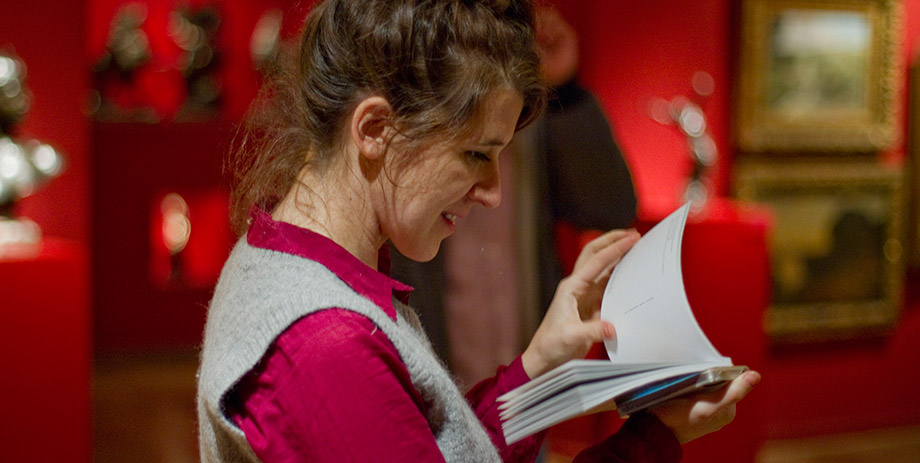


So I began focusing on details at the fringes. One scene takes place in a museum space, where the characters look at paintings of nude women, by Bouguereau I think. An enemy of impressionism, forgotten by the future, but much popular in his day with his piquante paintings hanging in many a French boudoir. The discussion touches on how much art-history is tangled up with the female body and the female sex - much more so than with female artistery. Victor himself might use his art to get women, or he might use his women to make art and stories. It's not entirely clear, not even to himself. He might also be used. There's a genderbending aspect of the film, in that they switch the roles of the play and have the women play the four central male characters. And while the play concerns machinations of men, in the film the women might be the combatants, competing with each other over Victor. They might also simply decide he isn't worth. Actually, I can't exactly figure out if they did. I should probably rewatch this at some time. And watch some other Pineiro at some point.

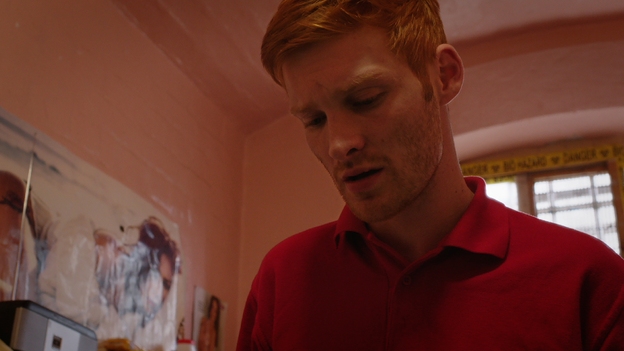
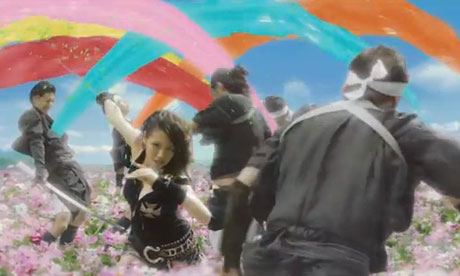
Over You Dead Body (Takashi Miike, Japan, 2014)


Sometimes you have a lot to say, even when you don't really get a film. Other times, you draw a blank. I have nearly nothing to say about this film. Miike is famous for Audition, the only other of his I've seen is 13 Assassins. It's not my thing. I was also not in the mood. Just before entering the cinema, I discovered a logistical error by the festival, which threw a bunch of my carefully laid plans into dissaray. So I was frustrated, confused, thinking way too much about what I had to do to see the films that I wanted to see. And then the film began, and the plot was all over the place, and there was a sexscene and a goldfish and now they were all samurais and... who cares?


Ok, I got the plot. It's awfully simple. More actors! More meshing of play and real life. A married couple play the lead characters in a lavish production of Yotsuya Kaidan, a famous Japanese ghost story about a ronin who leaves his wife for another woman, and is haunted by ghosts in revenge. The actor playing the cheating ronin is also cheating on his wife, and the wife also seeks supernatural means of revenge. And then there's blood. Who cares?

In a way, I wish this had just been a simple adaptation of the play, because those scenes are by far the best aspect of the film. Not just because the story and the central characters are fascinating even in the glimpses we see, but also because the staging is so aweinspiring. Heavily theatrical, with giant sets turning and changing, and multicolored lightning creating shadows and colours all over. It's beautiful, it's grandiose, it's fascinating. The scenes in the real world are so boring compared to that. I get why they're there, because nothing about the staged play is frightening, it's so theatrical that it never seems real. But the frights in the real world are boring as well, so cut them out. The theatrical murder and mayhem and horror is more like Grand Guignol, it induces a guilty relish at being allowed to watch all the blood and the violence at a distance. Which might not be what horror is supposed to be today, but the feeling I'm left with is of a director creating a much more complicated plot than he needed to be, in order to make it more conventionally effectful. That is bad. Simple but strange is always better than convoluted but conventional.

Also seen: I rewatched Lav Diaz' From What Is Before, and I've watched a bunch of films from the main competition, which I'm reviewing in Danish. But if you get the chance to watch Antoine Barraud's Portrait of the Artist, seize it! It's pretty close to being a masterpiece. Laura Bispuri's Sworn Virgin is very fine as well, as is Jeppe Rønde's Bridgend, which will get a British premiere shortly. Yannis Veslemes' Norway is a vampire film, and I don't much care for vampire-films, but it's use of lighting is ridiculously accomplished, and the film is worth it for that alone.

onsdag den 28. januar 2015

GIFF day 4-5: Thou Wast Mild and Lovely, Wild Tales, Still the Water

Thou Wast Mild and Lovely (Josephine Decker, USA, 2014)


US filmmaking can feel like a pretty insular world. Lots of different kinds of filmmaking, lots of different kinds of scenes, but many of those can feel a bit closed. There are Hollywood blockbusters, finetuned to make money, there are prestige filmmaking, finetuned to win oscars, there are indie-scenes such as mumblecore, finetuned to... I have no idea what could possibly be of use in mumblecore, but I guess their friends like it? Most American films feel like they are in conversation with other American films, and not trying to discuss that much with films from the rest of the world. Josephine Deckers film definitely speaks with Terrance Malick, first and foremost, but for long stretches it feels more international, like it speaks with Carlos Reygadas' rural Mexico, or with the sensuous images of Argentinian filmmaker Lucretia Martel. Perhaps it just felt Latin American?


It's not that the film isn't connected to American filmmaking. Josephine Decker has acted in mumblecore films, and mumblecore filmmaker Joe Swanberg plays the main character Akin, a hired hand who arrives at a secluded ranch with an old owner Jeremeiah and his lovely daughter Sarah. That part of the film is the oldest story in the book. The growing atraction between Sarah and Akin is depicted with a shocking amount of sensuality. One of those films that make me think, that I know nothing about women. A young female filmmaker making a sensuous film about a girl and a boy longing for each other, begun with voice-over from the girl, that should be filled with lustful images of the male body, right? Why does the camera focus so much on the lips, hands, hair and clothe-covered curves of Sarah? Akin can't stop looking at her, as she is bending over to pick weeds, as she sits and knits with her legs slightly apart, as she walks around in various states of undress, but even when he's not around, when it's just Sarah alone with herself, the camera will glide over her body. I think I got it at the end: It's not really about Sarah discovering Akin's body, as it is about her discovering her own. Discovering how crazy she can drive him with a smile, a posture, small noise. Sarah is so imaginative in her sexuality, as she writhes in grass, dances while sighing, plays with string, even at one point biting the head of a small frog and spits blood out, splashing her blonde hair and lips with glowing red. Which is sexy in action, I promise. Akin furiously masturbates and fantasizes about her in common pin-up positions - but he incorporates the thing with the string - when he finally takes her it's rough, short and to the point. Akin is just a body, when he tries to be playful and flirty it's awful. Jeremiah - who is a weird old man indeed - uses an amazing farmers metaphor: Apparantly horses can be inseminated very easily, while cows need a lot of finesse and a good syringe. He asks Akin: Are you a horseman or a cowman? The film seems to suggest that men are horses and women are cows.

So many good and imaginative things in this film. A short sequence is even shown from the point of view of a cow. The film does become a bit more conventionally American as it goes along. One of the first scenes is a long take of Akin driving up to the farm, getting out of the car and walking, then coming back, taking off his wedding ring, and leaving it in the glove compartment. And fine, mysterious gesture. But that whole wife-thingy is then used to cause drama in the final part. Towards the end, there is a brilliant sex scene, one that fully builds on the great sensual scenes leading up to it. Have never seen a sex-scene quite like it, and I've seen a lot of European films. But the film also takes some surprising twists and turns, which perhaps makes it on the whole more unique, but makes the ending dissapointingly American. Oh, well. Only a second feature. Decker's first is also at the festival, hope to catch that one as well. If it's as good as this one, then Decker is my new favourite American filmmaker.

Wild Tales (Damián Szifrón, Argentina, 2014)

This was sensational! Szifrón was almost unknown when his film was selected to compete at Cannes last year, but his film received a rapturous response. Perhaps not as in people thinking it should have the Palme d'Or, but as in people thoroughly enjoying the film and being happy to see something like it in what can be a pretty serious competition. It's one of the best comedies I've seen in a long time. Six short, unrelated tales, with a common theme of revenge and violence. Most of them depict the indignities of our everyday so perfectly, that we don't know whether to be happy or angry when the characters snap. Road-rage, bureaucracy, parking tickets, unfaithful spouses, traffic (really, quite a lot of the film revolves around cars...) Almost everything begins as relatable, but then quickly spirals out of control. The one section that didn't really work, about two women considering poisoning a mobster who visits their diner, is also the one that is farthest from everyday experience. Though perhaps not in Argentina?

But it's not just what is being shown, the way it's being shown is also uncommonly assured. The first tale is the most outlandish, involving a complicated scheme and massive violence. Then a sudden freeze frame leads into a great, colourful title sequence, with all the names of the many actors matched by clips of animals. At that point, you already know you will have a good time. The best sequences builds and twists and turns, and the filmmaking matches with brilliant tension and release. Camera inside car, inside car, close and claustrophibic -> camera outside, overlooking entire traffic que. Camera inside luggage compartment, or bolted unto revolting doors, mixed with distant longshots. So many good musical interludes. It was the biggest success of the year in Argentina, it has been nominated for a Best Foreign Language Oscar, it could honestly be a big international success. It really is arthouse cinema at it's most accessible and riveting.

But then you might speculate about the future. Is this perhaps lightning in a bottle? Will Damian Szifron be able to follow up on it? I'm not sure. It's so wellmade, in all ways, but perhaps it doesn't show that much personality. It has the dreaded teal and orange look, even. I watched Roy Andersson's latest, A Pigeon Sat on a Branch Reflecting on Existence, today, another film from a maker of weird but sort of funny films from a foreign country, and his films is so uniquely Anderssonian that he still has an audience today, 14 years after Songs From the Second Floor. I don't know if Wild Tales can be repeated and offer the same rewards. But for now, we have a great film.

Still the Water (Naomi Kawase, Japan, 2014)

Why on earth was this film called Still the Water? What does that mean? Why not just Still Water? Or perhaps Still is the Water? There was some kind of very important metaphor about water in this film, about two Japanese teenagers falling in love, and dealing with their families. The girl, Kyoko, loves swimming in it, and think it is envoloping like sex will be. The boy, Kaito, is afraid of the sea, as he does not know what is in it, and thinks that it is 'sticky'. To be perfectly honest, I think this film was badly translated, from the title and all the way through. Kyoko's mother, a shaman in the village, is gravely sick, so her father takes her home so that she can 'flop' on the terrace outside. Que? I did not get this film. Now, the festival didn't make it easy on us presspeople, as there was an overlap of fifteen minutes between the press screenings of Wild Tales and Still the Water, which, since there were only three films showing in the cinema at that point, seemed like weird planning. And I've said once or twice that I might have missed the point of a film due to fatigue. But still, I don't think it was solely my fault for not getting this film. I think it was oblique and muddied.

I'm not sure that, even if it had been perfectly translated, that I would have liked it. I'm not sure I like this style. Naomi Kawase has had several films in competition at Cannes, and won the Grand Prix in 2007 for The Mourning Forest. This was the first one of hers I've seen, so I can't speak to the quality of her films in general. But this seemed like the same kind of films that Hirokazu Kore-eda makes at times, such as Like Father, Like Son, and I run hot and cold on his films as well. All nature imagery, and young people, and piano music. Without some firm grounding, if the dialogue isn't good enough, or the characters superficial, it can become very cloying and sacharine. And in this film, the dialogue was weird, the acting wasn't that great, and the psychology of the characters didn't ring true. So it all fell flat for me.

As mentioned, the dying mother is a shaman. She talks about being one with nature, that death is just transformation. Her philosophy is water at it's stillest. But Kaito is troubled. His parents have divorced, and his mother has taken new lovers. One of them drowns at the beginning of the film. He is water at it's most disturbed, like the typhoon that hits the island. Problem is, every 'typhonic' scene in the film rings false. They slaughter a goat, and the goat just bahs a bit while it bleeds out. Kaito and Kyoko's teenage love seem to be completely devoid of hormones, at least in the way they act. The big death scene, that the film builds to, is sacharine as well, though that seems motivated by the people. Whenever Kaito has to be angry and yell, the limits of the actor are very clear. This did not work for me at all. But some of the images are undeniably beautiful, so beautiful that a short clip rightfully ends the short film running in front of every screening at the festival. A clip of the teenagers diving nude. So before each and every screening at this festival, there is a two-second short clip of the bottoms of two teenagers. That is Sweden for you, I guess.

Also Seen:
Many Scandinavian films, which is why I've only written about three films in two days. But I've seen Winter Buoy, a strong documentary on social workers working with pregnant women to work on their problems with addiction and abusive boyfriends. From the Dragon Award Competition, there was Icelandic comedy Paris of the North, and the darkest film seen this year, Finnish youth road movie They Have Escaped. Two Swedish prize winners from 2014: Rotterdam Tiger Award winner Something Must Break, about two young men struggling with sexual identity; and as mentioned, Roy Andersson's Golden Lion winner A Pigeon Sat on a Branch Reflecting on Existence. All of those will hopefully be reviewed elsewhere. And finally, I rewatched Tsai Ming-liang's Journey to the West, which I've written about elsewhere, for the third time. On third seethrough, the fiftyfive minutes felt more like fifteen.

lørdag den 24. januar 2015

GIFF day 1: Timbuktu, Mateo, Tokyo Tribe

Hi. I'm at Gothenburg International Film Festival! It's great, the mood is awesome, the theaters are packed, people really seem into it. I'm from Denmark, and have been going to Danish festivals a few times, but they aren't like this. There really is a sense of excitement over here, which makes the whole thing so much better. And also, I have family over here, and they are awesome as well! So so far, the whole thing has been pretty much perfect! The only problem is, I can't really get into all the films I want to see, because they are sold out...

Timbuktu (Abderrahmane Sissako, Mauritania, 2014)

African film rarely get the spotlight, so when a film like this gets nominated for both the Palme d'Or at Cannes as well as an Oscar, it's cause for celebration. And when it's as good as this, it's could actually be pretty important. I really wanted to see this, but all the screenings are completely sold out already. Luckily, an extra screening was arranged, and I made it into that.

Well, honestly, this was more 'important' than 'great'. The film depicts what happens after a group of islamists take over Timbuktu, and it's great at both showing the processes of jihad as well as sharia, and at showing the way people slowly fight against it. There are amazing sequences in it, like a group of kids playing football without a ball as balls have been outlawed. Or a shot of two people struggling in a lake, filmed at a distance with the afternoon sun shining down, making the water glisten and the men into dark shadows. But the main story never really lifts off, and the main family are honestly a bit boring. Much more interesting things are happening on the sidelines, both with the jihadists and their victims.

The film is surprisingly nuanced towards sharia, though. It shows the many horrors coming from the strict laws, but it also shows the violence and turbulence caused by lawlessness. When the young boys play soccer, it's amazing not just because they show such great imagination, but also because they actually manage to agree on who scores at which time. It's a utopian dream of collaboration and compromise. But immediately after that, two men come to blows in a conflict based on their conflicting uses of the sole river in the area. Two kids matter of factly discuss the death of the one kid's father due to him being a fighter. This area has been ravaged by war and violence for a long long time, it's not something the jihadists has brought. But they really don't help it. Make no mistake, they are hypocrites, violent and lustful. The film has no illusions things would be right if they dissapeared.

Great scenes where people play Malian music are followed by horrifying scenes where musicians are publicly whipped. Many characters are great, like Abdelkrim, a jihadist learning to drive his four-wheel Toyota and struggling with a now clandestine smoking addiction. Or a female witch, of sorts, a practitioner of some sort of old African religion, claiming to have been dislocated from Haiti a few years back, and walking the streets un-scarfed confronting the jihadists and getting away with it through force of will. So many great stories are in this. It's just, the spine isn't that interesting, and those scenes can grind the film to a halt. But important filmmaking, definitely, showing new perspectives on a global problem. And those great scenes absolutely lift it above just being 'worthwhile', or some other kind of faint praise. It's good.

Mateo (Maria Gamboa, Columbia, 2014)

When you watch a gangster-film, you don't expect there to be great choreography. So this one kinda took me by surprise.

Young Mateo works for his uncle Walter, the local loanshark, in one of Columbias most dangerous cities. He's doing simple work, collecting money from local merchants, every now and then taking merchandise instead, and not realizing the dangerous mess he's getting himself into. You've seen this film before. Young boys in dangerous cities. It's City of God. It's Gomorrah. It's The Wire season 4. But then Mateo joins a local theater-group, first to not get kicked out of school, then to spy on the participants for his uncle, and then the film becomes somewhat strange. What seemed like a slow build to death and violence instead becomes about trust and solidarity. That is pretty clearly what the theater-group is about: The first thing they practice is looking each other in the eyes and carrying each other up. Mateo knows how to act, when we first see him he moves through streets and poolhalls with practiced swagger, but he don't know how to act along with others. He can never look the leader of the group, a young priest, in the eyes. The young priest preaches standing up to the evil forces, showing solidarity. Mateo's mother works with her friends to build a small farm that will bring more wealth to all of them. They are clearly small solutions to the big problems doing so much damage to Columbia.

It's a gentle film, with beautifully filmed scenes of young people acting, dancing, moving around. The guns almost move out of the film, almost. The camera moves fluidly as well, including some absolutely wild craneshots over rivers I have absolutely no idea how they got the resources to do in a small film like this. At some point I didn't know if I was willing to go along with the tale, the whole theater-beating-thugs thing can seem like complete wish-fullfillment at times. But the ending is suitably dark and ambiguous, which really helps a lot. This was a film a looong way down the bill, one of the films in the 'New Voices' section for debut features, that isn't in the 'Ingmar Bergman International Debut Award' competition, nor in the section for 'Visionaries', which include some very young filmmakers as well. I had no expectations for this film. But I was pleasantly surprised.

Tokyo Tribe (Sion Sono, Japan, 2014)

Sion Sono makes a film a year, and every film makes the festival circuit. And they aren't austere, short films, they are packed to the gills with ideas, images, twists, and characters. I watched and liked Land of Hope in 2013, and Why Don't You Play in Hell in 2014. This is his biggest, weirdest, yet, of the ones I've seen. A truckload of crazy characters, in big costumes, on amazingly big and intricate sets where the camera roams for minutes at a time without a cut. And, oh, the film is a hiphop musical, so most of the dialogue is rapped. It's insane, is what it is.

Actually, this time I get how he does it, because the whole thing is based on a manga, called Tokyo Tribe2. Googling images, it's clear that a lot of character and set design is taken straight from the page. A lot of the lyrics are apparantly written by the hiphop-artists playing the characters as well. The plot is apparantly heavily modified from the manga, but it doesn't make any sense at all, so it probably didn't take that much time to put together. Something about a bunch of 'Tribes' in Tokyo, gangs warring for territory, and one of them all of a sudden has a bunch of henchmen so all the other tribes has to band together. And some of them are for love and peace, and others want war and domination, and there is some kind of High Priest from 'Wong Kong' who's daughter has dissapeared and two diminutive teenage karate experts kicking ass and a beatboxing waitress and a swordwielding thug in a thong and a bunch of other weird stuff. It's packed to the gills with wacky details. It's destined to become a cult-film for a long time to come.

A song from the French version of the Anime version of this. Which for some reason exists.

But... I don't think it was as riveting as Why Don't You Play In Hell. The difference is, WDYPIH was a loveletter to cheap filmmaking in all forms, from 8mm amateur film to glossy commercials, and that joy of film was always easy to see in every frame of the film. Tokyo Tribes is an ode to hiphop culture, but... The beats aren't that great, and the rapping isn't that great, and I don't know about Japanese hiphop, but American hiphop actually has a visual grammar from it's videos, and it looks nothing like this film. The visuals of this film are West Side Story meets The Warriors meets Mad Max in a dayglo-neon-cityscape. Don't get me wrong, that is cool. But the different parts at times work against each other, and at times the hip-hop aesthetic seems like stick. Or it could be that Japanese hiphop-culture is as weird as this.

Nevertheless, this one will probably be watched by many people, and that is as it should be. This is weirder than weird, and Sono is a massively accomplished filmmaker. Long, one-take scenes on big sets with masses of extras walking back and forth and several stories playing out at once. Great fights. Beautiful images. It's all cool, I'm down with it, the scratching grandma, the jewel-encrusted katanas, the human furniture, the guy creating a lockpick through breakdancing. This was cool. But do watch some more Sion Sono afterwards, he is really on a roll these years!

Also Seen
I've also seen Michael Noer's (R, Northwest) Key House Mirror which is in competition, and which I will write about elsewhere. But to say it short: It's a big leap forward for the young director, Ghita Nørby is great as an old lady trying to create a life in a nursing home, and I wouldn't be surprised if it won a bunch of awards here and elsewhere. Also, I rewatched J.P. Sniadecki's The Iron Ministry, which I've written about here. Related to Harvard SEL, the experimental group famous for films like Leviathan and Manakamana, it's a great visual portrait of China in motion as seen through it's trains.

fredag den 7. november 2014

CPHDOX day 1: Tomorrow is Always Too Long, Visitors, The Emperor's Naked Army Marches On, The Lanthanide Series

So, the CPHDOX festival har started. I will be writing about the films I see, but not everything will be posted here. I'll link to other pieces as they become available.

Tomorrow is Always Too Long (Phil Collins, UK, 2014)
No, not that Phil Collins. This is a british artist, and the film is a mix of shadow-puppet sequences; sequences from an imagined public service station replete with dumb quizzes, infomercials, an Elvis impersonator making cheese sandwiches, elderly poets; and musical sequences with ordinary people singing orchestrated versions of songs by Welsh songwriter Cate le Bon. It all adds up to a weird, weird portrait of Glasgow.

It was apparantly a very communal experience making the film. It definitely has a lot of humor, and it was overwhelmingly Scottish. I did not get the dialogue at the start of the film due to the heavy Scottish accents. The orchestral pop also felt really Scotish, like a more dramatic Belle and Sebastian, but apparantly it was Welsh. Oh well. But for all the inclusion of locals in the film, and the sense it was made collectively by a large group of people, I can't help but feel that it was a pretty dark, cynical and mocking portrait of Glasgow. All the public-tv sequences obviously was taking the piss, with a fitness instructor helping people get all the drugs from last night out of the system, and the participants in the quiz failing to answer any big questions, but always knowing stuff about brands, celebrities, etc. The shadow-puppet sequences was dark as hell, shadow-puppetry being pretty scary to begin with (in my opinion, at least) but portraying the people as drunkards, party-drug-takers (in a handicap bathroom, obviously, with a guy in a wheelchair desperately banging on the door, obviously), graveyard-orgy-havers and tv-junkies. Most of the musical sequences really worked. They went from birth, over school, up to old age. In the birth sequences, there was a real sense of joy of life in the voices of the proud parents. And a duet about middleaged people in love was touching as well. On the other hand, one of the school sequences contrasted the youth of today brainstorming about 'the freedom not to like Miley Cyrus' with archival material of young folks of yesteryear marching in the streets, and it came off as pretty unsympathetic. The greatest sequence, though, was about a young man in prison, singing the hit Are You With Me Now?, with a surprising amount of passion. That felt heartfelt. Especially the end of the sequence, as the young man was released, waiting in the courtyard for the door to freedom to be opened, then walking hastily out onto the street, and slowing down just a bit, actually a bit unsure of where to go. I'll take that scene with me. Plus the discovery of Cate le Bon, who's album Mug Museum I've heard on repeat while writing these reviews. Good stuff!

Visitors (Godfrey Reggio, US, 2014)
Godfrey Reggio is one of the grand old men of the abstract documentary scene. His Koyaanisqatsi from 1982 is one of the most famous documentary films, having the kind of fame where it gets referenced in Simpsons. He turned that into the Qatsi-trilogy, along with Powaqqatsi (88) and Naqoyqatsi (2002). Visitors is his first film in 12 years.


It's almost the same idea. A bunch of silent footage, with music underneath, around some sort of theme. This time in high contrast black-and-white. Koyaanisqatsi was famous for it's sped-up footage, Visitors is more about slowness. There are still spedup sequences, where the sky is racing past, but there the focus is more on the slowness of shadows moving over a rundown appartment block. The first half is filled with long and slow looks at peoples faces, and then a few shots of hands fiddling, twidling. It's not that exciting. And it would probably be very beautiful, but either the copy wasn't in good enough quality, or the screen was dirty or something, either way, the pictures weren't sharp enough. If I have to sit and stare at two fingers for a minute or so, I should not be distracted by blurs and grain. That did not work. The pictures weren't beautiful enough to carry interest.

Luckilly for Godfrey Reggio, he always has an ace up his sleeve, in the way that all his soundtracks are made by famed composer Philip Glass. I'm not the worlds biggest fan of him, but I'm up for listening to 90 min of new Glass-compositions every now and then, and cool pictures are then just a bonus. This soundtrack isn't as good as Koyaanisqatsi, but it has some great stretches. It's very elegiac, matching the mood of the pictures, but still just nice music. And every now and then, there were some funny stuff onscreen. Reggios style will always seem a bit too much like commercials for my taste, and the films doesn't really seem that deep to me. I spent a bit of time thinking about who the 'visitors' of the title were, if it was aliens observing us or anything, but I came to the conclusion it's more about how we all are just visiting the earth for a moment, and then we stop visiting. Many shots of vacation destinations in the offseason/at night, shots of volcanos and big trees to make us remember what's really old. There was also something about how cinema is always just about visiting peoples lives, never really getting to know them, no matter how long the camera stays on someone. But it wasn't that deep. Misc stuff I liked: The shots of Triska, a lowland gorilla, and the fact that Triska was mentioned five times in the end credits. A shot of a group of people watching a sports event, one of them rooting for the other team than the rest. That was so entrancing I forgot to listen to the music.

The Emperor's Naked Army Marches On (Kazuo Hara, Japan, 1987)
Every year, DOX curates an assortment of older films. It seems to me there are fewer this year than usual, but there are still some gems. This, for instance, is a masterpiece. It follows an angry, angry man called Kenzo Okuzaki, who repeatedly states how much time he has spent in prison, for amongst other things murdering a man, and shooting at the emperor with a slingshot. Kenzo was in the Japanese army at New Guinea, amidst inhumane condition, of which he holds the emperor accountable. The film follows him around as he tries to uncover the mystery of two soldiers, who were executed after the end of the war. He confronts old soldier after old soldier, at times with the victims siblings in tow, at other times with people he instructs to impersonate those siblings. His style is extremely confrontational. And that is an euphemism.


It reminds me of parts of Shoah, except more crazy. The story of the atrocities done by the Japanese army is incredibly dark. There was just a complete, almost unfathomable breakdown of morals. It seems different to me than the evil of the German army, which it seems has mostly been coupled to Hannah Arendt's notion of the 'banality of evil'. The holocaust was industrialized death, on a scale unseen. It was morality twisted into it's complete opposite, by a disgusting ideology. The evil Kenzo Okuzaki uncovers is different, more like absence of morals. The soldiers were desperate for their own survival, unsure of what to do, only informed that they should fight to the last man, and lashed out, killing natives, prisoners, perhaps even their own. It is a dark, dark tale that stays with you.

A small thing on aesthetics: Visitors is made to be beautiful, but the bad digital copy made it into nothing special. The Emperor's Naked Army Marches On is a lo-fi film, the camera mainly follows the main character as he travels around, without a lot of trickery. But the 35mm print, flown in from Japan, made it a special, unique experience. I don't really think of myself as a format fascist, but today, it was very clear that the old way of doing things, while perhaps unreasonably clunky and expensive to be the only format at a big festival like DOX, is simply filmicly a better experience. It was beautiful to look at, no matter the scratches. A great big thanks to the DOX-team for presenting this classic in the right way.

The Lanthanide Series (Erin Espelie, US, 2014)


And finally, an essay-film on the uses of Lanthanides in the modern world. This was a very good essay. I'm not entirely sure how great of a film it was, like, filmically speaking. The whole film was shot through the black screen of an iPad, which meant that all we saw were reflections. It was okay, if a bit samey. More problematic for me, seeing this as the fourth film in day, the tempo of the film was too laidback. Seemingly every Lanthanide had it's own chapter, and they were all introduced by black screen and white text, which after a while seemed to stop the film again and again. Reflective footage, archival footage, calm voiceover by the director herself, without subtitles. I'll admit I didn't get all of it. But I got most, I think. Enough that I liked it.

Because as stated, as an essay, this was really good. It did what an essay should do, find a theme, and use it to spur thought and create connectons. Those Lanthanides! There are lanthanides seemingly everywhere, in x-rays, detecting earthquakes, creating red light in modern tv's. And yup, in iPads. They are rare, and mining them is a big industry. The film contrasted our relationship with lanthanides, with past relationships. The aztecs and obsidian mirrors, in which they apparantly glimpsed their god Tezcatlipoca, 'the smoking mirror'. There was an old film from the fifties about modern glass-making, celebrating how that illustrated progress. There was a baby playing with an iPad, and a monkey doing likewise, and a story about whether or not monkeys realize mirrors show themselves. They do; babies do not. There were bits from Primo Levi's The Chemical Elements, on how a piece of Cerium kept him alive at Auschwitz, along with bits of Proust, Yeats, and others. According to the director at the Q&A afterwarsd, 75-80% of the voice-over was quotations from literature, manipulated and cut together. It was quite poetic, I'd have to say. I was probably just a bit too tired for poesy.

Here's what I find thoughtprovoking: We normally damn our age as being 'materialistic', but this film seems to claim we have actually lost a sense for the materials that surround us. As seen in the trailer, obsidian mirrors, 'an ancient credit card', were taken with people in their graves. People were buried with materials. Who would be buried with their iPad? We throw it out after two years. At the scene with the baby and the touch-screen, I had an immediate negative reaction. Small children should not have iPad's, it's obviously bad for them. But... why is that? Portable computers is one of the most amazing things ever created, come to think of it. Lanthanides are pretty incredible as well, why aren't we hailing the mining of Lanthanides as a sign of progress? Well, because mining is murky business. China had a monopoly. The US is eyeing a volcano in Helmand, Afghanistan, worth billions. Radioactive leaks from mining in California and elsewhere has contaminated ground water, killing livestock, causing cancer. The world is out of balance, as Godfrey Reggio would say. Lanthanides are seemingly too complex, too impersonal to embrace. When did this happen? When did we go from earnest romantic poets (I didn't catch who exactly, sorry) ecstatically walking backwards in forrests with mirrors in hand, to our modern days of buying every new Apple product, while begruding the ways it's produced, the minerals are exhumed, basically all it stands for? Are we more honest now? Well, no, probably not, I mean, we still celebrated Mark Zuckerberg in The Social Network as a hero of our age, even though everybody hates facebook. Do we just celebrate persons, even unlikable persons whose achievements we don't much care for, more than materials? I'll keep thinking about that for a while. And that is kinda the sign of an effective essay-film.

fredag den 18. april 2014

CPHPIX day 11+12: 3x3D, Like Father Like Son, Young & Beautiful, The Congress

So things are pretty busy now. I've also moved. And so, I've combined days 11 and 12 into one post. I only saw four films in those two days - and rewatched one - so it'll fit.

3x3D (Peter Greenaway, Edgar Pêra, Jean-Luc Godard, Portugal, 2013)


Omnibus films are weird. There seems to be made a surprising amount of them, and they aren't really shown that much. This collection was funded by the Portuguese city of Guimarães, European Cultural Capital of 2012, and is apparantly the second such project, after 2012's Centro Histórico with short films by Pedro Costa, Manoel de Oliveira, Victor Erice and Aki Kaurismäki. I think this one has had a higher profile, wonder if it's due to the inclusion of Godard or 3D...

The first segment was Peter Greenaway's Just in Time. It seems like a tourist advertising for the city of Guimarães, cirkling around a castle in the center, while figures from Portuguese history stands around and their is blocks of text everywhere. I had to look for reviews to get the segment-titles, and was dissapointed to find out that almost every reviewer pointed out what I thought was a clever and precise description: This was like a cross between Sokurov's Russian Ark and an old CD-ROM from the mid-nineties. It's like if Russian Ark wasn't a filmic achievement, and didn't really have a point of view, nor, frankly, any deep interest, in the history it depicts. It's all just facts and figures. I still kinda liked it. For one, it was quite like the other Greenaway I saw this year, Goltzius and the Pelican Company. European history, pictures in pictures, text and action on different planes in the picture. The fact that it mostly looked like a tester for a new kind of Image Software didn't bother me as much when I saw it as a test-run for a development in his filmic language. It doesn't make it good, but perhaps he learned some stuff he can use in a real film? The other thing is that I just find Portuguese history fascinating. It might be the country in Europe I know least about. It all seems like a weird mirror-house version of what I know of western-European history. I love stuff like de Oliveira's historic films and Raul Ruiz' very great Mysteries of Lisbon. This worked as an exhibition. It wasn't a good film, though.

Then came Edgar Pêra's Cine-sapiens. Apparantly, in Cannes this was the third segment, and a big part of the crowd walked out. At this screening, it had switched places with the Godard segment. Which was smart, save the best for last. I don't know who Edgar Pêra is, and I don't know if I care to find out. This was a rumination on the cinema of spectacle, with reenactments of Al Jolson in the Jazz Singer, bringing sound to the masses for the first time, scenes from Wizard of Oz, and mixed with a general b-movie asthetic. All held in a movietheater filled with spectators and set to overenounciated voiceover. The 3D effects were so extreme and in-your-face that it made my head hurt, and it was all just a cacophany of noise and spectacle. I understand why people got up and left, it was a bit headache-inducing. It's not as bad as people made it out to be. It's trash, but it's about trash. It's the one segment I would never want to see again, but I wasn't about to leave.

And then there is Godard. Good ol' Godard. Getting money from Guimarães to make a 3D film, what does he do? He makes Les Trois Dés-Astres, yet another of those cine-essays he has made since Histoire(s) du Cinema, begun in the late eighties. Mainly about the same as the rest of his essays, and 90% on anything else than 3D. Whenever he circles back to 3D it's on the format as a pointless gimmick, or as a disaster, as the title alludes to. It pretentious, it's way too much to take in in a single viewing. But I love this whole project. I love re-watching a segment and getting more of it as I work my way through film-history. Some of the juxtapositions are really touching. It might just be a guy in a dress dancing in slow-motion, cutting to a man shooting a mirror, but knowing it's the oprichnik scene from Eisenstein's Ivan the Terrible, and the mirror-house scene from Welles' Lady of Shanghai, two troubled productions, which the directors lost to people above them on the ladder, it becomes a statement on the films lost to the pressures of the surrounding world. And then the swirling drag-oprichnik becomes even more terrifying, and the man shooting at mirrors becomes even more sad. It connects frames and movements from film-history into this kaleidoscopic and fragmented tale, combined with citations from general culture. Godard is omnivorous though, and I didn't get that much of it. He cuts segments from 3D-films in there, modern rubbish like Final Destination and The Three Musketeers - again something I found out about through reviews, did not recognize any of this, still don't really know what was what. I want to rewatch this again, several times. But I don't want to have to sit through the other two segments that many times... 

This was interesting to see, but it's a film that is really annoying in the way it has to be seen as a whole, in a 3D-cinema, when really there is only one part that was great, and that part would work better on a tv-screen, with the ability to rewind and rewatch.

Like Father, Like Son (Hirokazu Kore-eda, Japan, 2013)


This was the cutest film I saw all festival. It had small boys with wide-open eyes, and parents learning to love them. It had indoor camping, rolling around in play-castles, fourhanded piano-playing and a father using his electric guitar as an improvised gun. It was funny, sweet, poignant, heart-warming. In other words: Not my kind of thing.

The plot is as follows: Two families are told that their six-year-old boys were switched at birth. Should they switch? What makes a son a son and a father a father, blood or time spent together? One family is rich, the father is busy, the boy is a single child and their home looks like a hotel room. The other family is poor, disorganized, always late, but warm and loving and even bathes together. The two families are rendered with telling detalis, and only slightly stereotyped. The film is exquisitely photographed, with a slowly moving camera and effective cuts, such as the cut from Keita trying to play the simple piano-song he's been struggling to learn, to the accomplished playing of a prodigy, putting in stark relief his lack of talent. Kore-eda catches beautiful sunsets, as well as the landscape between the two families on their constant travels back and forth. It's a total crowd-pleaser, extremely well-made. But I don't think it adds up to much.

I don't mean to sound like a grouch - although I probably am a grouch. It's not that I don't like the director, I thought his Still Walking was a much more succesful attempt at this kind of family drama. But here, he is dealing with a very painful situation, constantly described by the characters as being as such, with a lot of dilemmas. And at the start, the characters are discussing these dilemmas: What about the social divide between the two families, which boy should get the support-structure of the rich family? People explain that they need to make a descision quickly since the first year of school is starting - and the rich family has gotten their son a space in a very good school, putting him on the track to a rich career. And when a film raises all these questions, then I get annoyed when it then decides to shy away from them. We never hear about social status or education or anything. The second half of the film becomes only about love and parenthood and spending time together. Which is all well and good, but it's also the easy way out. And while you can say that in a situation like this there would be no easy answers, I think we can also say that some things should be no-brainers, and the film tries to get it's happy ending through reaching one of those answers where I thought: Well, duh... And then it concludes on such a glouriously beautiful camera-movement, which will take your breath away. This is the film in a nutshell. Way too safe, but also made by someone who is extremely good at what he does.

As the last film of the day, I rewatched Stray Dogs. Still a massive masterpiece. Read more about it here.

Young & Beautiful (Francois Ozon, France, 2013)


The most dangerous animal in the world is the 17-year old girl. Yeah, I know what you're saying: What about the tiger or the tiger-shark? But they don't prowl among us. Ok, the malaria-mosquito, but the most dangerous animal in the northern hemisphere is obviously the 17-year old girl. Sometimes, they even go undercover, claiming to be 18 or even 19, and then they get you, with their... And you can't go to a summer festival without them all running around all happy and drunk, what with their hotpants and their tanktops and their....

Is their anything sadder in the world than elder men fretting about the sexuality of 17-year old girls? And yet, last year at Cannes, two films in competition, Blue is the Warmest Colour (Abdellatif Kechiche, 53) and Young & Beautiful (Francois Ozon, 46) on this endlessly fascinating topic for middleaged men. I liked Blue is the Warmest Colour, though wouldn't have given it the Palm. But what this one was doing at Cannes is baffling to me. Boring filmic language, absolutely nothing out of the ordinary. Play's it safe every step of the way, except the young girl is quite naked, and really, haven't we progressed beyond the point where that is newsworthy? I've seen so many better films from that years Un Certain Regard section, more daring, more new, quite simply better. Seeing something like this, it becomes clear that Cannes should cut the crap and just make a quota for female-directed films, since 1) It's simply not true that there aren't better female-directed films than this and 2) This only makes it into competition if someone somewhere felt that the line-up needed a bit more French middlebrow pap. As a film, there is nothing to it. As a look into how we regard young female sexuality, there are some fun points.

Young Isabelle loses her virginity on a summer vacation, and then she decides to prostitute herself. We never really get an answer why. I'm pretty sure a female director could have said something more interesting about Isabelle. What Ozon knows about - and, laudably, where he puts a lot of focus - is the way the surrounding world sees a young girl trying to figure out her sexuality. The very first scenes follows Isabelle though a pair of glasses as she sunbathes topless on a beach. It's her younger brother, who is also beginning to be interested in girls. Her step-dad can't stop walking in on her naked - though she does so with him as well, it's more about a lack of privacy, than anything inapropriate on his part. The most fascinating part of the film for me was what happened after the news of her prostituting herself spreads out. All of a sudden, every character in the film acts differently. The news that she might be available for sex with elder men means that even her own mother is unsure of leaving her alone with her husband. A 17-year old girl is a powerful thing. During the last stretch of the film, Isabelle takes a lover her own age, and a few romantic montages made me fearful that this would be the most bullshit ending this festival. But it turns out that he is as dull and useless as 17-year old boys always are. I won't spoil the actual ending - or the surprising earlier scene it's connected to - but suffice to say, that it's better than her becoming domesticated by a 'normal' relationship would have been. I actually liked it. Didn't make me see what on earth it was doing at in competition at Cannes, but at least it could have been worse...

The Congress (Ari Folman, Israel, 2013)


... it could have been The Congress. Yup, on the 12th day, I ran into a film that was complete and utter crap, something that made me embarrassed for everyone involved, including us in the audience. Really, this was the one and only time a film this year has kinda made me angry. It's not that it's dull, though it is. Nor is it that it's a bunch of pretentious bollocks, though it is. No, what kills this film stone-dead, and makes it one of the most embarrasing ones I've seen in a looong time, is the insanely high regard the film has for itself.

This is the type of film, where we see a young boy flying a kite, and it's ok and fine, but then we later hear the boy explain how incredibly beautiful the earlier scene was. This is the type of film, where a character describes the films visual style as 'a genius designer on bad acid'. This is the type of film, where a character tells another character a boring and overwritten story designed to make her laugh and cry, and she obviously reacts exactly as planned, while strings are rising to a crescendo. This is the type of film that has the main character speak 'truth to power', in an incredibly stupid set-up, and her bullshit platitudes are treated as so dangerous and hard-hitting that the powers angrily get her out of the way. This was bullshit. Just an embarassment.

I kinda liked Ari Folman's earlier film, Waltz With Bashir. It was weirdly paced, and felt almost lethargic at times, but that seemed fair, as it delved into war atrocities and PTSD. But it just might be, that Folman is an incredibly bad director. The first part of this film is live-action, and it's so dreadfully dull. Everyone talks so slowly, and bites every line over in half. And the pictures don't have a third of the beauty to make the boring story - on the actress Robin Wright getting the offer to 'scan' herself, to let the studious use her likeness in future films - work. And then it's twenty years later, and the film becomes animated, and we are at the Futurist Congress, and the studios are selling drugs to make people live in a cartoon world, and at this point it's all very hard to work out, and there is no point in doing so, because you hit the wall of cod bullshit so early and so often. The whole film is a missive against the entertainments industry, offering only escapism and doing nothing to actually help the world. And the failure of the film is to only offer itself as an alternative, and making that seem a hundred times worse. This is useless.

tirsdag den 8. april 2014

CPHPIX day 5: A Touch of Sin, Bastards, Real

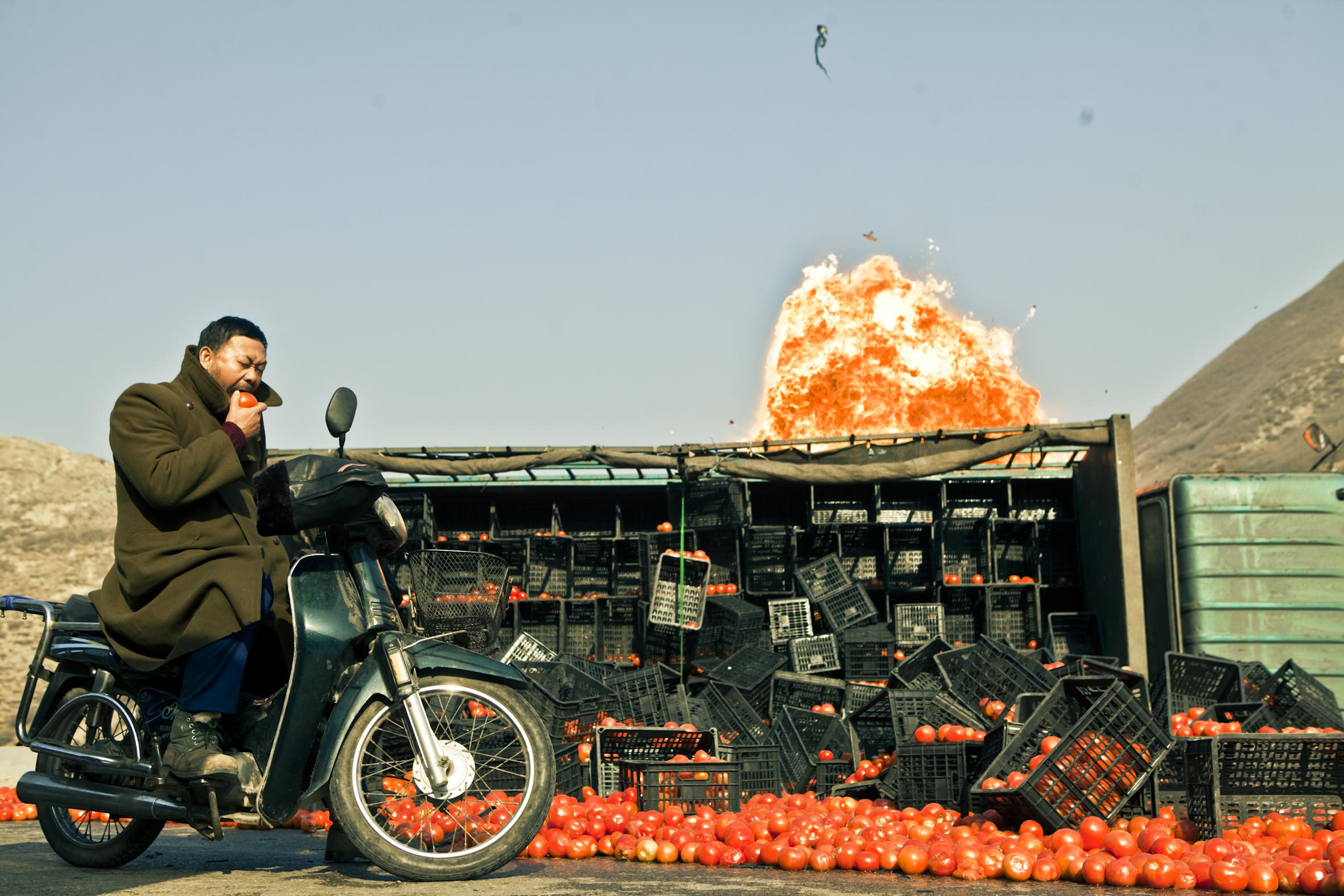
A Touch of Sin (Jia Zhangke, China, 2013)


There is a fun dynamic in the arthouse world in Denmark. A film premieres at Cannes, gets rave reviewes, wins an award. Then it takes 11 months for it to hit CPHPIX. A very long time to prepare, read reviews, analyses, watch the director's earlier filmography (though I failed to do so with Jia). Get hyped. In the end, it might be hard for the film to really hit you, and exceed your expectations. Stray Dogs managed to do so. A Touch of Sin is quite clearly the second-best film I've seen this year, but it didn't really rise above my expectations.


Four stories with violent conclusions, taken from contemporary China. Slightly intertwined. All taken from real news-stories, though they were mainly big on China's microblogging site Weibo, the unofficial way to get news. Using genretrappings to create a picture of a deceased society. In many ways, this is the perfect version of what Manuscript's Don't Burn tried to do. The cinematography is stunning, with the mobile but steady camera constantly catching amazing picture after amazing picture. It's never boring. And the film feels open, as if it has more on it's mind than just the four tragic stories it tells.

Actually, what most fascinates me right now is the insane amount of stories being told or alluded to in this film. There are Weibo-stories of corruption being discussed. There is a trainwreck catastrophy occuring all of a sudden. Tv-screens show apropiate movies - John Woo and Tsui Hark, apparantly, famous Hong Kong action directors. The characters watch snippets of Chinese Opera, based on the old Chinese novel The Water Margin, about noble characters forced into being violent outlaws. The English name of the film is an allusion to the old wuxia film A Touch of Zen, a masterpiece in it's own right. The scenography of the film manages to tell a bunch of stories as well: An oppulent car in a desolate village tells a story of inequality and corruption, grand hills of coal tells of ecological disruption.


It all adds up to a compendium of modern myths. This is a brilliant way to counter censorship: An explosion of counter-stories, showing not just a multitude of unofficial stories, but also the inability to keep those stories hidden. An overwhelming portrait of a dysfunctional country, this film should be seen by everyone interested in the world as it is today. The shut-down coal-mines, the migrant-workers, the saunas, the high-speed trains, the unsafe sweatshops creating goods for export. This film does to China what The Great Beauty did to Italy, though many times more effectively - and I liked The Great Beauty. It's a film filled with great scenes and details, like a character using three cigarettes to pray to the ghosts of the people he's killed, or a line of girls marching in a display of Red Army kitch for Cantonese visitors. The fact that it was ever slated for a mainland Chinese release is amazing, though the regime has delayed it infinitely. But it will hopefully be downloaded illegally, and discussed on Weibo. It is a great film, and very important. But I knew that, most of the people reading this probably also already knows this. And it's not more than that, I think.

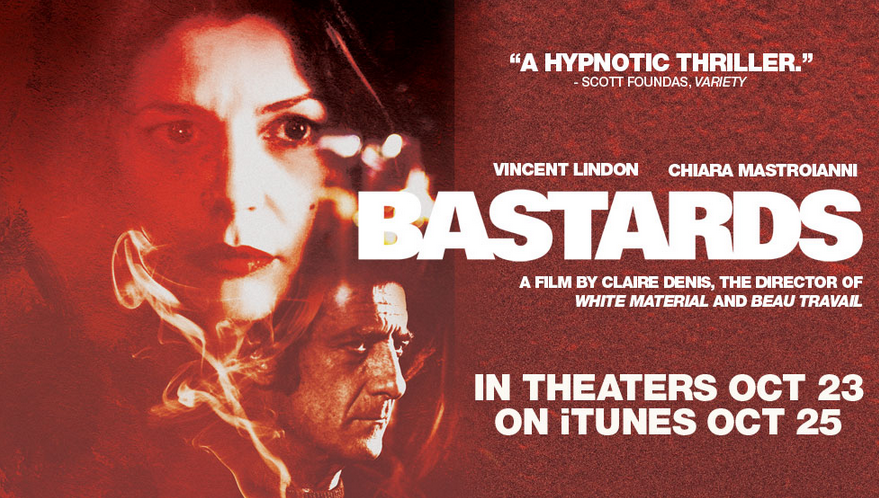
Bastards (Claire Denis, France, 2013)


I've seen this film before, on a VOD-stream. But boy did I miss a lot. One has to be careful with a Denis-film, I missed a neon-sign, and thereby a huge chunk of the plot. A woman walks toward a Tabac-sign, then it shuts down, signalling that the shop has closed. The man living in the appartment above grabs some packs of cigarettes, wraps them in his shirt, and throws them down on the street. That shirt becomes the facillitator of their flirt, and without understanding why he threw it down, it all just seemed very weird.

I like the way details add up in this kind of Denis. Shots of stuff, of faces, of bodies. And then we have to piece their meaning together. 35 Shots of Rhum did it with a story of a makeshift family of immigrants, whose relations only gradually came clear to the audience. Bastards does the same thing with a Lynchian mystery. Which does make it less interesting to me. A mystery-like style is more innovative for a family drama than for a mystery. Also, the pictures are slightly murky, and the dream-like interludes make the plot hard to follow: After the suicide of his brother-in-law and the hospitalization of his niece, Marco returns home and moves into the flat above the man he decides is responsible: The wealthy banker Laporte. Marco begins an affair with Laporte's young wife, which is depicted tenderly. But the investigation into Laporte remain unfulfilling.


A thing I noted: The title of the film is in plural (Les Salauds in French instead of Le Salaud. The true English translation would be The Bastards) So when Marco claims on Laporte: It is He who is the Bastard. He is wrong. At other times he seems to recognize this, he claims to have been happy he's divorced, so that his daughters won't be 'infected' by what was wrong with his sisters family. Notably, that infection would have to run through himself. I've seen commenters talking about this as a film attacking the wealthy privilege of Laporte, but I don't see it. I see it more as a feminist tale. A short clip of a naked woman lying on the street in Paris seems to bear this out. In this way, Marco becomes one of the Bastards as well: He continues to want to dominate in his affair and tells her what to think and do, and never listens to what she says. He is using her to get at Laporte, and Laporte is actually quite right when he takes his young son away from the influence of a man he decides is dangerous. In the end, people will die, tough secrets will come to the surface, and a woman will make a choice and take action. And the young son will probably be traumatized.

I think Denis belongs in any discussion of the best directors working today. Beau Travail is a massive masterpiece. Friday Night is slight, but creates a fantastic world for it's characters. 35 Shots of Rhum and White Material are great as well. This one is lesser. The filmmaking is exquisite, though murky and hard to grasp. But the themes don't really add up, I don't think. It becomes slightly facile.

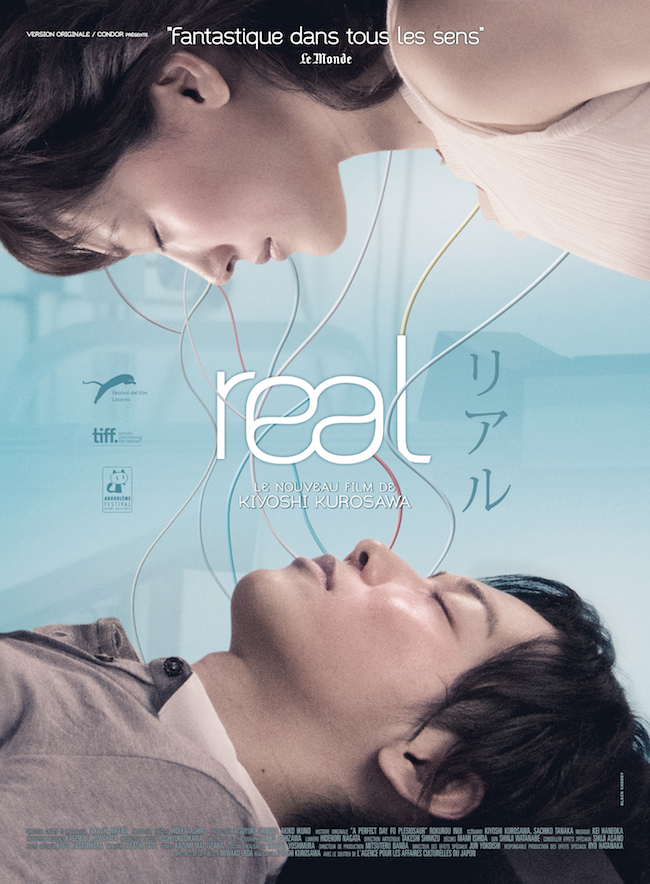
Real (Kiyoshi Kurosawa, Japan, 2013)


Kiyoshi Kurosawa is really productive these years. Last year I saw his Penance at PIX, a 2012 tv-series turned into 4-hour film. And after Real, he managed to get yet another film into theaters in 2013, which we might get to see in 2015? And this is coming after him not having made a feature since Tokyo Sonata in 2008. I kinda liked Penance, though it had it's flaws. It was uneven visually and overlong and -plotted, but I just decided that was probably due to it being a tv-series, and focused on the highpoints and it's thematic richness. But Real is a feature film, and it has all the same problems. Apparantly, this might be a new 'style', and if so, them I'm probably not going to prioritize catching the next thing he does.

Kiyoshi Kurosawa got famous for doing J-horror to begin with, and though this isn't a horror-film, his chops are in great use. The plot revolves around a machine allowing people to do something called 'Sensing', entering the mind of a comatose patient, and trying to convince them to wake up. The young man Koichi is trying to wake up his girlfriend Atsumi, a manga-artist who tried to commit suicide. The brilliant twist is that the stress from use of the machine causes people to hallucinate, even when they are out of it. So you have an Inception-like dream-world, where everything can happen. And then you have the real world, except it's full of hallucinations. So everything can happen. There's some great stuff with this, scenes looking like they are drawn, off-kilter photography, and tropes taken from the horror-playbook. Except that it quite explicitly is just all in the head, and everyone knows this. But then the twists starts coming, and boy... I don't want to ruin the experience but I feel like I need to say this: People in the theater was howling with laughter at the stupid twists, and then groaning once another twist meant the film had more story to tell.


That was insane. I don't know what on earth Kurosawa was thinking, but there are things in this film which is quite clearly the dumbest, ugliest, most ridiculous stuff I've seen at this festival. It might not be Kurosawa's fault, the film is based on a book called A Perfect Day for Plesiosaur, so the dumb plot might be a consequence of adapting the book too faithfully. That the visual side is so unapealing, that is on Kurosawa, though. It might be a question of taste, but I strongly dislike the aesthetic of his last few films. Tokyo Sonata is amazing - and the only earlier of his I've seen - so I don't get why this looks like it does. But it's way too digital and sleek, with modern appartments in steel and glass looking way too impersonal, and the colours being way too cold. And the music is just horrible, all the way through.

This is baffling. Half a fun but flawed psychological horror/sci-fi-hybrid, and half completely ridiculous... yeah, I don't know how to describe the second half. It's awful, though. Catch it for the visual trickery in the first half, but be prepared for a massive let-down.

lørdag den 5. april 2014

CPHPIX day 2: Jealousy, Why Don't You Play In Hell

The festival's started slowly for me this year. Last year, I saw some of my favorite films the first two days. This year, not so much. Though one of these two were very good. Anyway, quick write ups of Philippe Garrel's Jealousy and Sion Sono's Why Don't You Play in Hell follows:

Jealousy (Philippe Garrel, France, 2013)


Another day, another 'Maestro'-selection I don't get. Who is Philippe Garrel? The name honestly doesn't ring any bells. But at least he is old. And apparantly a mainstay at Venice. Well, I found this article at Senses of Cinema, which talks about him, but it is 13 years old. Underground, auto-biographical, pared-down cinema. Well, it sort of fits with this one as well. It also claims that Garrel is the best filmmaker working today, which is a surprise to me.

Jealousy is a pretty simple film on the lovelife of the creative class. That makes it the third film sorta on this subject I've seen this year, after Our Sunhi and Free Range. Honestly, I'm getting a bit bored by it. It's very unassuming and simply build: Louis leaves the mother of his child, and moves in with another woman. They grow apart. She leaves him. 77 min. Austere but beautiful black and white. I liked how the world kept opening up, as the main characters flirted with more and more people. Louis is played by Louis Garrel, the son of the director, and his sister is played by his sister, Esther. It's a fine little film.

Thing is, though. La Jalousie is a pretty famous book in France. By Alain Robbes-Grillet. A classic of the Nouveau Roman. The film definitely recognizes this famous book, as it begins with a scene of the young daughter spying on her parents breaking up through a keyhole, just as the unseen narrator of La Jalousie is spying through a jalousie window. And, well, I can't really get over the fact that this film borrows the title from one of the most famous examples of French experimental fiction, and then uses it for a pretty ordinary and stale relationship drama. It just seems wrong, and perhaps even a bit sad. And it's not as if anyone should wonder how to do Robbe-Grillet filmically, the guy made films and wrote the script for Last Year in Marienbad. And it didn't look like this.

I have nothing against the film. The pictures are exquisite, some of the scenes are unique and brilliant, like a tracking shot of the new couple in the beginning of their relationship, which follows them in focus, while the world behind them is reduced to a blur. What I think is totally possible, is that if I saw a few more Garrel-films, if I knew more of his world, then this latest dispatch would mean more to me. Kinda like with Hong Sang-soo. But I don't, and as such, I'm a bit in the dark. If you like American indies, but would wish they were more Gallic, then this is a film for you. But other than that, I think there are better places to start in Garrel's filmography.

Jealousy is shown again Wed 4/16 at 17:00

Why Don't You Play in Hell? (Sion Sono, 2013, Japan)


Okay, this was insane. 1) Check out the trailer above. It's insane. 2) The screening of this film was completely ridiculous, there were black borders on all four side of the picture, and at one point the film started hiccuping, and we missed quite a lot of it. More on this later.

Sion Sono was one of my discoveries at last years festival. I saw his Land of Hope with no expectations, mainly because I'm interested in the Fukushima accident, and found it extremely wellmade and beautiful. I knew it was an outlier in his production, that he is normally a more extreme kind of director, so I wasn't that surprised by this films journey into complete insanity. Still: It's an extremely weird film. It revolves around two warring Yakuza-families; a group of guerilla filmmakers calling themselves The Fuck Bombers; the young daughter of the one Yakuza-boss, famous from an insanely catchy toothpaste commercial. Somehow, it all devolves into the filmmakers filming the final showdown between the two families, and carnage ensues. If it sounds needlessly complicated, well, it is, and the setup for this film takes forever. But the last half hour or so is amazingly fun.


Sion Sono is quite simply a good director, and the film is full of indelible images, many of them glimpsed in the trailer. The young girl dancing in a sea of blood, the yakuza-men squirting a rainbow of blood, loads more. And the jokes are timed and paced, so simple cuts elicited big laughs in the cinema. There is also one big stylistic gamble in the film: The first part, taking place ten years before, is filmed in 35 mm, while the main part is digital. This creates a massive amount of nostalgia, both in the film, as the flashbacks in the second part has the look of an actually older time, and just for the death of celluloid occuring over the decade, which the young filmmakers are acutely aware of. It's a great little thing. It did create problems though, as the hiccuping began when the style switched, and I'm almost certain it had something to do with the shift, though I can't explain how. Anyway, it meant that the part after the timejump became quite imcomprehensible, and that was where the main plotlines were set up, so I'm pretty sure I missed quite a bit of the plot.

Having only watched two of his films, I'd still put Sion Sono up there with the best of the Japanese directors of the new century. These two films pretty much match any Miike, Kore-eda, (late-period) Kitano, Kiyoshi Kurosawa, etc, I've seen, which admittedly isn't anything. Still, I'm going to check out the rest of his ouvre, and if you get the chance to watch this bonkers b-film action/comedy/splatter, then I'd very much recommend it.

Why Don't You Play In Hell is shown again Mon 4/7 at 19:00.

mandag den 9. maj 2011

Agnes Varda's Le Bonheur + Thoughts on Women in Art


Sometimes you see something and a few thoughts seem to fall into place. Or at least into place a bit more. I saw Agnes Varda's film Le Bonheur from 65 last night, and it seemed to fit like a piece of a puzzle I've been trying to put together, on the topic of feminism, women artists, and the like. I've been trying to figure out this kind of thing for a long time, and jotted down several quotes from different places that I find helping. So this is mainly a bunch of pretentious quotes strung together into a half baked political framework, that in the end is probably still severely lacking, and only intended to absolve myself for my lack of activism in this regard. Nevertheless, it is nice to try and think stuff like this over from time to time, and a good thing about a blog is that it allows oneself to air thoughts that one haven't really resolved sufficiently, and that one might abandon in due time. Anyways, here they are. Spoilers, of course.


Talk talk talk. And then the scene in question from 7:00 onwards. Two unforgettable inserts at 8:30...

The thing that triggered these thoughts is the ending of the film. While relaxing in a park, Therese has heard that her husband Francois has begun an affair, an to begin with she seems to accept his explanation, that his actions has only made him happier and that this happiness has made his love for her even greater. But then, while he takes a nap, she wanders of and drowns in a pond. I deliberately don't say that she drowns herself, for the film seems a bit ambiguous on this point. A short shot shows her in the water, grasping at a stick, perhaps trying to stay above water. The ambiguity, and the shot where Francois holds the drowned Therese in his arms, reminded me of the fate of Ophelia from Hamlet. And immediately afterward, it reminded me of this poem by the Russian poet Anna Akhmatova, named Reading Hamlet:

A barren patch to the right of the cemetery,
behind it a river flashing blue.
You said: ”All right then, get thee to a nunnery,
or go get married to a fool...”

It was the sort of thing that princes always say,
but these are words that one remembers.
May they flow a hundred centuries in a row
like an ermine mantle from his shoulders.

(from the collection Poems of Akhmatova from Mariner books, translated by Stanley Kunitz and Max Hayward. Go find it on Amazon, it is really, really good...)

Akhmatova wrote a few of these poems, about women who gets lost in the struggle of men, such as Lots Wife who turned into a pillar of salt (Who will grieve for this woman? Does she not seem / too insignificant for our concern?), or Cleopatra (Tomorrow they'll put her children in chains...). As a Russian artist in the first half of twentieth century, she was of course a target of the Stalinist purges. But she was never hurt herself, her ex-husband was executed and her son was interned. She is very famous for the poem Requiem she wrote about her experience as the mother of a deportee. It begins with something Instead of a Preface, in which she is recognized standing in line outside the prison in Leningrad, and another woman asks her: ”Can you describe this?” / And I said: ”I can.” / Then something like a smile passed fleetingly over what had once been her face”


The French postmodern philosopher Jean-Francois Lyotard began his work The Differend with a rumination on the then new phenomenon of Holocaust deniers. As he described their solipsistic argument, the only proof of the Holocaust they would except would have been someone who could prove that the gas chambers had been used to kill people. And since everyone who had witnessed the gas chambers in function had died from it, this could not be proved, and ergo Holocaust could be denied. He used this extreme example to, amongst other things, draw a distinction between a plaintiff and a victim (in §9 on page 8 of the English edition from Minnesota University press). ”A plaintiff is someone who has incurred damages and who disposes of the means to prove it. One becomes a victim if one loses these means.” It is to remain a plaintiff and not become solely a victim, that the woman in the line in Leningrad asks Akhmatova if she can describe this wrong that are committed against them, if she is able to bear witness to it. By giving voice to victimized women from the past, Akhmatova also tries to turn them into plaintiffs. As a plaintiff you still have hope for revenge, or recompense. Once your a victim, that hope has been taken from you.


But of course, the question remains: Could Akhmatova really describe these wrongs? Don't get me wrong, it is a magnificent poem, a masterpiece even, but can we be sure she actually described the feeling of this other women? Can we be sure that she captures the feelings of Ophelia or Lots Wife (disregarding the fact that they are constructs...). Is she not, in a small way, perhaps doing them another wrong by using them to make her own description stronger? If this woman from Leningrad perhaps had written her own account, it would probably be disregarded, for it is inconceivable that it would ever be as brilliant as Akhmatova’s Requiem. Another extreme example is Dante and Beatrice. Beatrice is immortalized in Dante’s Divine Comedy. She is described as the most perfect woman ever, who is sitting almost next to God and Christ in the highest realm of Paradise. But has Dante immortalized Beatrice, or has he removed the actual woman from the annals of history, and substituted her with his own cleansed picture?


And this brings me back to Varda's film. For while every person in the film seem inherently sympathetic, Francois, the adulterer, has at least one major fault. He talks. He talks and talks and talks, yet he never really listens. He perpetually tries to explain his own acts and feelings, but never wants to hear anything about anyone else. And Therese doesn't tell him. She just wanders off, and then she drowns. Francois might be the archetypal male thinker. He thinks and thinks and talks and talks but his thinking remains completely self involved. He doesn't take the feelings of the two women into consideration. And this might be the point, a point that I think only a female director could have made. When male artists want to speak out about women's rights, they have a tendency to create women whom they themselves think are strong and good. And then voice their opinions through these characters. This strategy can lead to great results – I'm reading one of the greatest examples, Tolstoy’s Anna Karenina at the moment – but it is quite different from what Varda is doing. She didn't create any strong women in this film. In fact, they are quite weak willed, also the other woman, Emilie, whom Francois to begin with loves because of her independence, but who is quickly domesticated after she assumes the role of wife to Francois. But Varda instead perhaps showed why they are weak. Because they are not allowed to speak for themselves. They can therefore never be plaintiffs, only victims.


Such quiet, determined grace. Such beauty. Almost unnatural...

Another scene with a women drowning has been on my mind since the first time I saw it. It's from the Japanese filmmaker Kenji Mizoguchi's beautiful Sansho the Bailiff. The young woman has helped her brother escape from their slave camp, but since she fears that she would probably disclose which way he went if tortured, she chooses to walk into a pond, and drowns herself. She gracefully wanders into the water, and then the film cuts to small ripples on the water, where she has subsumed herself. I've seen Mizoguchi described as a filmmaker with 'a feminine universe' (by French philosopher Gilles Deleuze in his Cinema 1 – The Movement Image, also from Minnesota, page 192), as a filmmaker who was interested in the plight of women. But in this scene, the action undertaken by the woman is supposed to be a sacrifice, it is seen as good and noble. But is it really a healthy picture of women? Someone who sacrifices themselves for the good of their family? (Admittedly, Deleuze points to Mizuguchi as feminine in contrast with Kurosawa, and he is definitely more feminine than him. But who isn't?) It is interesting to contrast these two scenes of women drowning themselves, for the moment that Mizoguchi has removed from the sequence, the moment where the woman actually drowns, as in dying with water coming over her and into her lungs and last breaths and all those grisly details, is the only moment that Varda shows the audience in her version. And I wouldn't be surprised if that is deliberate on Varda's part, the film is quite allusive, as films of the Nouvelle Vague are wont to be. But this also points to another difference, that the sacrifice of the woman in Mizuguchi's version actually accomplishes something, that the brother is able to escape, while the drowning in Le Bonheur just seems pointless and in vain. A few minutes later, Francois has married his lover, and life seems to go on without any one really mourning... This ending is another twist on Shakespeare: where Francois seemed like Hamlet when he held his substitute Ophelia, after her burial he acts much more like Gertrud... But this ending, with one woman replaced by another, and happy lives continuing as if nothing particularly important has taken place, this ending seems to me to show 'patriarchy' in effect, in all it's petty pervasiveness, where women are completely defined by men, and their only other choice is to 'opt out' of it, so to speak, since they can never ever hope to be allowed to define their own life. And I think that this ending could only have been created by a woman, a man would have done it otherwise, he would not have shown the bad effects of patriarchy so clearly, perhaps since he as a male artist, with a strong effect on defining societal discourse, he is in fact part of the problem. And even if he created a completely new path for a woman to take, created the strongest, best female character he could possibly create, then he would inexorably have created a new woman defined by a man, and would then sadly just have become an even bigger part of the problem...

Well, to get to the point of these pretentious ramblings – and wow, they ended up being even more pretentious than I planned them to be... - this points to a problem I have with a lot of my own writing. I'm a male, heterosexual WASP. And I think and write quite a lot about race, gender and sexuality. And I kinda feel like I'm wrong in doing it. I once came to the conclusion, that I wouldn't consider myself a feminist, for that implied that I fought and spoke on their behalf, and as I've tried to explain, that can easily turn into usurping their fight and using it for my own gain. So I promised myself I wouldn't do that. I try not to speak on behalf of women, and minorities of every kind. But I try to listen. And I do my own interpretations of what they say, which can never be done without doing some kind of violence to the original, and which I feel is kinda wrong. But what to do... I've gotta write about something.

Oh what a boring, obvious, noncommittal conclusion. Let me instead end with yet another poem by Akhmatova, let Akhmatova get the final word:

Epigram (1960):

Could Beatrice have written like Dante,
or Laura have glorified love's pain?
I set the style for women's speech.
God help me shut them up again!