This film isn't about the birth of a cynic. It is about the downfall of one. Which is actually a bit paradoxical. The setting of the film is World War Two, which could very plausibly be seen as the birth through victory of the modern / post-modern world. So if the cynic is the common person in the modern world, then a film about World War Two should logically show how the cynical side persevered over the old-fashioned fanatically ideological one. Yet Tarantino turns this one around. The most modern character in the film is by far Hans Landa, while the Allied 'Basterds' seem much more driven by ideology than him.
I've written earlier about the western, and how it is the essential genre to depict the birth of modernity. Tarantino uses motives from Western canon right from the first words of the film, as the name of chapter 1 is 'Once Upon a Time... in Nazi-occupied France' This is of course a play on the famous Sergio Leone film (or films, he made both ...the West, and … America) and the homage becomes even more clear as the first scene takes place, when the soundtrack contains a parody (or homage, or whatever) of the famous Morricone-music from The Good, The Bad and the Ugly. Except it includes fragments of Für Elise, to illustrate that Germany plays a part in this setting. That whole first segment is very similar to one of the first scenes in Once Upon a Time in the West, where a family on a secluded farm is massacred by gunmen as part of a conspiracy concerning the coming railroad. Yes, OUaTitW is a revisionist western, where the 'evil' forces are actually connected to the onset of modernity. And this film copies that. The German forces are evil modernity, and their enemies? Well, they are constantly connected to Indian imagery (I'm going to keep on using the politically incorrect word 'Indian', as the imagery the Allies draw upon is the cultural idea of Indians, rather than actual Native Americans). Aldo is called The Apache, the Basterds scalpel their enemies, and when Shosanna prepares for the great night, she puts warpaint on her face like the Indians do in the movies.

And it's like that throughout the film. The Germans are the modern ones, the Allied forces are pre-modern. Landa is, as I've mentioned, a modern Cynic. He doesn't care for truth, while speaking to the farmer he says: ”I love rumours. Facts can be so misleading, while rumours true or false are often revealing.” Later on he tells a long story about why he hates Jews, even though he knows it is an irrational hatred, by comparing it to the farmers irrational hatred of rats. Yet as he says: ”However interesting as a thought may be, it makes not one bit of difference to how you feel!” He is Cynical, he is self aware about his prejudices, yet he doesn't care. Aldo Raine on the other hand, is an ideologue. In his first speech to his men, he says: ”Nazi ain't got no humanity. There the foot-soldiers of a Jew-hating mass murdering maniac, and they need to be destroyed. That's why any and every sum-bitch we find wearing a Nazi-uniform, they gonna die!” Throughout the movie, the Germans are able and willing to play with other roles and personalities than their own, to indulge in that incredibly modern condition of split personality or schizophrenia. We see the German soldiers spending their free time by playing a game where they pretend to be someone else, and has to guess who it is. In some ways, personality can be put on your forehead, and taken away again. The Allied, on the other hand, can't play roles (except Indians or animals). They are rubbish at pretending to be German or Italian, and they don't like the German game. They believe that once a Nazi, always a Nazi, and they hate the thought that the role can be taken off with the uniform and hidden away, even though they mainly fight enlisted men. While the Germans put identity cards on their heads and take them off again, the Allies carve identity into foreheads with big knives.
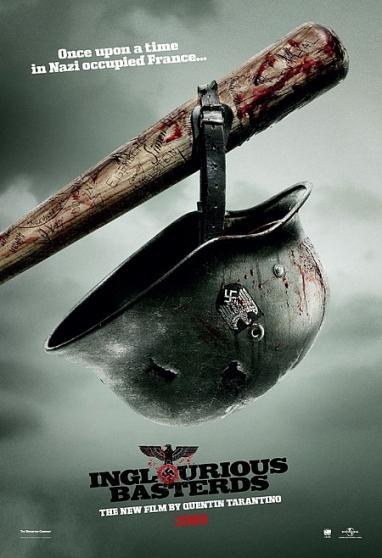
Most of the film consists of mind games between the Allied and the Germans. And every time both sides play fairly, the Germans win. Landa wins in the opening scene, the German SS-officer 'wins' in the scene at the tavern, and Hans Landa seemingly wins over everyone at the end. Every time there is a contest of intelligence, the Germans win, the only exception is the scene between Zoller and Shosanna in the projectors booth, which ends in a draw (and by the way, it's a funny view on man and woman. Shosanna tricks Zoller by pretending they are going to have sex, and then Zoller tricks her back by angling for pity. For men is libido and women is feelings.) The allied win by lying and being amoral. They trick poor Wilhelm into thinking that they will let him go, and they break every convention of war at the ending of the film. But throughout the film, they are losing. And when Aldo Raine has to utter his fake Italian 'Bonjornoh', it is almost pathetic (but the game is already over at that point. The point where Landa takes control is illustrated in a marvelously cinematic way, as Tarantino employs one of his beloved circular camera movements to circle Landa, von Hammersmark and the Basterds, and when Landa employs his fake laugh and shows that he has seen through the ruse, he takes a step back while manically laughing, yanking the camera out of it's course as he yanks the agenda out of his opponents hands).
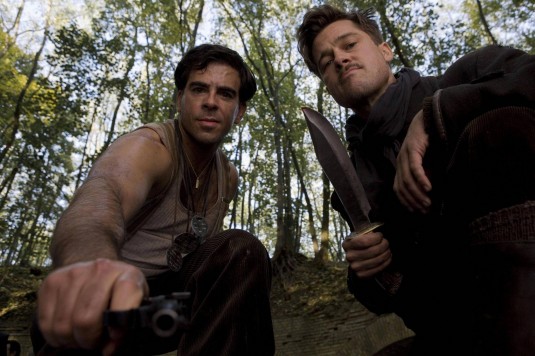
The implications of the film goes further, and is in my opinion quite political. The Allied concoct themselves as pre-modern Indians, yet today, when the film was made, they seem more like terrorists. In Aldo's speech, he exclaims: ”The German will fear us!” He could easily have said that they would be terrified. The Basterds torture there prisoners and they use suicide bombers. And the Germans don't know how to retaliate. In the end, the war is won through lies and terrorism. This seems quite controversial, to show the Allies as the schemers, and show Jews as terrorists, but Tarantino employs a few safety hatches, so to speak. First of all, he makes sure to show that Landa and Zoller is not just banal soldiers and administrators, though they claim to be. Both of them make violent motions towards women, and Landa even chokes von Hammersmark with his own hands, showing that they are in fact 'bad'. And Tarantino is not trying to say that Allied and Jews are equal to terrorists. He is trying to show how powerful fanaticism and extremism is. How powerful the extreme forces of the US would be, if they were as fanatical and willing to play 'dirty' as the opponents of 'Democracy' has traditionally been, from fascists to insurgents in Vietnam or Iraq. If we in the west would compromise (more...) on our principles, and could employ true fanaticism, we could easily win every war. But we should not. And we can't. We are cynics, and so, we have to slog through.
This film probably ain't a timeless masterpiece. For one, the digital coloring is horrible, it's focus on orange and teal will hopefully seem dated in a few years (and not just does this coloring make the pictures look samey after a while, it makes everyone’s eyes look deep blue. When you are making a film about the fight against antisemitism, employing a filter that makes everyone’s eyes look more Aryan really sends weird signals). But the 'value' of the film doesn't really matter to me. It really seems to comment quite profoundly on the problems of the Cynics in our society, especially with regards to warfare, in a pretty daring way. Plus, it's entertaining as hell.
Next week: We step away from culture and into the real world, but stay in the realm of Basterds, with Cynical Historian Niall Fergusson.
[Part I: Introduction and Mad Men]
[Part II: The Man Who Shot Liberty Valance & Police, Adjective]
[Part III: Brothers Karamazov and Melancholia]
[Part IV: Apocalypse Now]
[Part V: Inception]