Timbuktu (Abderrahmane Sissako, Mauritania, 2014)
African film rarely get the spotlight, so when a film like this gets nominated for both the Palme d'Or at Cannes as well as an Oscar, it's cause for celebration. And when it's as good as this, it's could actually be pretty important. I really wanted to see this, but all the screenings are completely sold out already. Luckily, an extra screening was arranged, and I made it into that.
Well, honestly, this was more 'important' than 'great'. The film depicts what happens after a group of islamists take over Timbuktu, and it's great at both showing the processes of jihad as well as sharia, and at showing the way people slowly fight against it. There are amazing sequences in it, like a group of kids playing football without a ball as balls have been outlawed. Or a shot of two people struggling in a lake, filmed at a distance with the afternoon sun shining down, making the water glisten and the men into dark shadows. But the main story never really lifts off, and the main family are honestly a bit boring. Much more interesting things are happening on the sidelines, both with the jihadists and their victims.
The film is surprisingly nuanced towards sharia, though. It shows the many horrors coming from the strict laws, but it also shows the violence and turbulence caused by lawlessness. When the young boys play soccer, it's amazing not just because they show such great imagination, but also because they actually manage to agree on who scores at which time. It's a utopian dream of collaboration and compromise. But immediately after that, two men come to blows in a conflict based on their conflicting uses of the sole river in the area. Two kids matter of factly discuss the death of the one kid's father due to him being a fighter. This area has been ravaged by war and violence for a long long time, it's not something the jihadists has brought. But they really don't help it. Make no mistake, they are hypocrites, violent and lustful. The film has no illusions things would be right if they dissapeared.
Great scenes where people play Malian music are followed by horrifying scenes where musicians are publicly whipped. Many characters are great, like Abdelkrim, a jihadist learning to drive his four-wheel Toyota and struggling with a now clandestine smoking addiction. Or a female witch, of sorts, a practitioner of some sort of old African religion, claiming to have been dislocated from Haiti a few years back, and walking the streets un-scarfed confronting the jihadists and getting away with it through force of will. So many great stories are in this. It's just, the spine isn't that interesting, and those scenes can grind the film to a halt. But important filmmaking, definitely, showing new perspectives on a global problem. And those great scenes absolutely lift it above just being 'worthwhile', or some other kind of faint praise. It's good.
Mateo (Maria Gamboa, Columbia, 2014)
When you watch a gangster-film, you don't expect there to be great choreography. So this one kinda took me by surprise.
Young Mateo works for his uncle Walter, the local loanshark, in one of Columbias most dangerous cities. He's doing simple work, collecting money from local merchants, every now and then taking merchandise instead, and not realizing the dangerous mess he's getting himself into. You've seen this film before. Young boys in dangerous cities. It's City of God. It's Gomorrah. It's The Wire season 4. But then Mateo joins a local theater-group, first to not get kicked out of school, then to spy on the participants for his uncle, and then the film becomes somewhat strange. What seemed like a slow build to death and violence instead becomes about trust and solidarity. That is pretty clearly what the theater-group is about: The first thing they practice is looking each other in the eyes and carrying each other up. Mateo knows how to act, when we first see him he moves through streets and poolhalls with practiced swagger, but he don't know how to act along with others. He can never look the leader of the group, a young priest, in the eyes. The young priest preaches standing up to the evil forces, showing solidarity. Mateo's mother works with her friends to build a small farm that will bring more wealth to all of them. They are clearly small solutions to the big problems doing so much damage to Columbia.
It's a gentle film, with beautifully filmed scenes of young people acting, dancing, moving around. The guns almost move out of the film, almost. The camera moves fluidly as well, including some absolutely wild craneshots over rivers I have absolutely no idea how they got the resources to do in a small film like this. At some point I didn't know if I was willing to go along with the tale, the whole theater-beating-thugs thing can seem like complete wish-fullfillment at times. But the ending is suitably dark and ambiguous, which really helps a lot. This was a film a looong way down the bill, one of the films in the 'New Voices' section for debut features, that isn't in the 'Ingmar Bergman International Debut Award' competition, nor in the section for 'Visionaries', which include some very young filmmakers as well. I had no expectations for this film. But I was pleasantly surprised.
Tokyo Tribe (Sion Sono, Japan, 2014)
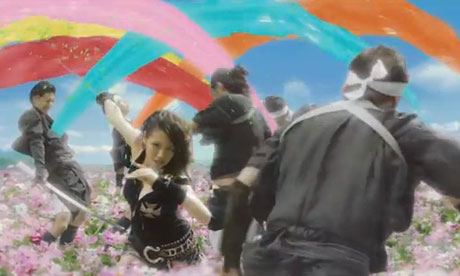
Sion Sono makes a film a year, and every film makes the festival circuit. And they aren't austere, short films, they are packed to the gills with ideas, images, twists, and characters. I watched and liked Land of Hope in 2013, and Why Don't You Play in Hell in 2014. This is his biggest, weirdest, yet, of the ones I've seen. A truckload of crazy characters, in big costumes, on amazingly big and intricate sets where the camera roams for minutes at a time without a cut. And, oh, the film is a hiphop musical, so most of the dialogue is rapped. It's insane, is what it is.
Actually, this time I get how he does it, because the whole thing is based on a manga, called Tokyo Tribe2. Googling images, it's clear that a lot of character and set design is taken straight from the page. A lot of the lyrics are apparantly written by the hiphop-artists playing the characters as well. The plot is apparantly heavily modified from the manga, but it doesn't make any sense at all, so it probably didn't take that much time to put together. Something about a bunch of 'Tribes' in Tokyo, gangs warring for territory, and one of them all of a sudden has a bunch of henchmen so all the other tribes has to band together. And some of them are for love and peace, and others want war and domination, and there is some kind of High Priest from 'Wong Kong' who's daughter has dissapeared and two diminutive teenage karate experts kicking ass and a beatboxing waitress and a swordwielding thug in a thong and a bunch of other weird stuff. It's packed to the gills with wacky details. It's destined to become a cult-film for a long time to come.
But... I don't think it was as riveting as Why Don't You Play In Hell. The difference is, WDYPIH was a loveletter to cheap filmmaking in all forms, from 8mm amateur film to glossy commercials, and that joy of film was always easy to see in every frame of the film. Tokyo Tribes is an ode to hiphop culture, but... The beats aren't that great, and the rapping isn't that great, and I don't know about Japanese hiphop, but American hiphop actually has a visual grammar from it's videos, and it looks nothing like this film. The visuals of this film are West Side Story meets The Warriors meets Mad Max in a dayglo-neon-cityscape. Don't get me wrong, that is cool. But the different parts at times work against each other, and at times the hip-hop aesthetic seems like stick. Or it could be that Japanese hiphop-culture is as weird as this.
Nevertheless, this one will probably be watched by many people, and that is as it should be. This is weirder than weird, and Sono is a massively accomplished filmmaker. Long, one-take scenes on big sets with masses of extras walking back and forth and several stories playing out at once. Great fights. Beautiful images. It's all cool, I'm down with it, the scratching grandma, the jewel-encrusted katanas, the human furniture, the guy creating a lockpick through breakdancing. This was cool. But do watch some more Sion Sono afterwards, he is really on a roll these years!
Also Seen
I've also seen Michael Noer's (R, Northwest) Key House Mirror which is in competition, and which I will write about elsewhere. But to say it short: It's a big leap forward for the young director, Ghita Nørby is great as an old lady trying to create a life in a nursing home, and I wouldn't be surprised if it won a bunch of awards here and elsewhere. Also, I rewatched J.P. Sniadecki's The Iron Ministry, which I've written about here. Related to Harvard SEL, the experimental group famous for films like Leviathan and Manakamana, it's a great visual portrait of China in motion as seen through it's trains.
Great scenes where people play Malian music are followed by horrifying scenes where musicians are publicly whipped. Many characters are great, like Abdelkrim, a jihadist learning to drive his four-wheel Toyota and struggling with a now clandestine smoking addiction. Or a female witch, of sorts, a practitioner of some sort of old African religion, claiming to have been dislocated from Haiti a few years back, and walking the streets un-scarfed confronting the jihadists and getting away with it through force of will. So many great stories are in this. It's just, the spine isn't that interesting, and those scenes can grind the film to a halt. But important filmmaking, definitely, showing new perspectives on a global problem. And those great scenes absolutely lift it above just being 'worthwhile', or some other kind of faint praise. It's good.
Mateo (Maria Gamboa, Columbia, 2014)
When you watch a gangster-film, you don't expect there to be great choreography. So this one kinda took me by surprise.
Young Mateo works for his uncle Walter, the local loanshark, in one of Columbias most dangerous cities. He's doing simple work, collecting money from local merchants, every now and then taking merchandise instead, and not realizing the dangerous mess he's getting himself into. You've seen this film before. Young boys in dangerous cities. It's City of God. It's Gomorrah. It's The Wire season 4. But then Mateo joins a local theater-group, first to not get kicked out of school, then to spy on the participants for his uncle, and then the film becomes somewhat strange. What seemed like a slow build to death and violence instead becomes about trust and solidarity. That is pretty clearly what the theater-group is about: The first thing they practice is looking each other in the eyes and carrying each other up. Mateo knows how to act, when we first see him he moves through streets and poolhalls with practiced swagger, but he don't know how to act along with others. He can never look the leader of the group, a young priest, in the eyes. The young priest preaches standing up to the evil forces, showing solidarity. Mateo's mother works with her friends to build a small farm that will bring more wealth to all of them. They are clearly small solutions to the big problems doing so much damage to Columbia.
It's a gentle film, with beautifully filmed scenes of young people acting, dancing, moving around. The guns almost move out of the film, almost. The camera moves fluidly as well, including some absolutely wild craneshots over rivers I have absolutely no idea how they got the resources to do in a small film like this. At some point I didn't know if I was willing to go along with the tale, the whole theater-beating-thugs thing can seem like complete wish-fullfillment at times. But the ending is suitably dark and ambiguous, which really helps a lot. This was a film a looong way down the bill, one of the films in the 'New Voices' section for debut features, that isn't in the 'Ingmar Bergman International Debut Award' competition, nor in the section for 'Visionaries', which include some very young filmmakers as well. I had no expectations for this film. But I was pleasantly surprised.
Tokyo Tribe (Sion Sono, Japan, 2014)
Sion Sono makes a film a year, and every film makes the festival circuit. And they aren't austere, short films, they are packed to the gills with ideas, images, twists, and characters. I watched and liked Land of Hope in 2013, and Why Don't You Play in Hell in 2014. This is his biggest, weirdest, yet, of the ones I've seen. A truckload of crazy characters, in big costumes, on amazingly big and intricate sets where the camera roams for minutes at a time without a cut. And, oh, the film is a hiphop musical, so most of the dialogue is rapped. It's insane, is what it is.
Actually, this time I get how he does it, because the whole thing is based on a manga, called Tokyo Tribe2. Googling images, it's clear that a lot of character and set design is taken straight from the page. A lot of the lyrics are apparantly written by the hiphop-artists playing the characters as well. The plot is apparantly heavily modified from the manga, but it doesn't make any sense at all, so it probably didn't take that much time to put together. Something about a bunch of 'Tribes' in Tokyo, gangs warring for territory, and one of them all of a sudden has a bunch of henchmen so all the other tribes has to band together. And some of them are for love and peace, and others want war and domination, and there is some kind of High Priest from 'Wong Kong' who's daughter has dissapeared and two diminutive teenage karate experts kicking ass and a beatboxing waitress and a swordwielding thug in a thong and a bunch of other weird stuff. It's packed to the gills with wacky details. It's destined to become a cult-film for a long time to come.
A song from the French version of the Anime version of this. Which for some reason exists.
But... I don't think it was as riveting as Why Don't You Play In Hell. The difference is, WDYPIH was a loveletter to cheap filmmaking in all forms, from 8mm amateur film to glossy commercials, and that joy of film was always easy to see in every frame of the film. Tokyo Tribes is an ode to hiphop culture, but... The beats aren't that great, and the rapping isn't that great, and I don't know about Japanese hiphop, but American hiphop actually has a visual grammar from it's videos, and it looks nothing like this film. The visuals of this film are West Side Story meets The Warriors meets Mad Max in a dayglo-neon-cityscape. Don't get me wrong, that is cool. But the different parts at times work against each other, and at times the hip-hop aesthetic seems like stick. Or it could be that Japanese hiphop-culture is as weird as this.
Nevertheless, this one will probably be watched by many people, and that is as it should be. This is weirder than weird, and Sono is a massively accomplished filmmaker. Long, one-take scenes on big sets with masses of extras walking back and forth and several stories playing out at once. Great fights. Beautiful images. It's all cool, I'm down with it, the scratching grandma, the jewel-encrusted katanas, the human furniture, the guy creating a lockpick through breakdancing. This was cool. But do watch some more Sion Sono afterwards, he is really on a roll these years!
Also Seen
I've also seen Michael Noer's (R, Northwest) Key House Mirror which is in competition, and which I will write about elsewhere. But to say it short: It's a big leap forward for the young director, Ghita Nørby is great as an old lady trying to create a life in a nursing home, and I wouldn't be surprised if it won a bunch of awards here and elsewhere. Also, I rewatched J.P. Sniadecki's The Iron Ministry, which I've written about here. Related to Harvard SEL, the experimental group famous for films like Leviathan and Manakamana, it's a great visual portrait of China in motion as seen through it's trains.