Viser opslag med etiketten Hong Sang-soo. Vis alle opslag

lørdag den 11. april 2015

PIX15: Hill of Freedom, Greenery Will Bloom Again, Da Sweet Blood of Jesus

New year, new festival. I'll review a bunch of stuff in different places, some in Danish, some in English. I didn't watch anything on day one, but today I saw three films.

Hill of Freedom (Hong Sang-soo, South Korea, 2014)

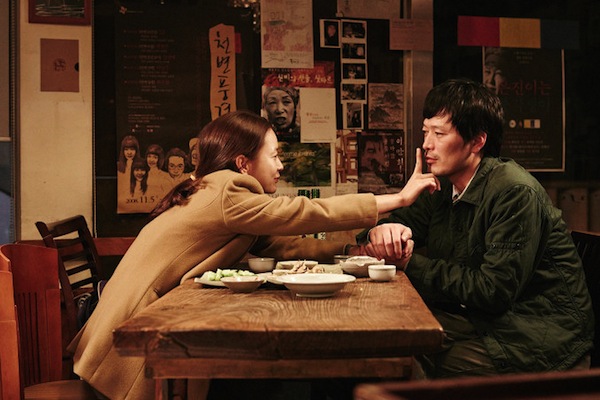
I began the festival the same way as last year: With the newest from prolific South Korean director Hong Sang-soo. It's the perfect way to start a festival the way all Hong's films start: Bright colors, korean script, and the charming pianomusic by Jeong Yong-jin. Same as always. Last year I was utterly charmed by his Our Sunhi. I'd heard, that this new one, Hill of Freedom, might be his very best, so I was looking forward to it. It's good. It's obviously fun and charming and Hong-like. But I wasn't as hooked as I was last year.

As I wrote last year, Hong Sang-soo can go from being really tricky to not that tricky. This is him at his utmost trickiest.The actual plot is very simple: Japanese guy Mori travels to Seoul to track down Kwon, a women he met a few years back. While searching for her, he meets an assortment of other characters, most notably other woman Young-son, who he gets involved with. The trick is the way the story is told: Through a bunch of letters that Mori has sent Kwon, which Kwon unfortunately drops, so it's completely out of order. Chronology is jumbled, and a whole bunch of the film is apparantly dreams that Mori has, so when something happens, or even if it actually happens at all, is always in doubt. There is an obvious order to a lot of it, with small stories involving a dog, another boyfriend, a man in debt, but then there's a bunch of weird other stuff. A young girl lives next door to Mori, whom his friend gets in a fight with, and then she gets collected by her father. Mori's voiceover then says 'you were lucky you were in the bathroom' and the scene ends. What? The film is full of playfulness like that.

This trickery is unusually bombastic by Hongs standards, and the film-language is unusually busy as well. The camera is static as allways, but nearly every seen involves zooms and pans to keep track of the characters. Mori is constantly in motion - when he isn't sleeping his day away - and the camera most always keep track of him. It's beautiful as always, but it's as if too much happens, too many characters. It doesn't breathe the way Our Sunhi did to me. Watching these films, I learn what kind of Hong I'm most drawn to. Hill of Freedom is a lot like In Another Country from 2012, where a young woman wrote three different stories about Isabelle Huppert travelling to Korea, down to the famous foreign actor visiting the country - Ryo Kase was in Letters From Iwo Jima. I wasn't a huge fan of In Another Country as well. I prefer the simpler ones, like Our Sunhi or Nobody's Daughter Haewon or Woman on the Beach, which aren't less weird, but just in subtler ways. The repetitions of Sunhi is actually weirder than in Hill of Freedom, since the bizarre details such as many characters telling Mori he was right to fight somebody unseen, using the exact same language, can be explained away by the film being authored by Mori. In Sunhi, it was simply the world that was weird.

With a prolific director like Hong Sang-soo, his filmography will constantly be redefined. I thought he was moving in a less tricky direction recently, and was focusing more on female characters than male. But now Hill of Freedom seems like the summation of everything he has made this decade, and focus is squarely back on week men. I wonder what we will get to watch next year. I hope they drink more Soju, it just isn't the same with red wine.

Greenery Will Boom Again (Ermanno Olmi, Italy, 2015)

What I always want out of a film is seeing something I haven't seen before. One of the best things with that principle, is that ignorance becomes a strength. Like with this one: I was pleasantly surprised by this one, because it had features I've never seen before. I'm pretty sure that says more about me than it does the qualities of the film, but who cares, I had a good experience.

Ermanno Olmi is a legend, whom I've never seen a film from before. He is 83. He won the Golden Palm in 78 for The Tree of Wooden Clogs and the Golden Lion in 88 for The Legend of the Holy Drinker. His sixties work should be really strong as well. But I haven't been that interested in checking him out, and I probably wouldn't have seeked this one out, but it fit my program. It's a World War One film, that takes place in a small outpost in the alps, that have been completely snowed in. Their communications gets intercepted by the Austrians, so now the enemy knows where they are, and begins attacking. That's pretty much it.

The film reminded me of submarine movies. The small outpost is plenty claustrophobic, and the men are sitting ducks while snipers snipe, mortars rain down, and a tunnel is being dug under them to undermine the place. The brass wants new communications, so a soldier is ordered to run outside, but unfortunately it's a full moon and there is no place to hide. He takes two steps and throws himself into the snow, and is immediately shot and killed. The next volunteer instead kills himself. What I realized was: I don't think I've ever seen a film told from the perspective of the defenders. I've only seen a few World War One movies: Paths of Glory and Blackadder Goes Forth is what first comes to mind, but those film revolve around the iconic notion of going over the top. This film shows the other end of that, the people sitting in their small dugout, waiting for the mass of men to come towards them. Undoubtedly, there exists films like that (I'm guessing something like Letters from Iwo Jima might be like that) but I've never seen them. And I was riveted.

80 minutes. The pictures are exquisite, color-drained digital. It looks cold and devoid of soul, as so much digital filmmaking does, which is very apt for this story. The men are pretty much indistinguishable from one another. The pace is slow, the mood is opressive. The men will adress the camera all the time, and tell small anecdotes about themselves, and I don't think a single one of them did anything to me. Actually, objectively speaking, this is not that good a film, I think. But I liked it anyway. A small surprise.

Da Sweet Blood of Jesus (Spike Lee, USA, 2014)

Objectively, this was an even worse film than Greenery Will Bloom Again. Spike Lee is also a legend, and in my opinion his Do the Right Thing is the best American film of the eighties. But it's been a while since he was really relevant, and this one is extremely lowbudget and made through kickstarter. It's a remake of an indie-film from  1973 called Ganja and Hess.

There is a thing called 'late-period style', which is used about films made by old directors. Normally, it connotes austere style, concerned with aging and death. This is not that. And Spike Lee is only 58, still very young for a director. But there is this enjoyable freedom in the filmmaking, as if the director knows that only a fraction of people are still interested in what he does. He does what he does best. The film opens fantastically, with dancer Charles 'Lil Buck' Riley doing his gliding dance around Brooklyn to gentle piano music, an opening that mirrors the way Rosario Dawson danced to Public Enemy at the start of Do the Right Thing. Back then the mood was intense, this time it's elegiac. The film never becomes that good again, but there's a bunch of nifty scenes.

Dr Hess has inherited a bunch of money from his parents, the first african-americans to own a Wall Street firm. He collects and writes about African art. His unstable assistant murders him with an ancient Ashanti dagger, that was used in ancient blood rituals, but Hess doesn't die. He begins drinking blood. Ganja, an English black woman, arrives at the 40 acre lot at Martha's Vinyard, and the couple fall in love. He murders her as well, and she springs back to life. But can they live with themselves as vampires?

The symbolism is pretty simple, and was seemingly more pointed in 73. Dr Hess sucks the blood out of the black community, without giving anything back. He prays on the poor women - including Felicia 'Snoop' Pearson from The Wire! - whom he can get to do anything since his whole demeanor proves that he is loaded. In a late scene, he visists a former victim, and her demeanor is exactly like a junkie, making Hess into her dealer, another person who prays on his own community. All his victims are black.

The style has been described as 'exploitation', but that is way too easy. It's more like daytime soap meets an incredibly good and experienced director who knows exactly what he's doing, but has no money or time to do that much. The acting is inconsistent. The original music is cheesy, but the whole film is drenched in music, soul and hiphop from a bunch of unsigned artists, as well as a couple of Brazilian songs, which I loved. There is the feeling of a director doing exactly what he wants, and not caring what anybody says. Pretty much everyone in the film is shown naked at some point, men and women. There's a really hot scene with two women flirting, which is filmed in one shot where the camera keeps circling over and over and over, which then cuts to a women naked in the shower with sex-funk playing underneath.

Everything about this film is bad taste, but in a much weirder way than just b-movie aesthetics. I liked that. There's a warmth to the feeling, a sense of communality. It reminded me of Michel Gondry's The We and the I, which he made with a group of young art-students. That film is too rare in film. As is music by kickass Brazilian artists. It's worth your while.

fredag den 4. april 2014

CPHPIX day 1: Our Sunhi, Free Range, Goltzius & the Pelican Company

Well, this is pretty simple: I see a lot of films at CPHPIX, and then I write about them. I did this last year, in Danish, and this year I'm going to try and see what happens if I write it in English. If I can get people to read it. I'm trying to figure out how to steer people this way through twitter, I guess I have two weeks to figure it out. Obviously, there isn't that much time to write about everything, so it might be a bit rushed from time to time. Yesterday was the first day of the festival, and I saw three films: Our Sunhi, Free Range and Goltzius and the Pelican Company

Our Sunhi (Hong Sang-soo, South Korea, 2013)


I feel like I should start the same way as last year, when In Another Country was shown at the festival: I still don't get why Hong Sang-soo is shown in the 'Maestro' section. Compared to the other directors in that section, he is young (53), his career has been short (less than twenty years) and he hasn't really won any big prizes. He won the Un Certain Regard at Cannes in 2010 for his very fine HaHaHa, and this one, Our Sunhi, won Best Director at Locarno last year. That seems like his two biggest prizes, and that's not really a lot. It just seems weird to me. He is, however, a true auteur, in that his films are always uniquely his, and always the same. Some of the characters will be film-directors. Everyone will drink an awful lot, especially Soju, traditional Korean drink. And the camera will be steady, pan from time to time to follow the characters, and occasionally zoom a bit. And the lighting will at least seem pretty natural. Also, his films have been called structuralistic, and there will be a lot of repetitions. Often they will take place along the coast - though this one takes place in Seoul. Hong has made six films in the last four years - including another one from 2013, Nobody's Daughter Haewon, which we apparantly won't get to see in Denmark - so there's been plenty of opportunity to learn the rules. Sometime, the films will be very structured, as with the three different visits by Isabelle Huppert, which makes up the plot of In Another Country. Othertimes, the structure will be more lose, as in Woman on the Beach from 2006, probably my favorite of the four I've seen. Apparantly, his cinema has become looser over time, but I'm not qualified to comment on that. I've only seen four out of fifteen movies.


Our Sunhi is one of the looser ones as well. It is structured around a set of meetings between Sunhi and her three paramours: Sunhi and ex-boyfriend Munsu, Munsu and film-maker Jaehak, Sunhi and her professor Donghyun, Donghyun and Jaehak, Sunhi and Jaehak, and finally a variation which I probably shouldn't spoil. Every meeting will evolve into a sit-down, everyone but one involving copious amounts of alcohol, and everyone filmed in one-take. Small things are repeated, such as the same romantic song being played three times, both Munsu and Donghyun standing underneath Jaehak's window and calling up, and three of the meetings involving fried chicken. Also, and crucially, the same language is involved in these conversations, which mostly revolve around defining Sunhi.


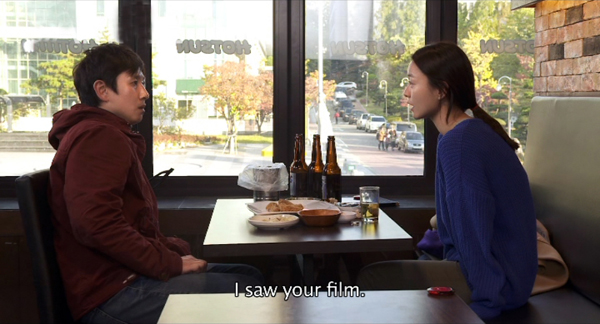
The definition of Sunhi is the entire plot of the film: Sunhi has returned to her old film-making school, to procure a recomendation letter from her old professor Donghyun. The film is really, in a smart way, about a young woman trying to get an older man to tell her who she is. Munsu and Jaehak are happy to offer their own opinions as well, Munsu made a film based on his earlier relationship with Sunhi, and Jaehak seems as smitten as the other guys. And the same words are repeated in the descriptions: clever, reserved, brave, artistic sense. What develops is a drunken dance around Sunhi, but as we only hear the same stock phrases about her, she in the end becomes an enigmatic lack in the center. The problem is, obviously, that she only meets lovers or potential lovers, and is only defined by men. She doesn't talk to any other women - except one who only talks about chicken - and she doesn't define who she is herself. As such, it becomes yet another of Hong's examinations of the lopsided ways men and women relate to each other, the same as the rest of his films I've seen, and yet completely new and fresh.


I really, really liked this film. It's funny, insightful, and formalistic in an unobtrusive way. There are beautiful recurring shots of the sun through the autumn leaves, and the use of color on the main characters are really well-done, as can hopefully be glanced from the images. It's another good Hong Sang-soo film, and I can't wait to see what he has for us next year.

Our Sunhi is shown again Tue 4/8, 19:00

Free Range (Veiko Õunpuu, Estonia, 2013)


So after Our Sunhi, there was nothing on the program which was particularly interesting to me. So I decided to go for the one from Estonia. I love Eastern European cinema, but I've never seen an Estonian film before, and the program described it as cinematic 'chillwave', so I didn't really know what to expect. Turned out that, yeah, chillwave seems like an apt description. Like chillwave uses old and wobbly sounds to create a nostalgic and childlike image of the past, so did this film use 16 mm, manufactured 'splices' of mismatched pictures when the reels should connect, and old sounds to create something seemingly older than it is. Instagram was another thing that came to mind, the whole thing looked like the director had spent way too much time on Instagram. Or, with it's preternaturally beautiful young people, old soundtrack filled with Scott Walker and Pearls Before Swine, and beach parties around campfires, it all looked a film by Assayas, like Cold Water or Something in the Air.


Thing is, though, Assayas' nostalgic hipster-films actually takes place in the past. This film decidedly takes place in the present - in one of the first scenes, the main characters is fired from his job as a film-critic after he writes an explicit-filled pan of The Tree of Life, ending with: 'Fagotty God, why did you kill my son?' (quoted from memory). There are two reasons why the atemporality sort of works, though. The obvious one is that the main character lives in the past. The whole film is about him being forced to face the world and his future, as he is fired and finds out his girlfriend is pregnant. He wanted to be an artist, be a boheme, now he has to support a family. The stuntedness of the filmic language mirrors the stuntedness of the main character. However, I find that pretty uninteresting and klichéd, no one needs another film about an emotionally immature manchild. But the second reason is, that it's actually quite interesting how the nostalgia is subverted by the film being from Eastern Europe. When Fred and his friends are dancing to The Smiths and Scott Walker, they are not just mourning a past, they are mourning a past that never were. Towards the end of the film he says: 'Before, everyone lied, and everyone knew it. It was liberating.' This line seems very different, coming from an Estonian, than it would coming from someone from France. The film being Estonian also helps with what I consider one of the greatest klichés of arthouse film-making: The use of Arvo Pärt on the soundtrack. I mean, it's still cheesy to put under a fumbling sex-scene, but still, the composer's Estonian, it's not their fault that the rest of the film-world has driven the use of his music into the ground. And the second time the piece is used, when Fred wanders through town, downtrodden and defeated, the music manages to create a layer of societal decay over the images.


Also, it is quite simply beautiful music.

But in the end, the film cannot escape it's klichés. The biggest problem is a few of the supporting charcters. The girlfriend's parents are so over the top that half of it would still be way too much. And the co-workers Fred meets are unbelievably awful as well. It pretty much sinks a boy-vs-world film, when nothing in the world is portrayed realistically. And as much as the use of 16 mm creates an unusual look, the cinematography is not really strong and personal enough to overcome these issues. Except at the end. My god, the end. Here, the director lets loose with an impressionistic sequence of stunning beauty. The use of the city, the night-lights, and the intercut dream-like images: it's great, and what the entire film should have been. Also, not coincidentally, it's put to modern music, the Salem remixes of I'll Fly Away and Forever Young. This is modern filmmaking, the present repurposing the past, investigating it and reimagining it. If the whole of the film had been this good, it would have been a great film.

It's called Witch-house. Their album King Night is good, although this is apparantly from a mixtape.

Free Range is shown again Tue 4/8, 16:30

Goltzius & the Pelican Company (Peter Greenaway, UK, 2012)


Back when I was a pretentious teenager taking film-classes in high school, Peter Greenaway seemed like my kind of director. Postmodern, rigidly ritualistic, with numbers, riddles and stylised compositions. It seemed smart, and smart was what art should be. Then I saw his films... The Cook, The Thief, His Wife and Her Lover seemed okay, but it didn't seem that smart or rigidly composed. It seemed like typical eighties cinema. Some years later I saw Drowning by Number, the one I had had the highest hopes for, and I was completely underwhelmed. The problem seemed to me, that Greenaway wanted to completely create his own kind of universe, but cinema isn't really that malleable a medium, or perhaps Greenaway just wasn't good enough to form it. It all looked like eighties England, slightely askew. Dull and boring. As his style fell out of vogue, as I decided his powers had probably diminished with age, and as his name seldom came up in the film-press, he became part of the pile of directors I label 'well, someday...'


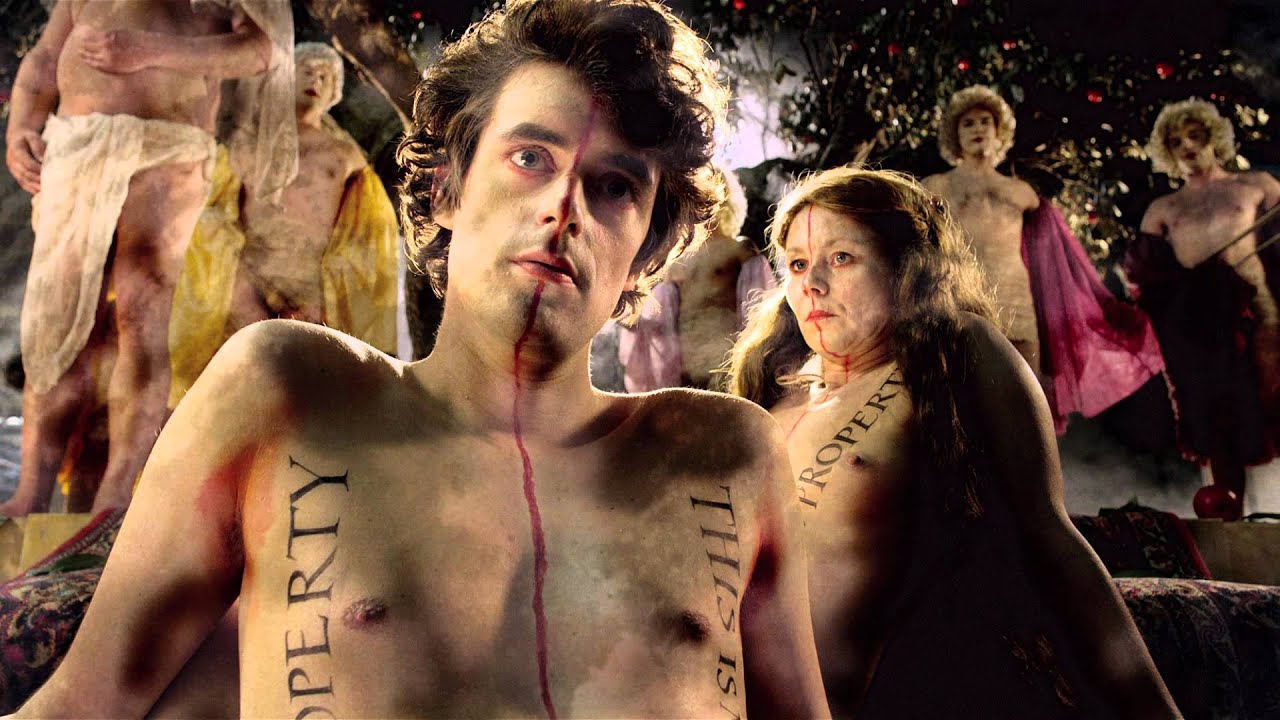
So colour me surprised: This was a quite good feature, with it's own sense of style that didn't seem like a deadend. It has me intrigued to finally check out the rest of the filmography. But I think digital cinema has been good to Greenaway, the image has become malleable enough. The film is filmed almost entirely in a gigantic factory hall, with ridiculously fake CGI to make it look at times like a dungeon or a meeting hall. Pictures in pictures abound, as an older Goltzius tells his tale of how he procured financing for a printing press from the Margrave of Alsace (F Murray Abraham, unhinged). Symmetrical compositions, mirrors, water and fire, words on screen, and a spinning wooden plate acting like a place for free debate and string concerts. It does not look like England. Effects even make it look at times like an old and parched painting, though the HD-photography remains crisp and hi-def. It is really fun to look at.


The plot is a mess, though. Based on the historical Hendrik Goltzius (1558-1617), who was famous for engraving erotically charged pictures, the story has him and his company acting out the six biblical stories they will later engrave, to amuse their potential benefactor. Stories like the invention of carnal sin, Lot and his daughters, the seduction of Joseph by Potiphar's wife, etc. It's kinda Porn by Numbers. These porn versions obviously stir religious debates at the famously liberal court, and it all becomes a mess of lust, torture, adultery, etc. Now, I've only seen two of Greenaway's films, but this seemed really familiar. The smart, religious men are dealt with in summerical fashion, Torture by Numbers. And the Margrave really seemed like the Thief, complete with sumptuous banquets and grotesqueries. It's all ridiculous, and we've all seen it before. Throw in some stupid accents and a copious amount of un-PC humour - as in keeping with the times, you see - and it does seem quite tired. Also, I don't think it says anything particularly thoughful on free speech, religion, sexual liberation, or anything. But still. The style is strong enough that I would recommend everyone to go see this stupid little curiosity. And I'm going to finally take that plunge through Greenaway's filmography, so that I'm qualified to say something more when his next film, on Hieronymus Bosch, comes out in 2016.

Goltzius and the Pelican Company is shown again Wed 4/9, 19:00 and Mon 4/14, 19:00.

Today I'm going to see Phillippe Garrel's Jealousy, and Sion Sono's Why Don't You Play in Hell. Hope to have something written up on them tonight. And if you made it this far: Thanks for reading, and have a splendid day!