Viser opslag med etiketten France. Vis alle opslag

fredag den 30. januar 2015

GIFF day 7: Clouds of Sils Maria, From What is Before

Clouds of Sils Maria (Olivier Assayas, France, 2014)


One of my favourite things about film is how well it works with acumulation. Seeing a director struggle with his favorite themes over and over throughout her films. Or discovering a new interesting voice, like Jessica Hausner and Eugene Green this festival, and diving into the rest of their work. A less than great film can still be of interest due to how it plays into a larger body of work (For example, Corneliu Porumboiu's film The Second Game is just the director and his dad discussing the art of refereeing over pictures of a boring football game from 1988, but since refereeing has been used by the director as a metaphor for how a justice system should work in general, the discussion took on a much larger significance for me). Literature also works a bit like that, of course, and my favourite collection of art will probably always be the writings of Thomas Pynchon, but then, you can't really read four-five books in a day, as would be the equivalent experience to the great festival I'm having at the moment.

So because of that joy, I tend to prioritize seeing films by directors I've already seen films from. And yet, while Assayas is one of the directors of this festival I've seen most films by, I originally hadn't planned to check this one out. Just as I didn't watch Something in the Air, his 2012 film on the aftermath of 68, when it played at CPH:PIX13. I've liked most of his films. But one way or another, they don't really acumulate well in my mind. He has his themes, but they are really diverse. Clouds of Sils Maria, about female actors in modern filmmaking, probably seems most like his Irma Vep from 1996, which also included examples of different kinds of filmmaking, as does this one, showing clips from an old silent film, and an invented superhero blockbuster. He's also concerned with a sense of the death of the modernist values from the sixties-seventies, and how they got replaced by something perhaps more phony, as was seen in Carlos and Something in the Air, and in this one is represented by the split between Juliette Binoche's middleaged actress Maria Enders, and Chloë Grace Muntz' young starlet Jo-Ann Ellis. They are going to star in a staged version of the play Maloja Snake, a play about a destructive lesbian relationship between a young, freespirited girl and an elder, buttoned up woman. Maria Enders played the young girl in her breakthrough performance, but now she gets the role of the elder woman.

That play is written by a playwright named Wilhelm Melchior, who commits suicide at the beginning of the film. He is supposedly based on Rainer Maria Fassbinder, who died in 82. Fassbinder would have been Melchior's age, had he lived, but there is still the sense to me that the film is depicting a kind of play that hasn't really been relevant for a much longer time than the film implies. Binoche also seems both a bit too young and a bit too old in a paradoxical way. I got the sense that she was supposed to have played the young actress as an 18-year old a bit more than 20 years ago, but Binoche is 50. On the other hand, I associate young Binoche not with serious modernist filmmaking, but the postmodernist 'cinema du look' like Leon Carax' Mauvais Sang. There is a sense of being out of time with this film, which might actually be the thing I have a hardest time with in Assayas. He seems out of time. Not as in 'timeless' but as in neither fish nor fowl. His handling of his themes seem dispassionate at times.

What I've just written seems way too auteurist, as if films should only be considered according to their directors. Of course, a 'body of work' could work for every kind of person involved in filmmaking, from a scriptwriter to a cinematographer. Most people judge films worthy of watching based more on actors. And in this film, the actresses might actually be the ones who bring more 'baggage' to the film, so to speak. Especially one actress. Most of the film actually focuses on Maria Enders and another young woman, her personal assistant Valentine, played by Kristen Stewart, who goes with her to Wilhelm Melchiors mountain home at Sils Maria, to rehearse the play. The clear subtext of the situation with the play is that Maria Enders has been replaced by a younger, more suitable actress. But with regards to the filmmaking situation, it's Kristen Stewart who has been replaced by Chloe Grace Muntz, as it's Stewart who has both had the sort of troubled tabloid existence and the same attempts at balancing franchise filmmaking with more personal works, that the young Jo-Ann Ellis shows in the film. I like this fact, since it brings a twist into what could be a boring 'generational' conflict between old and good and new and bad. But the film positions that the battle might be more in the women of every generation having to fight for the position as a 'timeless' actress such as Maria Enders. This changes a late scene, where a young filmmaker dispirits the antics of actresses of his own generation such as Ellis, and shows him more like a person without solidarity for his fellow youngsters.

From What is Before (Lav Diaz, Phillipines, 2014)


More acumulation: A film that is 5½ hours long. Perhaps it didn't need to be quite as long, there could probably be 30-45 minutes excised without causing any major damage to the fabric of the tale. But again: The cinema of director Lav Diaz becomes more interesting to me, the more of I see. I saw two of his films last year, his 4-hour 'breakthrough' Norte, the End of History, and Storm Children: Book One, a 2½ hour documentary on the aftermath of Typhoon Yolanda. He has made a bunch of films before that, most of which are very long and hard to come by, so it'll take a while before I get a grip on him, I think. Especially since he is currently in the midst of truly establishing himself in the pantheon of living directors, with Norte having premiered in Cannes, and From What is Before having won the Golden Leopard at Locarno. Also, the two films are very different, with Norte being plot-heavy, in colour, and with a very moving camera, and From What Is Before being black-and-white, more about mood than plot, and with a static camera that only rarely pans side to side. I wonder how his style was before, and how it will be hereafter. Probably, there will be another many-hour-long film next year to check out.


It is truly a privilege to spend so many hours keenly observing the problems of the Philipines. This film takes place in the early 70'ies, two segments taking place in 70 and 71, before the bulk of the film happening in 72. So many scenes in the first stretch of the film feature characters slowly moving towards something. It seems as if they are gathering together at the location for the film, though most of them have lived there for a young time. In 70, we watch as a procession brings sisters Itang and Joselina to a place where they act as healers, in a long interlude with music and dancing - already, this was where the first of the audience lost patience and left. In 71, Christian priest Father Guido has arrived, and is kindly but firmly correcting the way the sisters act and believe. Joselina was unwell from the beginning, but she succumbs more and more to madness and selfharm as the film progresses. There is also Sito, the elder rice-farmer who has taken in young boy Hakob, Tony, a winemaker, and Heding, a saleswoman with an annoying attitude, who spreads rumours and sticks her nose in everything. Then, in 72, the darkness comes. Cows are hacked to death. Huts are burned down. A man is found dead at a crossroads. And Philipino politics will also soon intrude in a big way.

5½ hours is a long time, but it does allow us to truly get to know the place of the film. The camera will hold steady and observe for a long time, as characters perhaps walks on a mountaintop, or perhaps works inside their homes. We get to know these hillsides, seashores, homes, fields and forrests, churches, schools, roads and rivers, from seemingly every angle. And there is definitely a sense of atmosphere. It is cloudy all the time, it rains a lot, and since the soundwork seems to be done really cheaply with microphones stuck on the actors, there is an almost constant roaring of wind on the soundtrack. Also, we get to know these characters through the way they talk, with people using words from Philipino, English and Spanish languages seemingly at random, but much accordingly to the status and education of each person. The rich characters in Norte did the same, so I think I'm learning something about society and language in the Phillipines.

The film is compared to Haneke's The White Ribbon in the programme, another black and white movie about a small society where political evil intrudes. But that comparison, while understandable, is a bit superficial, as there is a definite difference in theme in the two films. In The White Ribbon, evil comes from the characters themselves, we watch as the pathology that would lead to the Reich is first blossoming. In From What Is Before, the evil intrudes on a society from the outside (so a more fitting comparison might be with something like Cabaret). Not all of the characters are innocent, and there has seemingly always been an undercurrent of violence this place, but there is still a dichotomy between the mostly good poor rural people, and the mostly evil and callous government forces who intrude on them. Norte had quite the same, with the intellectual recreating the Crime from Crime and Punishment, and the poor man receiving the Punishment. This scheme might seem a bit simplistic, and I'm not entirely sure it needed 5½ hours to be put forth, much less so an assortment of films of that length. But the documentary Storm Children powerfully observed how neglegted the poor and dispossed were in the Philipinnes, even in the aftermath of a major catastrophe like a once-in-a-century Typhoon. That is so far what I like most in Diaz' cinema, and it is the reason that I'd rank the three films Storm Children > From What is Before > Norte. They work best when they are simply concerned with observing what the country has not wanted to observe. Oh, how they observe, for hours and hours and hours. I'll look forward to yet another dispatch in a years time or so.

søndag den 25. januar 2015

GIFF day 2: La Sapienza, Goodbye to Language, Daughter... Mother... Daughter...

La Sapienza (Eugène Green, France/Italy, 2014)

My plan this morning was to go and see Dominik Graf's three-hour Schiller-biopic, Beloved Sisters. But it turned out I misread the programme, and when I was ready to leave it had already been playing for an hour. I had a Plan B: Field of Dogs, according to the program a visionary retelling of Dante's Divine Comedy. But that one was sold out. So instead I went and saw this one, which played at the local business school, 100 m from where I was. There were a lot of tickets, and it was about architecture, which interests me. So that seemed a fine Plan C.

It was an amazing experience. The plot of the film is simple: A French architect named Alexandre travels to Rome with his wife to look at architecture by the great Borromini. On the way there, in Schwitzerland, they run into a young brother and sister. He wants to study architecture and she is sick. The rest of the film is the men looking at churches and the women talking. But the style... The style was like the rigorous modernist cinema of old, except in digital, and with a deadpan humour that never allowed things to get too serious. The actors walked around and declamated their lines like in the cinema of the great French filmmaker Robert Bresson. Many shots of only feet and hands of people also seemed Bressonesque. The rigourously composed symmetrical shots and long discussions with actors at times looking directly into the camera reminded me of the late-late-late period from 106-year-old-and-still-going filmmaker Manoel de Oliveira. With it's discussions of architecture and multilingual characters especially Oliveiras very great A Talking Picture (2003). And a large percentage of the images is just the camera looking at architecture, filming modern appartment buildings and factories from a distance, and contrasting it with loving closeups of the detailed, light-filled beauty of the old churches.


There is a tiny problem: The film depicts people fed up with functionalistic, modernist life and compares that to the baroque beauty found in Roman architecture, but the style of the film is kinda modernist and functionalistic as well. That is in and of itself not the biggest problem, and the film does critique it's own style as it goes along, slowly accumulating enough over-the-top characters, details and weird interludes, to carry on a sense of baroque-ness. And as the characters achieves the titular 'sapience' (which is a word for wisdom in some way, I don't really know) the style changes, becoming more rounded. But there was another big film recently about intellectuals looking for meaning amongst the old buildings of Rome: Paolo Sorrentino's The Great Beauty. And while La Sapienza works with the same outmoded, modernist form that he critiques, Sorrention's cinema seems to strive towards a new cinematic language, perhaps more fitting to the critique. The GIFF-programmers wittingly describe La Sapienza as a 'rectangle-drama', a great description of a certain type of cinema. In contrast, Sorrentino's film is all curves, broken lines, movements, fluidity. When Alexandre describes a facade by his beloved Borromini as being 'always in motion', his description sounds more like Sorrentino than the static shot we get from Green. And also, Sorrentino's film was one of the biggest arthouse successes in recent years, and even won a Foreign Language Oscar, one of the few times that prize has gone to a truly brilliant film. There is no way Eugene Green's film will get even close to that attention. So in a way, this whole film might be a bit... superfluous...

But on the other hand. I watched this film with many, many people in a big theater, and the people laughed, smiled, and had a good time. Two of the other three showings are already sold out. I was also surprised to find, that director Eugene Green is an old and experienced artist, having worked extensively in theater and only directed four theatrical features before, but those films premiering at Cannes and Locarno. It took no more than ten minutes before I mentally made a note of checking everything else I could find by this weird and idiosyncratic director. I had no idea what I was getting. I will perhaps never get the chance to watch this or the rest of the directors filmography again, at least not on the big screen. This was a unique experience, one I didn't anticipate at all. And surprises like this are the reason I love film festivals so very very much!

Goodbye to Language (Jean-Luc Godard, France, 2014)


Ah, Godard. Trying to handle a late-period Godard film after only one viewing is a foolish task. And this one was in 3D, so there were twice as many layers. I'm mainly confused, and grasping at straws, trying to connect as much of this montage of sounds, words, works cited and images into something adding up to something. I saw and wrote about his first 3D short Les Trois Dés-Astres last year at PIX, so I might begin there. That one depicted 3D as a disaster for cinema, yet another in a lineage of failures for the medium (ranging from the Holocaut to the domination of Hollywood, because those two things can obviously be compared). Perhaps Goodbye to Language is about saying goodbye to the old language of film? The screen flashes Ah, Dieux at times, and the final time I understood it to be a pun on Adieu, but perhaps also on Un, Deux (if you say it with an accent?) There are of course a bunch of clips from old films, but not really anyone I recognized. And the main story is something about a woman and a man, and another woman and a man, and the women are naked a lot of the time, and the men are disparaging and don't really think much of the women. 'Women can't create evil', they say (or something to that effect). Then there's a scene with Mary Shelley, writing Frankenstein, reminding us that a woman wrote perhaps the first piece of horror-fiction. So there is that. I don't know, I don't at all get what the plot was about. There was a great dog named Roxy, though, I liked the dog!

So much stuff on language. Over the end credits, a couple is 'speaking' in dog-language with a baby. There are a bunch of philosophical quotes on language. The two parts of the film are called 'Nature' and 'Metaphor', perhaps suggesting that the second part turns the first part into an understandable language? Except the two parts apparantly mirror each other quite a lot, and none of them are easy to figure out. There's a discussion of language and atrocity, one of the women tells a story of an SS officer yelling at a kid at the entrance to the gas chamber, that 'There is no why'. In the beginning of the film, a professor comments on the subtitle of Solshenitsyn's The Gulag Archipelago: A Literary Investigation. What lies beyond language is atrocity. Horror. But also childhood, and nature, shown on screen through the many many scenes featuring the dog Roxy. There is also a scene where a painter tries to explain how to show depth through water colour, mirroring the way Godard himself tries to figure out the grammar of this weird new technology.

And Godard struggles with turning 3D into a language. As with many of his more recent films, he uses low-grade video and digital, and those blurry images create sheets of colour when the image is given depth. The film checks out the ticks of this new medium, for instance filming out of the windshield of a car on a rainy night, which creates floating specks of neon-light where the water-drops mirror streetlight. There are a couple of times where the filmmakers must have turned one of the two cameras needed to film in 3D to the side, making the image simply split, and forcing me to blink each eye to watch two films at once, until the camera turns back and the image connects again. There are other sequences where the effect simply doesn't work for me, where the foreground is too far away from the background, and all of a sudden what was a couple tablelegs turns into a ghostly seethrough presence. And at times there are only abstract dots and lines onscreen. Basic filmic grammar is also broken, as the camera turns upside down, the shadow of the cameraman is seen on the ground, the plot is achronological, etc.

Haven't got a clue. I read the book Jean-Luc Godard: Cinema Historian by Michael Witt recently, and that book noted how perhaps Godard should be thought of as a mixed-media artist than a filmmaker, since for the longest time he has been working with collages of existing media, as well as video, installation, text, sound, etc. This film definitely blurs the limits of the new 3D medium, and is to a large extent about those limits. That is what I got from it on the first try. That, and an ever so slight headache.

Daughter... Mother... Daughter... (Panahbarkhoda Rezaee, Iran, 2014)


When watching a bunch of films over a short period, there will probably always be some that don't get full attention. I was tired, and the Godard mindfuck kept swirling round my brain. Also, this was a sloooow film, without dialogue, but with a beautiful soundtrack of music, nature sounds, and poetic narration in Iranian. Always the sounds of birds cheeping, water running, and a train passing by from time to time. It was hypnotic in a way. It put the person next to me to sleep several times throughout the seventy minutes.

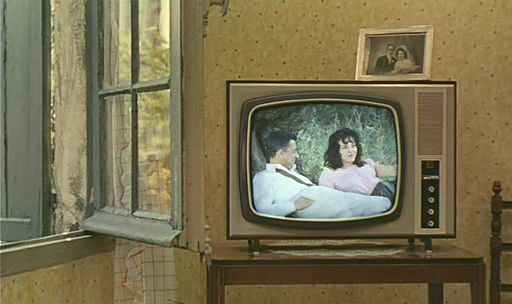
It was a film on boredom, on being trapped in a life without any hope for a future. Grandmother spins yarn all the time, spinning spinning spinning. Mother walks around the wheat-fields, longing for her husband who took the train to get away. Daugher is sick and struggling to breathe, lying in bed all day, listening to the sounds of nature, dreaming of seeing the sky. There is a son, but he also leaves early on. The women are stuck - as many women probably are in Iran. Most of the film is longheld shots of each woman standing or sitting or laying alone, and then the narrator says something about them. We never hear any names. At times the women watch tv together, and we get old black and white clips, or perhaps it's new clips made to look old, I don't know. Death is never far from the family, and at times the women look ghostly covered as they are completely in black, walking the barren landscape. A shot of light streaming over the mountains is amazing, perhaps showing grace. There is only a single shot where the women interact, where the mother strokes the hair of the daughter, and then they cry. It's very cathartic, after having watched so much film without anybody showing any emotion at all.

This was artfilm. Very lowbudget I think. High res digital pictures, no cameramovements at all, all sound added afterwards, only four people in the film. I love seeing such a small and personal projects, and I liked listening to the Iranian poesy. Had it been much longer than 70 minutes, it would probably have been too much, though... Also, googling the director, his name is apparantly spelled a bunch of different ways in the west, and his other features have names like A Cradle for Mother and even Daugher... Father... Daughter... Now I'm intrigued, and would like to see if his films might make more sense through accumulation.

Note on language, apropos Godard: I like Iranian cinema, I've seen quite a lot of Iranian films, which means I've seen a bunch of Iranian writing rolling over screen at the beginning and end of a film, and it has always seemed like curves and not like words. But all of a sudden, tonight, in the blink of an eye, I could make out letters. Not that I understood anything, it just looked like a language all of sudden. Weird how that works.

Also Seen:
Another film from competion, Susanna Lenken's debut feature My Skinny Sister, which I will write about elsewhere. A fine debut, a great depiction of two young sisters.

fredag den 18. april 2014

CPHPIX day 11+12: 3x3D, Like Father Like Son, Young & Beautiful, The Congress

So things are pretty busy now. I've also moved. And so, I've combined days 11 and 12 into one post. I only saw four films in those two days - and rewatched one - so it'll fit.

3x3D (Peter Greenaway, Edgar Pêra, Jean-Luc Godard, Portugal, 2013)


Omnibus films are weird. There seems to be made a surprising amount of them, and they aren't really shown that much. This collection was funded by the Portuguese city of Guimarães, European Cultural Capital of 2012, and is apparantly the second such project, after 2012's Centro Histórico with short films by Pedro Costa, Manoel de Oliveira, Victor Erice and Aki Kaurismäki. I think this one has had a higher profile, wonder if it's due to the inclusion of Godard or 3D...

The first segment was Peter Greenaway's Just in Time. It seems like a tourist advertising for the city of Guimarães, cirkling around a castle in the center, while figures from Portuguese history stands around and their is blocks of text everywhere. I had to look for reviews to get the segment-titles, and was dissapointed to find out that almost every reviewer pointed out what I thought was a clever and precise description: This was like a cross between Sokurov's Russian Ark and an old CD-ROM from the mid-nineties. It's like if Russian Ark wasn't a filmic achievement, and didn't really have a point of view, nor, frankly, any deep interest, in the history it depicts. It's all just facts and figures. I still kinda liked it. For one, it was quite like the other Greenaway I saw this year, Goltzius and the Pelican Company. European history, pictures in pictures, text and action on different planes in the picture. The fact that it mostly looked like a tester for a new kind of Image Software didn't bother me as much when I saw it as a test-run for a development in his filmic language. It doesn't make it good, but perhaps he learned some stuff he can use in a real film? The other thing is that I just find Portuguese history fascinating. It might be the country in Europe I know least about. It all seems like a weird mirror-house version of what I know of western-European history. I love stuff like de Oliveira's historic films and Raul Ruiz' very great Mysteries of Lisbon. This worked as an exhibition. It wasn't a good film, though.

Then came Edgar Pêra's Cine-sapiens. Apparantly, in Cannes this was the third segment, and a big part of the crowd walked out. At this screening, it had switched places with the Godard segment. Which was smart, save the best for last. I don't know who Edgar Pêra is, and I don't know if I care to find out. This was a rumination on the cinema of spectacle, with reenactments of Al Jolson in the Jazz Singer, bringing sound to the masses for the first time, scenes from Wizard of Oz, and mixed with a general b-movie asthetic. All held in a movietheater filled with spectators and set to overenounciated voiceover. The 3D effects were so extreme and in-your-face that it made my head hurt, and it was all just a cacophany of noise and spectacle. I understand why people got up and left, it was a bit headache-inducing. It's not as bad as people made it out to be. It's trash, but it's about trash. It's the one segment I would never want to see again, but I wasn't about to leave.

And then there is Godard. Good ol' Godard. Getting money from Guimarães to make a 3D film, what does he do? He makes Les Trois Dés-Astres, yet another of those cine-essays he has made since Histoire(s) du Cinema, begun in the late eighties. Mainly about the same as the rest of his essays, and 90% on anything else than 3D. Whenever he circles back to 3D it's on the format as a pointless gimmick, or as a disaster, as the title alludes to. It pretentious, it's way too much to take in in a single viewing. But I love this whole project. I love re-watching a segment and getting more of it as I work my way through film-history. Some of the juxtapositions are really touching. It might just be a guy in a dress dancing in slow-motion, cutting to a man shooting a mirror, but knowing it's the oprichnik scene from Eisenstein's Ivan the Terrible, and the mirror-house scene from Welles' Lady of Shanghai, two troubled productions, which the directors lost to people above them on the ladder, it becomes a statement on the films lost to the pressures of the surrounding world. And then the swirling drag-oprichnik becomes even more terrifying, and the man shooting at mirrors becomes even more sad. It connects frames and movements from film-history into this kaleidoscopic and fragmented tale, combined with citations from general culture. Godard is omnivorous though, and I didn't get that much of it. He cuts segments from 3D-films in there, modern rubbish like Final Destination and The Three Musketeers - again something I found out about through reviews, did not recognize any of this, still don't really know what was what. I want to rewatch this again, several times. But I don't want to have to sit through the other two segments that many times... 

This was interesting to see, but it's a film that is really annoying in the way it has to be seen as a whole, in a 3D-cinema, when really there is only one part that was great, and that part would work better on a tv-screen, with the ability to rewind and rewatch.

Like Father, Like Son (Hirokazu Kore-eda, Japan, 2013)


This was the cutest film I saw all festival. It had small boys with wide-open eyes, and parents learning to love them. It had indoor camping, rolling around in play-castles, fourhanded piano-playing and a father using his electric guitar as an improvised gun. It was funny, sweet, poignant, heart-warming. In other words: Not my kind of thing.

The plot is as follows: Two families are told that their six-year-old boys were switched at birth. Should they switch? What makes a son a son and a father a father, blood or time spent together? One family is rich, the father is busy, the boy is a single child and their home looks like a hotel room. The other family is poor, disorganized, always late, but warm and loving and even bathes together. The two families are rendered with telling detalis, and only slightly stereotyped. The film is exquisitely photographed, with a slowly moving camera and effective cuts, such as the cut from Keita trying to play the simple piano-song he's been struggling to learn, to the accomplished playing of a prodigy, putting in stark relief his lack of talent. Kore-eda catches beautiful sunsets, as well as the landscape between the two families on their constant travels back and forth. It's a total crowd-pleaser, extremely well-made. But I don't think it adds up to much.

I don't mean to sound like a grouch - although I probably am a grouch. It's not that I don't like the director, I thought his Still Walking was a much more succesful attempt at this kind of family drama. But here, he is dealing with a very painful situation, constantly described by the characters as being as such, with a lot of dilemmas. And at the start, the characters are discussing these dilemmas: What about the social divide between the two families, which boy should get the support-structure of the rich family? People explain that they need to make a descision quickly since the first year of school is starting - and the rich family has gotten their son a space in a very good school, putting him on the track to a rich career. And when a film raises all these questions, then I get annoyed when it then decides to shy away from them. We never hear about social status or education or anything. The second half of the film becomes only about love and parenthood and spending time together. Which is all well and good, but it's also the easy way out. And while you can say that in a situation like this there would be no easy answers, I think we can also say that some things should be no-brainers, and the film tries to get it's happy ending through reaching one of those answers where I thought: Well, duh... And then it concludes on such a glouriously beautiful camera-movement, which will take your breath away. This is the film in a nutshell. Way too safe, but also made by someone who is extremely good at what he does.

As the last film of the day, I rewatched Stray Dogs. Still a massive masterpiece. Read more about it here.

Young & Beautiful (Francois Ozon, France, 2013)


The most dangerous animal in the world is the 17-year old girl. Yeah, I know what you're saying: What about the tiger or the tiger-shark? But they don't prowl among us. Ok, the malaria-mosquito, but the most dangerous animal in the northern hemisphere is obviously the 17-year old girl. Sometimes, they even go undercover, claiming to be 18 or even 19, and then they get you, with their... And you can't go to a summer festival without them all running around all happy and drunk, what with their hotpants and their tanktops and their....

Is their anything sadder in the world than elder men fretting about the sexuality of 17-year old girls? And yet, last year at Cannes, two films in competition, Blue is the Warmest Colour (Abdellatif Kechiche, 53) and Young & Beautiful (Francois Ozon, 46) on this endlessly fascinating topic for middleaged men. I liked Blue is the Warmest Colour, though wouldn't have given it the Palm. But what this one was doing at Cannes is baffling to me. Boring filmic language, absolutely nothing out of the ordinary. Play's it safe every step of the way, except the young girl is quite naked, and really, haven't we progressed beyond the point where that is newsworthy? I've seen so many better films from that years Un Certain Regard section, more daring, more new, quite simply better. Seeing something like this, it becomes clear that Cannes should cut the crap and just make a quota for female-directed films, since 1) It's simply not true that there aren't better female-directed films than this and 2) This only makes it into competition if someone somewhere felt that the line-up needed a bit more French middlebrow pap. As a film, there is nothing to it. As a look into how we regard young female sexuality, there are some fun points.

Young Isabelle loses her virginity on a summer vacation, and then she decides to prostitute herself. We never really get an answer why. I'm pretty sure a female director could have said something more interesting about Isabelle. What Ozon knows about - and, laudably, where he puts a lot of focus - is the way the surrounding world sees a young girl trying to figure out her sexuality. The very first scenes follows Isabelle though a pair of glasses as she sunbathes topless on a beach. It's her younger brother, who is also beginning to be interested in girls. Her step-dad can't stop walking in on her naked - though she does so with him as well, it's more about a lack of privacy, than anything inapropriate on his part. The most fascinating part of the film for me was what happened after the news of her prostituting herself spreads out. All of a sudden, every character in the film acts differently. The news that she might be available for sex with elder men means that even her own mother is unsure of leaving her alone with her husband. A 17-year old girl is a powerful thing. During the last stretch of the film, Isabelle takes a lover her own age, and a few romantic montages made me fearful that this would be the most bullshit ending this festival. But it turns out that he is as dull and useless as 17-year old boys always are. I won't spoil the actual ending - or the surprising earlier scene it's connected to - but suffice to say, that it's better than her becoming domesticated by a 'normal' relationship would have been. I actually liked it. Didn't make me see what on earth it was doing at in competition at Cannes, but at least it could have been worse...

The Congress (Ari Folman, Israel, 2013)


... it could have been The Congress. Yup, on the 12th day, I ran into a film that was complete and utter crap, something that made me embarrassed for everyone involved, including us in the audience. Really, this was the one and only time a film this year has kinda made me angry. It's not that it's dull, though it is. Nor is it that it's a bunch of pretentious bollocks, though it is. No, what kills this film stone-dead, and makes it one of the most embarrasing ones I've seen in a looong time, is the insanely high regard the film has for itself.

This is the type of film, where we see a young boy flying a kite, and it's ok and fine, but then we later hear the boy explain how incredibly beautiful the earlier scene was. This is the type of film, where a character describes the films visual style as 'a genius designer on bad acid'. This is the type of film, where a character tells another character a boring and overwritten story designed to make her laugh and cry, and she obviously reacts exactly as planned, while strings are rising to a crescendo. This is the type of film that has the main character speak 'truth to power', in an incredibly stupid set-up, and her bullshit platitudes are treated as so dangerous and hard-hitting that the powers angrily get her out of the way. This was bullshit. Just an embarassment.

I kinda liked Ari Folman's earlier film, Waltz With Bashir. It was weirdly paced, and felt almost lethargic at times, but that seemed fair, as it delved into war atrocities and PTSD. But it just might be, that Folman is an incredibly bad director. The first part of this film is live-action, and it's so dreadfully dull. Everyone talks so slowly, and bites every line over in half. And the pictures don't have a third of the beauty to make the boring story - on the actress Robin Wright getting the offer to 'scan' herself, to let the studious use her likeness in future films - work. And then it's twenty years later, and the film becomes animated, and we are at the Futurist Congress, and the studios are selling drugs to make people live in a cartoon world, and at this point it's all very hard to work out, and there is no point in doing so, because you hit the wall of cod bullshit so early and so often. The whole film is a missive against the entertainments industry, offering only escapism and doing nothing to actually help the world. And the failure of the film is to only offer itself as an alternative, and making that seem a hundred times worse. This is useless.

torsdag den 10. april 2014

CPHPIX day 7: Small Homeland, The Quiet Roar, Life of Riley, Story of My Death

Small Homeland (Alessandro Rossetto, Italy, 2013)

Notice the music from 45 sec onwards. It's used very well in the film.

Another film from the New Talent Grand Prix. This one started out a bit violently, with a man and a young woman playing what seems to be half a sex game, half something more unnerving. The young woman takes some money and runs away, we could be in some sort of thriller but then: Lethargy. The title sequence combines aerial shots of the northern Italian landscape with a song for male chorus, and a shot of a cow relieving itself. We are in Veneto, Northern Italy, close to Venice. Luisa and Renata are two young girls working in a modern hotel. Luisa lives with her parents and has a boyfriend, Bilal, from Albania. Renata is more alone. She is the one from the opening scene, and seems to be prostituting herself at times. Luisa helps create a damning tape, in an almost Lynchian scene. There are aspects of plot in the first part of the film.

But boy, this film goes meandering. I liked that. To begin with, the plot is just subservient to scenes of everyday life: The two girls shop for clothes, Luisa's father goes to a political meeting with a group seeking indepence for the Veneto region. Most, but not all, of these scenes are very beautifully filmed, but still feel real. The nighttime photography, of which there is a lot, is amazing. There is a sense of a dead-end region, of recession and small hopes for the future. Luisa's father is mad at immigrants. And then, a long interlude finds Luisa and Bilal travelling to Venice for a few days to help Bilal's cousin escape immigration police. This is a long stretch of film, with only two of the characters of the film, which seemingly has nothing to do with the main story. But it has some of the best characterwork, and another beautiful night-time scene with dancing at a small-town festival. Line-dancing has to be the dumbest thing ever.


And then. We're back. What little plot was brought into place like, an hour before, is suddenly brought into play again. And the film, slowly and methodically, becomes the semi-high-stakes drama the beginning threatened it would be. It's a brilliant construction, and the slowness pays off in the final moment. Boy, this film nails it's final moments. It could have had the feel of a Greek tragedy, or of Romeo and Juliet. The klichéd version. Instead, it brings us to exactly the point where we cannot but accept the brokenness of the people in the region. And then it stops. Bravo!

The Quiet Roar (Henrik Hellström, Sweden, 2014)


Looking at Scandinavian cinema, you would probably be surprised to learn that it's a region with mountains. Swedish cinema is famous for Bergman's Farö-films, Lukas Moodyson's small towns, and cities like Göteborg, Stockholm or Wallander's Ystad. Fjords, perfect for nude swimming. The best Scandinavian mountain-film I've seen in recent years was the Norwegian film The Troll Hunters. That one remembered that parts of Scandinavia is still very much wilderness. Henrik Hellström's film is first and foremost valuable as the best mountain film anyone's made in ages.

The plot is a bit silly and pretentious: An old woman named Marianne is terminally ill, and to take her mind off things she takes a drug, which causes her to flash back to her youth and time spent in the mountains of Norway. That's it. It's all about the look. Oh, those mountains. Caught in crisp hi-def digital, it's sublime, rugged cliffs meeting gray and threatening clouds. And in the distance, a glacier. Streaks of ice. The modern wooden cabin with panoramic glass windows. This is worth the price of admission.


Marianne was depressed. She felt so sad, but was never able to tell. Her marriage fell apart, and she ended up not seeing her kids. The mood of the film is dark and heavy, and the dialogue, between young Marianne, old Marianne, and her husband, is a bit writerly and unnatural. Also, some might be put off by the pretentious-ness. I was captivated, but I did notice in retrospect that an insane part of the film was in slow-motion... Make of that what you want. It's a simple film, which simply manages to use a landscape we don't see enough of artistically. As such, it's a reminder of how rugged Scandinavia can actually be. And as a Scandinavian, I love that. So many boring small towns and middle class problems. God, it's good to see something sublime every now and then.

Life of Riley (Alain Resnais, France, 2014)


Alain Resnais is the Maestro'est of the Maestro's on the program. By far. His career stretches back to short documentaries in the fourties, one of which, on Van Gogh, won an Oscar in 1950. His trifecta of early masterpieces, Hiroshima Mon Amour, Last Year at Marienbad and Muriel, will keep him at a central place in the film-history books for all time. And his career after that, though less acclaimed, is filled with different styles, different experiments, different kinds of film. This year at Berlin, three weeks before his death at the age of 91, Life of Riley won the Alfred Bauer Award for 'opening new perspectives on cinematic art.' That is pretty well done. Unfortunately, the film doesn't really deserve that award.

A lot of later Resnais was inspired by theater, and Life of Riley belongs to a subset of four films, adapted from the British playwright Alan Aycbourn, along with Private Fears in Public Places and the diptych Smoking/Non-Smoking. Of these films I've only seen Smoking, but my guess is that the jury hasn't done much better. Because Life of Riley is pretty much like Smoking. We're talking a stylized, theatrical version of cinema, with typical Britishes humor and a story of people in small towns dreaming of getting somewhere else. While Smoking used model landscapes in the background, in Life of Riley the backgrounds are painted cloth. Nearly every scene in both films takes place in gardens, and there's the same sort of painted establishing shots, and written explanations on the development of time. It looks like a development of an earlier theme not a 'new perspective'. Nothing neccessarily wrong with that, though.

The plot is simple: Three couples react to the news, that school-teacher George Riley is terminally ill with cancer. It riles up the past, makes them reconsider the present and the future. Riley is never seen. Actually, except for the last scene of the film, only six actors are in the film, though they are constantly phoning or shouting at people outside of the frame. It's all playfully irreverent and amusing, but I still feel like there's something I don't get. I don't get the fetishisation of Northern England, which is really what one has to call it. Maps, roads, small houses, cottages. I don't get what Resnais sees in it, but he seems obsessed. I don't get why Resnais, this grand master of cinema, who worked with Duras and Robbe-Grillet in the early days of his carreer, has made four Aycbourn features, and why he was apparantly preparing a fifth when he died. It's fine, but...

It's quite fun looking at it in relation with the rest of his filmography, though. People might see the film as obsessed with death - and the final frame of the film seems very grim in retrospect - but it's not something new. His first films were obsessed with trauma from the unacknowledged dead, of Auschwitz, Hiroshima, Nevers, Algeria. If anything, he became more okay with death as he came closer to it. In the earlier features, the trauma of dead people are holding people down, it's what they have to escape. In this film, the spectre of death opens up the structures in the group. It riles up the past, opens perspectives for the future. The future lacune where Riley is now in the present becomes an escape route through which the characters seek to rearrange their lives. It's almost like a liberation.

Overwhelmed with sadness over the news of Riley's illness, one of the characters says: It is always those full of life who die young. The people who get old are boring and dull (quoted from memory) In Resnais' case, that is quite obviously wrong. This is a film full of life, in bright and glorious colours, with little stylistic flourishes like a series of monologues delivered in close-up against a white screen with black scratches. It is really strange comparing this film to the stark black-and-white of Hiroshima Mon Amour, made 55 years ago. Life of Riley is a lark, a very minor movie. I can't find anything in this film I haven't seen before in Resnais. Still, a pretty fun way to go out. RIP.

Story of My Death (Albert Serra, Spain, 2013)

Boy, this was boring. The plot is Casanova vs Dracula, how boring can it be? You'd be surprised. 148 min with almost nothing happening, people talking, eating, sitting around. Grainy pictures, lit by candlelight.  People were falling asleep in the theatre. This is probably the film I've seen so far, which is most an aquired taste. If you've read my other writeups of this festival, you might think that it sounds like my kind of film. And yeah, you'd be right.

More than most trailers, this captures the essence of the film quite well.

This is not a film to be understood, this is a film to be felt. The mood is so sad. Casanova spends the first part of the film talking about his sense of a coming revolution, it is quite clear that he has become old and a has-been. But he can't stop living, eating and laughing at everything. There is litterally a long scene of him laughing while shitting. It is a sad laugh, though, one I can't get out of my head. The first long stretch takes place at Casanova's castle, until we move into the country, where Casanova and his servant Pompeu settles down at a farmer's house. This is where they come across an old, bearded man, with intense eyes, who's mainly around at night. And some bored girls, who's drawn to all the visitors.

I was constantly drifting throughout this film, I didn't get that much of what they were talking about. But I don't think it's important. What's important is the sense of sadness and I did feel that. Such overwhelming sadness. The candlelit pictures are incredible, looking a bit like Kubrick's Barry Lyndon. Casanova's laughter is so striking, and so sad. He is an old fool, if he just decided to retire and be old, he would be okay. But he can't stop living, lusting, etc. And it makes him seem so sad, even while fornicating with beautiful young women. And then there's Dracula. Who can't stop killing. The two characters really seem like opposites, life vs death.

Nearly nothing happens, and I'll bet I've forgotten quite a lot of scenes. But when something all of a sudden happened, 90 minutes into the runtime, it gave me a shock like I've seldom gotten from cinema. Because I was in a state of half-sleep. And the dark and disturbing parts of the second half hit that much harder in this kind of cinema. I don't know if this is a 'good film'. All I know is that thinking back on the experience, I get a churning feeling in my stomach. I find it disturbing how much certain aspects of this film is seared into my mind. And my gut. This is not for anyone, but if you're in the right mood, and willing to lower your defences, it cuts like a knife.

tirsdag den 8. april 2014

CPHPIX day 5: A Touch of Sin, Bastards, Real

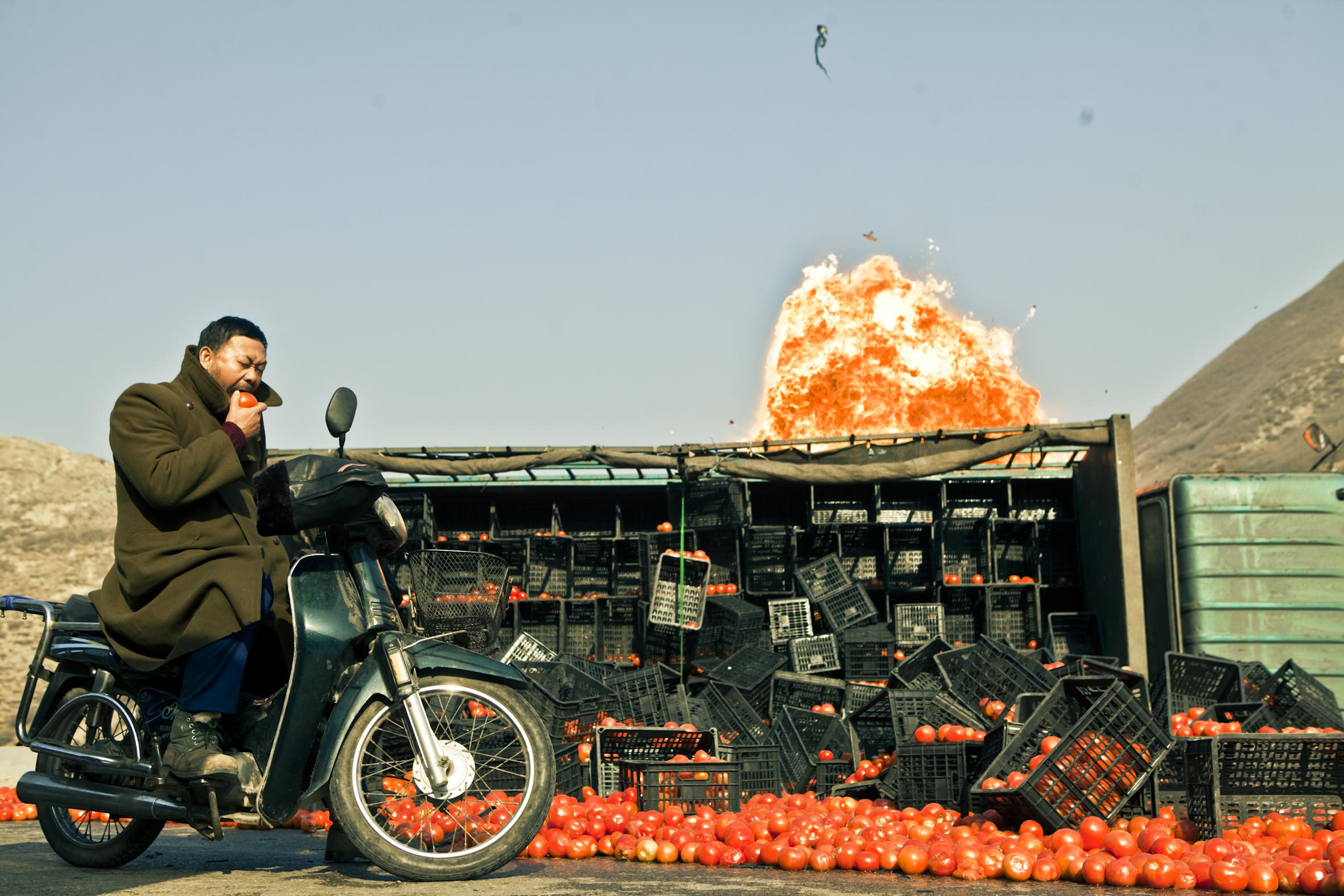
A Touch of Sin (Jia Zhangke, China, 2013)


There is a fun dynamic in the arthouse world in Denmark. A film premieres at Cannes, gets rave reviewes, wins an award. Then it takes 11 months for it to hit CPHPIX. A very long time to prepare, read reviews, analyses, watch the director's earlier filmography (though I failed to do so with Jia). Get hyped. In the end, it might be hard for the film to really hit you, and exceed your expectations. Stray Dogs managed to do so. A Touch of Sin is quite clearly the second-best film I've seen this year, but it didn't really rise above my expectations.


Four stories with violent conclusions, taken from contemporary China. Slightly intertwined. All taken from real news-stories, though they were mainly big on China's microblogging site Weibo, the unofficial way to get news. Using genretrappings to create a picture of a deceased society. In many ways, this is the perfect version of what Manuscript's Don't Burn tried to do. The cinematography is stunning, with the mobile but steady camera constantly catching amazing picture after amazing picture. It's never boring. And the film feels open, as if it has more on it's mind than just the four tragic stories it tells.

Actually, what most fascinates me right now is the insane amount of stories being told or alluded to in this film. There are Weibo-stories of corruption being discussed. There is a trainwreck catastrophy occuring all of a sudden. Tv-screens show apropiate movies - John Woo and Tsui Hark, apparantly, famous Hong Kong action directors. The characters watch snippets of Chinese Opera, based on the old Chinese novel The Water Margin, about noble characters forced into being violent outlaws. The English name of the film is an allusion to the old wuxia film A Touch of Zen, a masterpiece in it's own right. The scenography of the film manages to tell a bunch of stories as well: An oppulent car in a desolate village tells a story of inequality and corruption, grand hills of coal tells of ecological disruption.


It all adds up to a compendium of modern myths. This is a brilliant way to counter censorship: An explosion of counter-stories, showing not just a multitude of unofficial stories, but also the inability to keep those stories hidden. An overwhelming portrait of a dysfunctional country, this film should be seen by everyone interested in the world as it is today. The shut-down coal-mines, the migrant-workers, the saunas, the high-speed trains, the unsafe sweatshops creating goods for export. This film does to China what The Great Beauty did to Italy, though many times more effectively - and I liked The Great Beauty. It's a film filled with great scenes and details, like a character using three cigarettes to pray to the ghosts of the people he's killed, or a line of girls marching in a display of Red Army kitch for Cantonese visitors. The fact that it was ever slated for a mainland Chinese release is amazing, though the regime has delayed it infinitely. But it will hopefully be downloaded illegally, and discussed on Weibo. It is a great film, and very important. But I knew that, most of the people reading this probably also already knows this. And it's not more than that, I think.

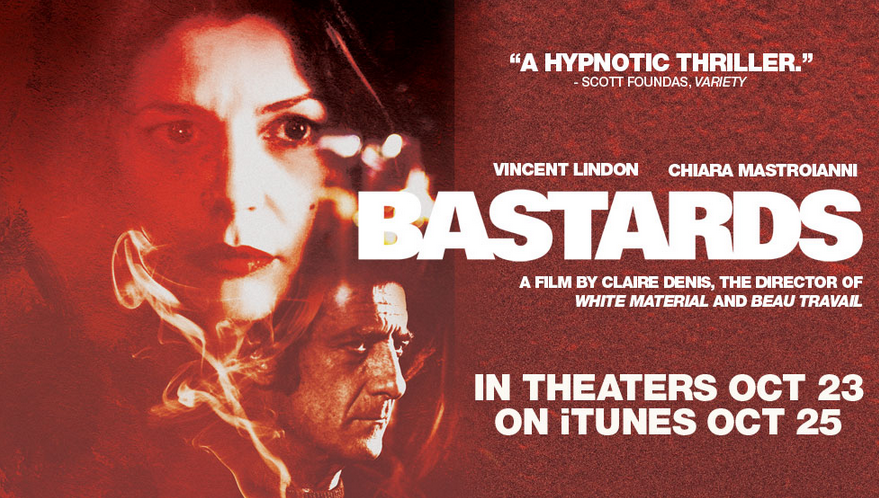
Bastards (Claire Denis, France, 2013)


I've seen this film before, on a VOD-stream. But boy did I miss a lot. One has to be careful with a Denis-film, I missed a neon-sign, and thereby a huge chunk of the plot. A woman walks toward a Tabac-sign, then it shuts down, signalling that the shop has closed. The man living in the appartment above grabs some packs of cigarettes, wraps them in his shirt, and throws them down on the street. That shirt becomes the facillitator of their flirt, and without understanding why he threw it down, it all just seemed very weird.

I like the way details add up in this kind of Denis. Shots of stuff, of faces, of bodies. And then we have to piece their meaning together. 35 Shots of Rhum did it with a story of a makeshift family of immigrants, whose relations only gradually came clear to the audience. Bastards does the same thing with a Lynchian mystery. Which does make it less interesting to me. A mystery-like style is more innovative for a family drama than for a mystery. Also, the pictures are slightly murky, and the dream-like interludes make the plot hard to follow: After the suicide of his brother-in-law and the hospitalization of his niece, Marco returns home and moves into the flat above the man he decides is responsible: The wealthy banker Laporte. Marco begins an affair with Laporte's young wife, which is depicted tenderly. But the investigation into Laporte remain unfulfilling.


A thing I noted: The title of the film is in plural (Les Salauds in French instead of Le Salaud. The true English translation would be The Bastards) So when Marco claims on Laporte: It is He who is the Bastard. He is wrong. At other times he seems to recognize this, he claims to have been happy he's divorced, so that his daughters won't be 'infected' by what was wrong with his sisters family. Notably, that infection would have to run through himself. I've seen commenters talking about this as a film attacking the wealthy privilege of Laporte, but I don't see it. I see it more as a feminist tale. A short clip of a naked woman lying on the street in Paris seems to bear this out. In this way, Marco becomes one of the Bastards as well: He continues to want to dominate in his affair and tells her what to think and do, and never listens to what she says. He is using her to get at Laporte, and Laporte is actually quite right when he takes his young son away from the influence of a man he decides is dangerous. In the end, people will die, tough secrets will come to the surface, and a woman will make a choice and take action. And the young son will probably be traumatized.

I think Denis belongs in any discussion of the best directors working today. Beau Travail is a massive masterpiece. Friday Night is slight, but creates a fantastic world for it's characters. 35 Shots of Rhum and White Material are great as well. This one is lesser. The filmmaking is exquisite, though murky and hard to grasp. But the themes don't really add up, I don't think. It becomes slightly facile.

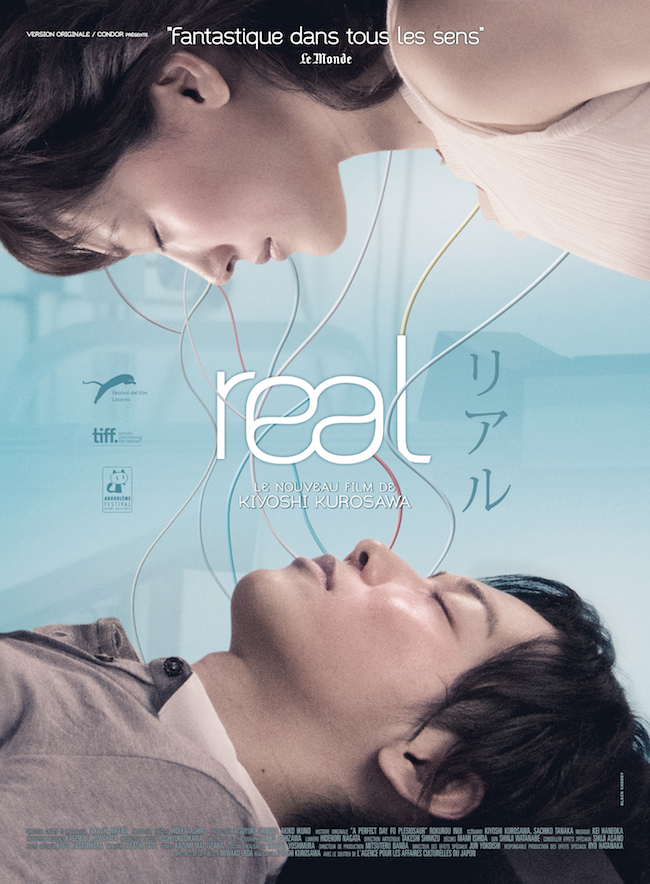
Real (Kiyoshi Kurosawa, Japan, 2013)


Kiyoshi Kurosawa is really productive these years. Last year I saw his Penance at PIX, a 2012 tv-series turned into 4-hour film. And after Real, he managed to get yet another film into theaters in 2013, which we might get to see in 2015? And this is coming after him not having made a feature since Tokyo Sonata in 2008. I kinda liked Penance, though it had it's flaws. It was uneven visually and overlong and -plotted, but I just decided that was probably due to it being a tv-series, and focused on the highpoints and it's thematic richness. But Real is a feature film, and it has all the same problems. Apparantly, this might be a new 'style', and if so, them I'm probably not going to prioritize catching the next thing he does.

Kiyoshi Kurosawa got famous for doing J-horror to begin with, and though this isn't a horror-film, his chops are in great use. The plot revolves around a machine allowing people to do something called 'Sensing', entering the mind of a comatose patient, and trying to convince them to wake up. The young man Koichi is trying to wake up his girlfriend Atsumi, a manga-artist who tried to commit suicide. The brilliant twist is that the stress from use of the machine causes people to hallucinate, even when they are out of it. So you have an Inception-like dream-world, where everything can happen. And then you have the real world, except it's full of hallucinations. So everything can happen. There's some great stuff with this, scenes looking like they are drawn, off-kilter photography, and tropes taken from the horror-playbook. Except that it quite explicitly is just all in the head, and everyone knows this. But then the twists starts coming, and boy... I don't want to ruin the experience but I feel like I need to say this: People in the theater was howling with laughter at the stupid twists, and then groaning once another twist meant the film had more story to tell.


That was insane. I don't know what on earth Kurosawa was thinking, but there are things in this film which is quite clearly the dumbest, ugliest, most ridiculous stuff I've seen at this festival. It might not be Kurosawa's fault, the film is based on a book called A Perfect Day for Plesiosaur, so the dumb plot might be a consequence of adapting the book too faithfully. That the visual side is so unapealing, that is on Kurosawa, though. It might be a question of taste, but I strongly dislike the aesthetic of his last few films. Tokyo Sonata is amazing - and the only earlier of his I've seen - so I don't get why this looks like it does. But it's way too digital and sleek, with modern appartments in steel and glass looking way too impersonal, and the colours being way too cold. And the music is just horrible, all the way through.

This is baffling. Half a fun but flawed psychological horror/sci-fi-hybrid, and half completely ridiculous... yeah, I don't know how to describe the second half. It's awful, though. Catch it for the visual trickery in the first half, but be prepared for a massive let-down.

lørdag den 5. april 2014

CPHPIX day 2: Jealousy, Why Don't You Play In Hell

The festival's started slowly for me this year. Last year, I saw some of my favorite films the first two days. This year, not so much. Though one of these two were very good. Anyway, quick write ups of Philippe Garrel's Jealousy and Sion Sono's Why Don't You Play in Hell follows:

Jealousy (Philippe Garrel, France, 2013)


Another day, another 'Maestro'-selection I don't get. Who is Philippe Garrel? The name honestly doesn't ring any bells. But at least he is old. And apparantly a mainstay at Venice. Well, I found this article at Senses of Cinema, which talks about him, but it is 13 years old. Underground, auto-biographical, pared-down cinema. Well, it sort of fits with this one as well. It also claims that Garrel is the best filmmaker working today, which is a surprise to me.

Jealousy is a pretty simple film on the lovelife of the creative class. That makes it the third film sorta on this subject I've seen this year, after Our Sunhi and Free Range. Honestly, I'm getting a bit bored by it. It's very unassuming and simply build: Louis leaves the mother of his child, and moves in with another woman. They grow apart. She leaves him. 77 min. Austere but beautiful black and white. I liked how the world kept opening up, as the main characters flirted with more and more people. Louis is played by Louis Garrel, the son of the director, and his sister is played by his sister, Esther. It's a fine little film.

Thing is, though. La Jalousie is a pretty famous book in France. By Alain Robbes-Grillet. A classic of the Nouveau Roman. The film definitely recognizes this famous book, as it begins with a scene of the young daughter spying on her parents breaking up through a keyhole, just as the unseen narrator of La Jalousie is spying through a jalousie window. And, well, I can't really get over the fact that this film borrows the title from one of the most famous examples of French experimental fiction, and then uses it for a pretty ordinary and stale relationship drama. It just seems wrong, and perhaps even a bit sad. And it's not as if anyone should wonder how to do Robbe-Grillet filmically, the guy made films and wrote the script for Last Year in Marienbad. And it didn't look like this.

I have nothing against the film. The pictures are exquisite, some of the scenes are unique and brilliant, like a tracking shot of the new couple in the beginning of their relationship, which follows them in focus, while the world behind them is reduced to a blur. What I think is totally possible, is that if I saw a few more Garrel-films, if I knew more of his world, then this latest dispatch would mean more to me. Kinda like with Hong Sang-soo. But I don't, and as such, I'm a bit in the dark. If you like American indies, but would wish they were more Gallic, then this is a film for you. But other than that, I think there are better places to start in Garrel's filmography.

Jealousy is shown again Wed 4/16 at 17:00

Why Don't You Play in Hell? (Sion Sono, 2013, Japan)


Okay, this was insane. 1) Check out the trailer above. It's insane. 2) The screening of this film was completely ridiculous, there were black borders on all four side of the picture, and at one point the film started hiccuping, and we missed quite a lot of it. More on this later.

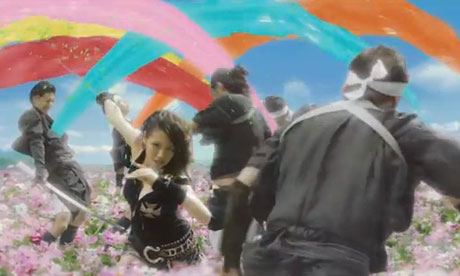
Sion Sono was one of my discoveries at last years festival. I saw his Land of Hope with no expectations, mainly because I'm interested in the Fukushima accident, and found it extremely wellmade and beautiful. I knew it was an outlier in his production, that he is normally a more extreme kind of director, so I wasn't that surprised by this films journey into complete insanity. Still: It's an extremely weird film. It revolves around two warring Yakuza-families; a group of guerilla filmmakers calling themselves The Fuck Bombers; the young daughter of the one Yakuza-boss, famous from an insanely catchy toothpaste commercial. Somehow, it all devolves into the filmmakers filming the final showdown between the two families, and carnage ensues. If it sounds needlessly complicated, well, it is, and the setup for this film takes forever. But the last half hour or so is amazingly fun.


Sion Sono is quite simply a good director, and the film is full of indelible images, many of them glimpsed in the trailer. The young girl dancing in a sea of blood, the yakuza-men squirting a rainbow of blood, loads more. And the jokes are timed and paced, so simple cuts elicited big laughs in the cinema. There is also one big stylistic gamble in the film: The first part, taking place ten years before, is filmed in 35 mm, while the main part is digital. This creates a massive amount of nostalgia, both in the film, as the flashbacks in the second part has the look of an actually older time, and just for the death of celluloid occuring over the decade, which the young filmmakers are acutely aware of. It's a great little thing. It did create problems though, as the hiccuping began when the style switched, and I'm almost certain it had something to do with the shift, though I can't explain how. Anyway, it meant that the part after the timejump became quite imcomprehensible, and that was where the main plotlines were set up, so I'm pretty sure I missed quite a bit of the plot.

Having only watched two of his films, I'd still put Sion Sono up there with the best of the Japanese directors of the new century. These two films pretty much match any Miike, Kore-eda, (late-period) Kitano, Kiyoshi Kurosawa, etc, I've seen, which admittedly isn't anything. Still, I'm going to check out the rest of his ouvre, and if you get the chance to watch this bonkers b-film action/comedy/splatter, then I'd very much recommend it.

Why Don't You Play In Hell is shown again Mon 4/7 at 19:00.

mandag den 9. maj 2011

Agnes Varda's Le Bonheur + Thoughts on Women in Art


Sometimes you see something and a few thoughts seem to fall into place. Or at least into place a bit more. I saw Agnes Varda's film Le Bonheur from 65 last night, and it seemed to fit like a piece of a puzzle I've been trying to put together, on the topic of feminism, women artists, and the like. I've been trying to figure out this kind of thing for a long time, and jotted down several quotes from different places that I find helping. So this is mainly a bunch of pretentious quotes strung together into a half baked political framework, that in the end is probably still severely lacking, and only intended to absolve myself for my lack of activism in this regard. Nevertheless, it is nice to try and think stuff like this over from time to time, and a good thing about a blog is that it allows oneself to air thoughts that one haven't really resolved sufficiently, and that one might abandon in due time. Anyways, here they are. Spoilers, of course.


Talk talk talk. And then the scene in question from 7:00 onwards. Two unforgettable inserts at 8:30...

The thing that triggered these thoughts is the ending of the film. While relaxing in a park, Therese has heard that her husband Francois has begun an affair, an to begin with she seems to accept his explanation, that his actions has only made him happier and that this happiness has made his love for her even greater. But then, while he takes a nap, she wanders of and drowns in a pond. I deliberately don't say that she drowns herself, for the film seems a bit ambiguous on this point. A short shot shows her in the water, grasping at a stick, perhaps trying to stay above water. The ambiguity, and the shot where Francois holds the drowned Therese in his arms, reminded me of the fate of Ophelia from Hamlet. And immediately afterward, it reminded me of this poem by the Russian poet Anna Akhmatova, named Reading Hamlet:

A barren patch to the right of the cemetery,
behind it a river flashing blue.
You said: ”All right then, get thee to a nunnery,
or go get married to a fool...”

It was the sort of thing that princes always say,
but these are words that one remembers.
May they flow a hundred centuries in a row
like an ermine mantle from his shoulders.

(from the collection Poems of Akhmatova from Mariner books, translated by Stanley Kunitz and Max Hayward. Go find it on Amazon, it is really, really good...)

Akhmatova wrote a few of these poems, about women who gets lost in the struggle of men, such as Lots Wife who turned into a pillar of salt (Who will grieve for this woman? Does she not seem / too insignificant for our concern?), or Cleopatra (Tomorrow they'll put her children in chains...). As a Russian artist in the first half of twentieth century, she was of course a target of the Stalinist purges. But she was never hurt herself, her ex-husband was executed and her son was interned. She is very famous for the poem Requiem she wrote about her experience as the mother of a deportee. It begins with something Instead of a Preface, in which she is recognized standing in line outside the prison in Leningrad, and another woman asks her: ”Can you describe this?” / And I said: ”I can.” / Then something like a smile passed fleetingly over what had once been her face”


The French postmodern philosopher Jean-Francois Lyotard began his work The Differend with a rumination on the then new phenomenon of Holocaust deniers. As he described their solipsistic argument, the only proof of the Holocaust they would except would have been someone who could prove that the gas chambers had been used to kill people. And since everyone who had witnessed the gas chambers in function had died from it, this could not be proved, and ergo Holocaust could be denied. He used this extreme example to, amongst other things, draw a distinction between a plaintiff and a victim (in §9 on page 8 of the English edition from Minnesota University press). ”A plaintiff is someone who has incurred damages and who disposes of the means to prove it. One becomes a victim if one loses these means.” It is to remain a plaintiff and not become solely a victim, that the woman in the line in Leningrad asks Akhmatova if she can describe this wrong that are committed against them, if she is able to bear witness to it. By giving voice to victimized women from the past, Akhmatova also tries to turn them into plaintiffs. As a plaintiff you still have hope for revenge, or recompense. Once your a victim, that hope has been taken from you.


But of course, the question remains: Could Akhmatova really describe these wrongs? Don't get me wrong, it is a magnificent poem, a masterpiece even, but can we be sure she actually described the feeling of this other women? Can we be sure that she captures the feelings of Ophelia or Lots Wife (disregarding the fact that they are constructs...). Is she not, in a small way, perhaps doing them another wrong by using them to make her own description stronger? If this woman from Leningrad perhaps had written her own account, it would probably be disregarded, for it is inconceivable that it would ever be as brilliant as Akhmatova’s Requiem. Another extreme example is Dante and Beatrice. Beatrice is immortalized in Dante’s Divine Comedy. She is described as the most perfect woman ever, who is sitting almost next to God and Christ in the highest realm of Paradise. But has Dante immortalized Beatrice, or has he removed the actual woman from the annals of history, and substituted her with his own cleansed picture?


And this brings me back to Varda's film. For while every person in the film seem inherently sympathetic, Francois, the adulterer, has at least one major fault. He talks. He talks and talks and talks, yet he never really listens. He perpetually tries to explain his own acts and feelings, but never wants to hear anything about anyone else. And Therese doesn't tell him. She just wanders off, and then she drowns. Francois might be the archetypal male thinker. He thinks and thinks and talks and talks but his thinking remains completely self involved. He doesn't take the feelings of the two women into consideration. And this might be the point, a point that I think only a female director could have made. When male artists want to speak out about women's rights, they have a tendency to create women whom they themselves think are strong and good. And then voice their opinions through these characters. This strategy can lead to great results – I'm reading one of the greatest examples, Tolstoy’s Anna Karenina at the moment – but it is quite different from what Varda is doing. She didn't create any strong women in this film. In fact, they are quite weak willed, also the other woman, Emilie, whom Francois to begin with loves because of her independence, but who is quickly domesticated after she assumes the role of wife to Francois. But Varda instead perhaps showed why they are weak. Because they are not allowed to speak for themselves. They can therefore never be plaintiffs, only victims.


Such quiet, determined grace. Such beauty. Almost unnatural...

Another scene with a women drowning has been on my mind since the first time I saw it. It's from the Japanese filmmaker Kenji Mizoguchi's beautiful Sansho the Bailiff. The young woman has helped her brother escape from their slave camp, but since she fears that she would probably disclose which way he went if tortured, she chooses to walk into a pond, and drowns herself. She gracefully wanders into the water, and then the film cuts to small ripples on the water, where she has subsumed herself. I've seen Mizoguchi described as a filmmaker with 'a feminine universe' (by French philosopher Gilles Deleuze in his Cinema 1 – The Movement Image, also from Minnesota, page 192), as a filmmaker who was interested in the plight of women. But in this scene, the action undertaken by the woman is supposed to be a sacrifice, it is seen as good and noble. But is it really a healthy picture of women? Someone who sacrifices themselves for the good of their family? (Admittedly, Deleuze points to Mizuguchi as feminine in contrast with Kurosawa, and he is definitely more feminine than him. But who isn't?) It is interesting to contrast these two scenes of women drowning themselves, for the moment that Mizoguchi has removed from the sequence, the moment where the woman actually drowns, as in dying with water coming over her and into her lungs and last breaths and all those grisly details, is the only moment that Varda shows the audience in her version. And I wouldn't be surprised if that is deliberate on Varda's part, the film is quite allusive, as films of the Nouvelle Vague are wont to be. But this also points to another difference, that the sacrifice of the woman in Mizuguchi's version actually accomplishes something, that the brother is able to escape, while the drowning in Le Bonheur just seems pointless and in vain. A few minutes later, Francois has married his lover, and life seems to go on without any one really mourning... This ending is another twist on Shakespeare: where Francois seemed like Hamlet when he held his substitute Ophelia, after her burial he acts much more like Gertrud... But this ending, with one woman replaced by another, and happy lives continuing as if nothing particularly important has taken place, this ending seems to me to show 'patriarchy' in effect, in all it's petty pervasiveness, where women are completely defined by men, and their only other choice is to 'opt out' of it, so to speak, since they can never ever hope to be allowed to define their own life. And I think that this ending could only have been created by a woman, a man would have done it otherwise, he would not have shown the bad effects of patriarchy so clearly, perhaps since he as a male artist, with a strong effect on defining societal discourse, he is in fact part of the problem. And even if he created a completely new path for a woman to take, created the strongest, best female character he could possibly create, then he would inexorably have created a new woman defined by a man, and would then sadly just have become an even bigger part of the problem...

Well, to get to the point of these pretentious ramblings – and wow, they ended up being even more pretentious than I planned them to be... - this points to a problem I have with a lot of my own writing. I'm a male, heterosexual WASP. And I think and write quite a lot about race, gender and sexuality. And I kinda feel like I'm wrong in doing it. I once came to the conclusion, that I wouldn't consider myself a feminist, for that implied that I fought and spoke on their behalf, and as I've tried to explain, that can easily turn into usurping their fight and using it for my own gain. So I promised myself I wouldn't do that. I try not to speak on behalf of women, and minorities of every kind. But I try to listen. And I do my own interpretations of what they say, which can never be done without doing some kind of violence to the original, and which I feel is kinda wrong. But what to do... I've gotta write about something.

Oh what a boring, obvious, noncommittal conclusion. Let me instead end with yet another poem by Akhmatova, let Akhmatova get the final word:

Epigram (1960):

Could Beatrice have written like Dante,
or Laura have glorified love's pain?
I set the style for women's speech.
God help me shut them up again!