My plan this morning was to go and see Dominik Graf's three-hour Schiller-biopic, Beloved Sisters. But it turned out I misread the programme, and when I was ready to leave it had already been playing for an hour. I had a Plan B: Field of Dogs, according to the program a visionary retelling of Dante's Divine Comedy. But that one was sold out. So instead I went and saw this one, which played at the local business school, 100 m from where I was. There were a lot of tickets, and it was about architecture, which interests me. So that seemed a fine Plan C.
It was an amazing experience. The plot of the film is simple: A French architect named Alexandre travels to Rome with his wife to look at architecture by the great Borromini. On the way there, in Schwitzerland, they run into a young brother and sister. He wants to study architecture and she is sick. The rest of the film is the men looking at churches and the women talking. But the style... The style was like the rigorous modernist cinema of old, except in digital, and with a deadpan humour that never allowed things to get too serious. The actors walked around and declamated their lines like in the cinema of the great French filmmaker Robert Bresson. Many shots of only feet and hands of people also seemed Bressonesque. The rigourously composed symmetrical shots and long discussions with actors at times looking directly into the camera reminded me of the late-late-late period from 106-year-old-and-still-going filmmaker Manoel de Oliveira. With it's discussions of architecture and multilingual characters especially Oliveiras very great A Talking Picture (2003). And a large percentage of the images is just the camera looking at architecture, filming modern appartment buildings and factories from a distance, and contrasting it with loving closeups of the detailed, light-filled beauty of the old churches.
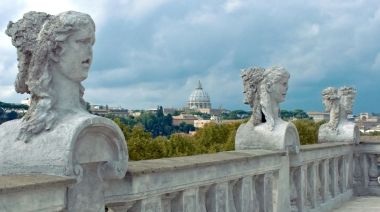
There is a tiny problem: The film depicts people fed up with functionalistic, modernist life and compares that to the baroque beauty found in Roman architecture, but the style of the film is kinda modernist and functionalistic as well. That is in and of itself not the biggest problem, and the film does critique it's own style as it goes along, slowly accumulating enough over-the-top characters, details and weird interludes, to carry on a sense of baroque-ness. And as the characters achieves the titular 'sapience' (which is a word for wisdom in some way, I don't really know) the style changes, becoming more rounded. But there was another big film recently about intellectuals looking for meaning amongst the old buildings of Rome: Paolo Sorrentino's The Great Beauty. And while La Sapienza works with the same outmoded, modernist form that he critiques, Sorrention's cinema seems to strive towards a new cinematic language, perhaps more fitting to the critique. The GIFF-programmers wittingly describe La Sapienza as a 'rectangle-drama', a great description of a certain type of cinema. In contrast, Sorrentino's film is all curves, broken lines, movements, fluidity. When Alexandre describes a facade by his beloved Borromini as being 'always in motion', his description sounds more like Sorrentino than the static shot we get from Green. And also, Sorrentino's film was one of the biggest arthouse successes in recent years, and even won a Foreign Language Oscar, one of the few times that prize has gone to a truly brilliant film. There is no way Eugene Green's film will get even close to that attention. So in a way, this whole film might be a bit... superfluous...
But on the other hand. I watched this film with many, many people in a big theater, and the people laughed, smiled, and had a good time. Two of the other three showings are already sold out. I was also surprised to find, that director Eugene Green is an old and experienced artist, having worked extensively in theater and only directed four theatrical features before, but those films premiering at Cannes and Locarno. It took no more than ten minutes before I mentally made a note of checking everything else I could find by this weird and idiosyncratic director. I had no idea what I was getting. I will perhaps never get the chance to watch this or the rest of the directors filmography again, at least not on the big screen. This was a unique experience, one I didn't anticipate at all. And surprises like this are the reason I love film festivals so very very much!
Goodbye to Language (Jean-Luc Godard, France, 2014)
Ah, Godard. Trying to handle a late-period Godard film after only one viewing is a foolish task. And this one was in 3D, so there were twice as many layers. I'm mainly confused, and grasping at straws, trying to connect as much of this montage of sounds, words, works cited and images into something adding up to something. I saw and wrote about his first 3D short Les Trois Dés-Astres last year at PIX, so I might begin there. That one depicted 3D as a disaster for cinema, yet another in a lineage of failures for the medium (ranging from the Holocaut to the domination of Hollywood, because those two things can obviously be compared). Perhaps Goodbye to Language is about saying goodbye to the old language of film? The screen flashes Ah, Dieux at times, and the final time I understood it to be a pun on Adieu, but perhaps also on Un, Deux (if you say it with an accent?) There are of course a bunch of clips from old films, but not really anyone I recognized. And the main story is something about a woman and a man, and another woman and a man, and the women are naked a lot of the time, and the men are disparaging and don't really think much of the women. 'Women can't create evil', they say (or something to that effect). Then there's a scene with Mary Shelley, writing Frankenstein, reminding us that a woman wrote perhaps the first piece of horror-fiction. So there is that. I don't know, I don't at all get what the plot was about. There was a great dog named Roxy, though, I liked the dog!
So much stuff on language. Over the end credits, a couple is 'speaking' in dog-language with a baby. There are a bunch of philosophical quotes on language. The two parts of the film are called 'Nature' and 'Metaphor', perhaps suggesting that the second part turns the first part into an understandable language? Except the two parts apparantly mirror each other quite a lot, and none of them are easy to figure out. There's a discussion of language and atrocity, one of the women tells a story of an SS officer yelling at a kid at the entrance to the gas chamber, that 'There is no why'. In the beginning of the film, a professor comments on the subtitle of Solshenitsyn's The Gulag Archipelago: A Literary Investigation. What lies beyond language is atrocity. Horror. But also childhood, and nature, shown on screen through the many many scenes featuring the dog Roxy. There is also a scene where a painter tries to explain how to show depth through water colour, mirroring the way Godard himself tries to figure out the grammar of this weird new technology.
And Godard struggles with turning 3D into a language. As with many of his more recent films, he uses low-grade video and digital, and those blurry images create sheets of colour when the image is given depth. The film checks out the ticks of this new medium, for instance filming out of the windshield of a car on a rainy night, which creates floating specks of neon-light where the water-drops mirror streetlight. There are a couple of times where the filmmakers must have turned one of the two cameras needed to film in 3D to the side, making the image simply split, and forcing me to blink each eye to watch two films at once, until the camera turns back and the image connects again. There are other sequences where the effect simply doesn't work for me, where the foreground is too far away from the background, and all of a sudden what was a couple tablelegs turns into a ghostly seethrough presence. And at times there are only abstract dots and lines onscreen. Basic filmic grammar is also broken, as the camera turns upside down, the shadow of the cameraman is seen on the ground, the plot is achronological, etc.
Haven't got a clue. I read the book Jean-Luc Godard: Cinema Historian by Michael Witt recently, and that book noted how perhaps Godard should be thought of as a mixed-media artist than a filmmaker, since for the longest time he has been working with collages of existing media, as well as video, installation, text, sound, etc. This film definitely blurs the limits of the new 3D medium, and is to a large extent about those limits. That is what I got from it on the first try. That, and an ever so slight headache.
Daughter... Mother... Daughter... (Panahbarkhoda Rezaee, Iran, 2014)
.JPG)
When watching a bunch of films over a short period, there will probably always be some that don't get full attention. I was tired, and the Godard mindfuck kept swirling round my brain. Also, this was a sloooow film, without dialogue, but with a beautiful soundtrack of music, nature sounds, and poetic narration in Iranian. Always the sounds of birds cheeping, water running, and a train passing by from time to time. It was hypnotic in a way. It put the person next to me to sleep several times throughout the seventy minutes.
It was a film on boredom, on being trapped in a life without any hope for a future. Grandmother spins yarn all the time, spinning spinning spinning. Mother walks around the wheat-fields, longing for her husband who took the train to get away. Daugher is sick and struggling to breathe, lying in bed all day, listening to the sounds of nature, dreaming of seeing the sky. There is a son, but he also leaves early on. The women are stuck - as many women probably are in Iran. Most of the film is longheld shots of each woman standing or sitting or laying alone, and then the narrator says something about them. We never hear any names. At times the women watch tv together, and we get old black and white clips, or perhaps it's new clips made to look old, I don't know. Death is never far from the family, and at times the women look ghostly covered as they are completely in black, walking the barren landscape. A shot of light streaming over the mountains is amazing, perhaps showing grace. There is only a single shot where the women interact, where the mother strokes the hair of the daughter, and then they cry. It's very cathartic, after having watched so much film without anybody showing any emotion at all.
This was artfilm. Very lowbudget I think. High res digital pictures, no cameramovements at all, all sound added afterwards, only four people in the film. I love seeing such a small and personal projects, and I liked listening to the Iranian poesy. Had it been much longer than 70 minutes, it would probably have been too much, though... Also, googling the director, his name is apparantly spelled a bunch of different ways in the west, and his other features have names like A Cradle for Mother and even Daugher... Father... Daughter... Now I'm intrigued, and would like to see if his films might make more sense through accumulation.
Note on language, apropos Godard: I like Iranian cinema, I've seen quite a lot of Iranian films, which means I've seen a bunch of Iranian writing rolling over screen at the beginning and end of a film, and it has always seemed like curves and not like words. But all of a sudden, tonight, in the blink of an eye, I could make out letters. Not that I understood anything, it just looked like a language all of sudden. Weird how that works.
Also Seen:
Another film from competion, Susanna Lenken's debut feature My Skinny Sister, which I will write about elsewhere. A fine debut, a great depiction of two young sisters.


