Viser opslag med etiketten CPHPIX. Vis alle opslag

søndag den 19. april 2015

PIX15: Parabellum, White God

Parabellum (Lukas Valenta Rinner, 2015, Argentina)

If you're going to straight up copy the opening scene of another, more famous film, you better to something with it. When I saw the opening of Parabellum, it was immediately clear that the director was copying the opening of Reygadas' Silent Light. A shot of the sky at dawn, slowly cirkling round, through trees, coming to a stop on a field. Something has to happen. Clanging sounds rise: Clangclangclang and then BAM! A punchline!



Another joke: An early scene simply shows the boring office life of the main character, but violent, significant eposition is heard on the radio. 'Oh' I thought. 'Smart way to explain the backstory. Clearly the point of the scene can't be this dull delivery of paperwork.' CUT! After office work, but in the middle of radio sentence, meaning we never really learn exactly what is going on.


Something is clearly happening, though. The mood is sinister. Our man dream of fireworks shooting up from all over Buenos Aires. He leaves his world behind, and travels to a camp to learn survival skills. Here, the imagery truly comes into it's own. Turns out director Lukas Valenta Rinner was born in Austria, which seems fitting, since the scenes at the secluded survival camp is so reminescent of the resort and the weight-loss camp from Ulrich Seidl's Paradise's  Love and Hope. Very rectangular framing, much about ordered, regimented hours and classes, much droll comedy in the pale citizens all trying to do something out of the ordinary in exactly the same way.You've kinda seen it before, but it's very well made and very funny. I might have hoped for just a tiny bit more, though.

I often decry when films let such superfluous stuff like 'plot' or 'character depth' detract from the important stuff like sounds and images. But at times, a film has such a masterful grasp on it's style that it can withstand a whole lot of detracting. Such a film is Parabellum. Seidl is pretty famous for not holding back with his characters, but there is till often fleeting glimses of sweetness in his films - it's often what his characters are searching for. Parabellum could have used a bit like that. I'm not looking for a conventional love story, but all dialogue in the film is instructions and commands,and it's awesome and funny, so I have fath that Rinner could have written a few good conversations as well.


Something to make the characters more livid, so that we care more in the third part of the film, where practice and reality becomes blurred as the trainees must find their own way up a river - the horror! This is where the payoffs are, but they could have hit harder. The imagery remains great throughout, and culminates in an absolutely stunning final shot. There is no doubt that this debut director can make film. I'll watch whatever he does next, without a doubt. A longer film, with just a bit more variation, could be a major arthouse triumph!

White God (Kornél Mondruczó, 2014, Hungary)

Hey, did you know that 'God' is 'dog' backwards? Think about it!


Un Certain Regard har a pretty legendary selection in 2014 with Amour Fou, Force Majeure, Jauja and Bird People. And White God won. So I was quite curious if this could really be a deserving winner of that competion. And no. It's not. Not at all.

I get why this gets attention. It has spectacular dog-imagery  attained through practical effects. But honestly, that's all it has and it's not the most flexible of imagery. It looks awesome every time, but the filmmaker doesn't even try to vary it enough to fill the runtime. There is a great intro with slomo and music. And then there's the attack in the final 20 minutes.
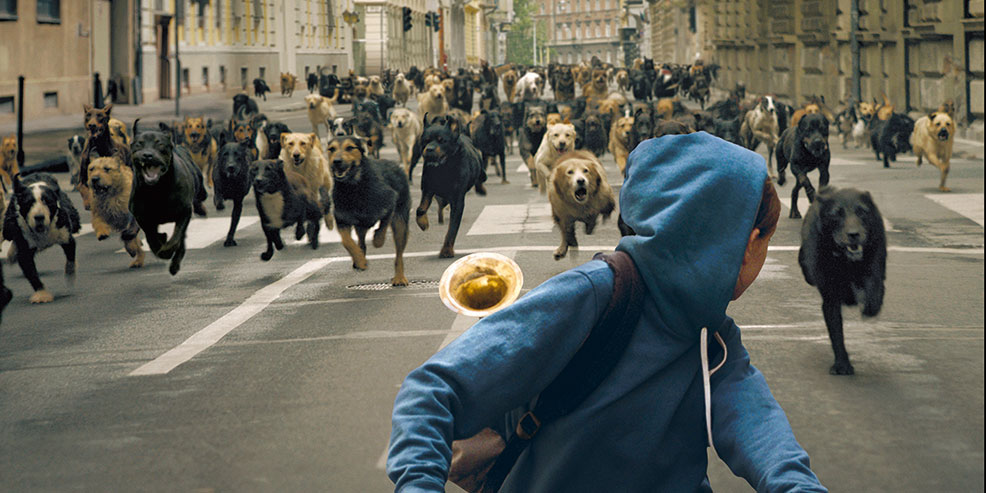


And the rest of the time, it quite honestly seems as if the filmmaker doesn't know what to do. The filmmaking is competent arthouse but still awfully color-coded into teal and orange. There's a bunch of silly human stories about a teenage girl and boys and her asshole conductor and none of it is interesting. Worst of all, the main dog gets a whole character arc to explain his feral devolution, and I swear it contains actual references to Disney films like Lady & the Tramp and Oliver & Co.


Disney can be awesome. Frozen is a masterpiece. But you can't treat the dogs like anthropomorphized little people without it hurting the sublime savagery of the final part. Think of The Birds. The birds in The Birds are terrifying because they attack without us knowing why. The birds in The Birds wouldn't be half as terrifying if we'd spent 40 minutes seeing the leader bird being treated like a bird. It's dumb. And the specificity also takes away from the metaphoric utility of the creatures. Now think of Bird People. The fact that the main character turns into a bird in that film is less overtly impressive than what has been done in White God, but filming as a bird can be varied for a long time. It doesn't start as interesting as an army of dogs, but it also doesn't become tired as fast. So in the end it's better.

This was a dissapointment. I'm guessing this won't stand the test of time. It's typical 'can't believe they did this'-cinema: You see it once and it's cool, then there's no reason to watch it again.

tirsdag den 14. april 2015

PIX15: The Princess of France, Over Your Dead Body

The Princess of France (Mattias Piñeiro, Argentina, 2014)


Prologue:
There are a lot of films out there. To handle all those films, you need to create systems to sort them. We all know the genre-labels: Action, comedy, romance. You know what you get. As a cineaste, a snob, I mostly sort by director, and then by country, by era, etc. If I hear something is Romanian New Wave, it's probably worth seeing. If it's Japanese Extreme Cinema, it's probably crap. But I'm not a formally educated film-buff, I've had a bit in high-school and a few classes in college, but I'm not as well versed in cinematic history as many of my peers. At times, I don't know what I'm talking about. So I create my own mental categories to sort weird films together. After I'd seen Jessica Haussner's masterful Amour Fou, I wrote that it was something I called Austrian Rectangle Cinema - Ulrich Seidl, Nicolaus Geyrhalter, even Michael Haneke. I was kindly informed, that it's probably more correctly called Berlin New School, since Haussner has been working with directors and systems that is already grouped together under that name. I don't mean to make fun of that correction, that is fine, you write to be understood, if people already understand a description, don't improvise unless you're sure what you say is more correct.

The reason for this long preamble - apart from the fact that prologues always seem Shakespearian to me - is because I'm going to coin yet another genre-name. I've seen a bunch of films from Argentina and Chile, that seems kinda alike to me. They often involve young, incredibly beautiful people, all doing cultural work, and hung up on romances - so often more than one. It always has an extremely high amount of cultural capital, and includes references to art, to literature, to theater. We're talking films like Leonardo Brzezicki's Noche (2013), Christián Jiménez' Bonsai (2011), perhaps even something like a lot of films by legendary Chilean director Raul Ruiz. We're talking the spirit of Jorge Luis Borges and Julio Cortazar. And I'm going to label this kind of cinema - damdamdaaaam - : Southern Cone Hipster Film! Or SCH!-films for short.


Main Review
If Sourthern Cone Hipster is a style, then I think Mattias Pineiro is it's main auteur at the moment. He makes very peculiar pictures. He has so far made three films based around actors working on Shakespearean comedies. In Rosalinda it was As You Like It while in Viola it was Twelth Night. And he's more in command of his camera and his world than the rest of his contemporaries, I think - though not as much as directors like Lisandro Alonso and Lucretia Martel, who I don't consider Southern Cone Hipster. The opening shot of this one is absurdly wellmade. On a rooftop, at night, a woman yells. Then the camera pans, and begins watching a group of footballers playing far below, while titles and credits are shown onscreen. It's such a great idea, and so well done, but it also says so much about what's to come.

For me at least, in Shakespearian comedy, it's all about games of love being played between men and women. In Much Ado About Nothing everybody treats their task of getting Beatrice and Benedict to fall in love as a game, while Don John plays a much more sinister game of lies and subterfuge with the affections of poor Hero and Claudio. Football is a great metaphor for the film. First, the players pass a ball back and forth between them, the same way the lovers will change affections constantly. And then they form two teams, as in two genders always playing with each other. But not on equal terms. For some reason, there are eight players in green, and only three in orange.

There are 4 women and 2 men in this film. The central character is Victor, returning to Buenos Aires from Mexico with funding in his pocket to create a radio-version of Love's Labour's Lost. All the women are actresses, and all of them have been in a relationship with him, or are now, or want to be. It's confusing. I quite honestly lost the plot at the point where the same two short scenes are replayed 3 times with different participants and outcomes. I have no idea if all versions are supposed to really happen. So I don't get the specifics of the romantic entanglements. There were also way too many dark-haired beauties for me to tell them apart (there might have been more than 4...) Don't get me wrong, a film can never have too much dark-haired beauty. It's just, what is won in aesthetic quality is lost in clarity of plotting.


So I began focusing on details at the fringes. One scene takes place in a museum space, where the characters look at paintings of nude women, by Bouguereau I think. An enemy of impressionism, forgotten by the future, but much popular in his day with his piquante paintings hanging in many a French boudoir. The discussion touches on how much art-history is tangled up with the female body and the female sex - much more so than with female artistery. Victor himself might use his art to get women, or he might use his women to make art and stories. It's not entirely clear, not even to himself. He might also be used. There's a genderbending aspect of the film, in that they switch the roles of the play and have the women play the four central male characters. And while the play concerns machinations of men, in the film the women might be the combatants, competing with each other over Victor. They might also simply decide he isn't worth. Actually, I can't exactly figure out if they did. I should probably rewatch this at some time. And watch some other Pineiro at some point.

Over You Dead Body (Takashi Miike, Japan, 2014)


Sometimes you have a lot to say, even when you don't really get a film. Other times, you draw a blank. I have nearly nothing to say about this film. Miike is famous for Audition, the only other of his I've seen is 13 Assassins. It's not my thing. I was also not in the mood. Just before entering the cinema, I discovered a logistical error by the festival, which threw a bunch of my carefully laid plans into dissaray. So I was frustrated, confused, thinking way too much about what I had to do to see the films that I wanted to see. And then the film began, and the plot was all over the place, and there was a sexscene and a goldfish and now they were all samurais and... who cares?


Ok, I got the plot. It's awfully simple. More actors! More meshing of play and real life. A married couple play the lead characters in a lavish production of Yotsuya Kaidan, a famous Japanese ghost story about a ronin who leaves his wife for another woman, and is haunted by ghosts in revenge. The actor playing the cheating ronin is also cheating on his wife, and the wife also seeks supernatural means of revenge. And then there's blood. Who cares?

In a way, I wish this had just been a simple adaptation of the play, because those scenes are by far the best aspect of the film. Not just because the story and the central characters are fascinating even in the glimpses we see, but also because the staging is so aweinspiring. Heavily theatrical, with giant sets turning and changing, and multicolored lightning creating shadows and colours all over. It's beautiful, it's grandiose, it's fascinating. The scenes in the real world are so boring compared to that. I get why they're there, because nothing about the staged play is frightening, it's so theatrical that it never seems real. But the frights in the real world are boring as well, so cut them out. The theatrical murder and mayhem and horror is more like Grand Guignol, it induces a guilty relish at being allowed to watch all the blood and the violence at a distance. Which might not be what horror is supposed to be today, but the feeling I'm left with is of a director creating a much more complicated plot than he needed to be, in order to make it more conventionally effectful. That is bad. Simple but strange is always better than convoluted but conventional.

Also seen: I rewatched Lav Diaz' From What Is Before, and I've watched a bunch of films from the main competition, which I'm reviewing in Danish. But if you get the chance to watch Antoine Barraud's Portrait of the Artist, seize it! It's pretty close to being a masterpiece. Laura Bispuri's Sworn Virgin is very fine as well, as is Jeppe Rønde's Bridgend, which will get a British premiere shortly. Yannis Veslemes' Norway is a vampire film, and I don't much care for vampire-films, but it's use of lighting is ridiculously accomplished, and the film is worth it for that alone.

lørdag den 11. april 2015

PIX15: Hill of Freedom, Greenery Will Bloom Again, Da Sweet Blood of Jesus

New year, new festival. I'll review a bunch of stuff in different places, some in Danish, some in English. I didn't watch anything on day one, but today I saw three films.

Hill of Freedom (Hong Sang-soo, South Korea, 2014)

I began the festival the same way as last year: With the newest from prolific South Korean director Hong Sang-soo. It's the perfect way to start a festival the way all Hong's films start: Bright colors, korean script, and the charming pianomusic by Jeong Yong-jin. Same as always. Last year I was utterly charmed by his Our Sunhi. I'd heard, that this new one, Hill of Freedom, might be his very best, so I was looking forward to it. It's good. It's obviously fun and charming and Hong-like. But I wasn't as hooked as I was last year.

As I wrote last year, Hong Sang-soo can go from being really tricky to not that tricky. This is him at his utmost trickiest.The actual plot is very simple: Japanese guy Mori travels to Seoul to track down Kwon, a women he met a few years back. While searching for her, he meets an assortment of other characters, most notably other woman Young-son, who he gets involved with. The trick is the way the story is told: Through a bunch of letters that Mori has sent Kwon, which Kwon unfortunately drops, so it's completely out of order. Chronology is jumbled, and a whole bunch of the film is apparantly dreams that Mori has, so when something happens, or even if it actually happens at all, is always in doubt. There is an obvious order to a lot of it, with small stories involving a dog, another boyfriend, a man in debt, but then there's a bunch of weird other stuff. A young girl lives next door to Mori, whom his friend gets in a fight with, and then she gets collected by her father. Mori's voiceover then says 'you were lucky you were in the bathroom' and the scene ends. What? The film is full of playfulness like that.

This trickery is unusually bombastic by Hongs standards, and the film-language is unusually busy as well. The camera is static as allways, but nearly every seen involves zooms and pans to keep track of the characters. Mori is constantly in motion - when he isn't sleeping his day away - and the camera most always keep track of him. It's beautiful as always, but it's as if too much happens, too many characters. It doesn't breathe the way Our Sunhi did to me. Watching these films, I learn what kind of Hong I'm most drawn to. Hill of Freedom is a lot like In Another Country from 2012, where a young woman wrote three different stories about Isabelle Huppert travelling to Korea, down to the famous foreign actor visiting the country - Ryo Kase was in Letters From Iwo Jima. I wasn't a huge fan of In Another Country as well. I prefer the simpler ones, like Our Sunhi or Nobody's Daughter Haewon or Woman on the Beach, which aren't less weird, but just in subtler ways. The repetitions of Sunhi is actually weirder than in Hill of Freedom, since the bizarre details such as many characters telling Mori he was right to fight somebody unseen, using the exact same language, can be explained away by the film being authored by Mori. In Sunhi, it was simply the world that was weird.

With a prolific director like Hong Sang-soo, his filmography will constantly be redefined. I thought he was moving in a less tricky direction recently, and was focusing more on female characters than male. But now Hill of Freedom seems like the summation of everything he has made this decade, and focus is squarely back on week men. I wonder what we will get to watch next year. I hope they drink more Soju, it just isn't the same with red wine.

Greenery Will Boom Again (Ermanno Olmi, Italy, 2015)

What I always want out of a film is seeing something I haven't seen before. One of the best things with that principle, is that ignorance becomes a strength. Like with this one: I was pleasantly surprised by this one, because it had features I've never seen before. I'm pretty sure that says more about me than it does the qualities of the film, but who cares, I had a good experience.

Ermanno Olmi is a legend, whom I've never seen a film from before. He is 83. He won the Golden Palm in 78 for The Tree of Wooden Clogs and the Golden Lion in 88 for The Legend of the Holy Drinker. His sixties work should be really strong as well. But I haven't been that interested in checking him out, and I probably wouldn't have seeked this one out, but it fit my program. It's a World War One film, that takes place in a small outpost in the alps, that have been completely snowed in. Their communications gets intercepted by the Austrians, so now the enemy knows where they are, and begins attacking. That's pretty much it.

The film reminded me of submarine movies. The small outpost is plenty claustrophobic, and the men are sitting ducks while snipers snipe, mortars rain down, and a tunnel is being dug under them to undermine the place. The brass wants new communications, so a soldier is ordered to run outside, but unfortunately it's a full moon and there is no place to hide. He takes two steps and throws himself into the snow, and is immediately shot and killed. The next volunteer instead kills himself. What I realized was: I don't think I've ever seen a film told from the perspective of the defenders. I've only seen a few World War One movies: Paths of Glory and Blackadder Goes Forth is what first comes to mind, but those film revolve around the iconic notion of going over the top. This film shows the other end of that, the people sitting in their small dugout, waiting for the mass of men to come towards them. Undoubtedly, there exists films like that (I'm guessing something like Letters from Iwo Jima might be like that) but I've never seen them. And I was riveted.

80 minutes. The pictures are exquisite, color-drained digital. It looks cold and devoid of soul, as so much digital filmmaking does, which is very apt for this story. The men are pretty much indistinguishable from one another. The pace is slow, the mood is opressive. The men will adress the camera all the time, and tell small anecdotes about themselves, and I don't think a single one of them did anything to me. Actually, objectively speaking, this is not that good a film, I think. But I liked it anyway. A small surprise.

Da Sweet Blood of Jesus (Spike Lee, USA, 2014)

Objectively, this was an even worse film than Greenery Will Bloom Again. Spike Lee is also a legend, and in my opinion his Do the Right Thing is the best American film of the eighties. But it's been a while since he was really relevant, and this one is extremely lowbudget and made through kickstarter. It's a remake of an indie-film from  1973 called Ganja and Hess.

There is a thing called 'late-period style', which is used about films made by old directors. Normally, it connotes austere style, concerned with aging and death. This is not that. And Spike Lee is only 58, still very young for a director. But there is this enjoyable freedom in the filmmaking, as if the director knows that only a fraction of people are still interested in what he does. He does what he does best. The film opens fantastically, with dancer Charles 'Lil Buck' Riley doing his gliding dance around Brooklyn to gentle piano music, an opening that mirrors the way Rosario Dawson danced to Public Enemy at the start of Do the Right Thing. Back then the mood was intense, this time it's elegiac. The film never becomes that good again, but there's a bunch of nifty scenes.

Dr Hess has inherited a bunch of money from his parents, the first african-americans to own a Wall Street firm. He collects and writes about African art. His unstable assistant murders him with an ancient Ashanti dagger, that was used in ancient blood rituals, but Hess doesn't die. He begins drinking blood. Ganja, an English black woman, arrives at the 40 acre lot at Martha's Vinyard, and the couple fall in love. He murders her as well, and she springs back to life. But can they live with themselves as vampires?

The symbolism is pretty simple, and was seemingly more pointed in 73. Dr Hess sucks the blood out of the black community, without giving anything back. He prays on the poor women - including Felicia 'Snoop' Pearson from The Wire! - whom he can get to do anything since his whole demeanor proves that he is loaded. In a late scene, he visists a former victim, and her demeanor is exactly like a junkie, making Hess into her dealer, another person who prays on his own community. All his victims are black.

The style has been described as 'exploitation', but that is way too easy. It's more like daytime soap meets an incredibly good and experienced director who knows exactly what he's doing, but has no money or time to do that much. The acting is inconsistent. The original music is cheesy, but the whole film is drenched in music, soul and hiphop from a bunch of unsigned artists, as well as a couple of Brazilian songs, which I loved. There is the feeling of a director doing exactly what he wants, and not caring what anybody says. Pretty much everyone in the film is shown naked at some point, men and women. There's a really hot scene with two women flirting, which is filmed in one shot where the camera keeps circling over and over and over, which then cuts to a women naked in the shower with sex-funk playing underneath.

Everything about this film is bad taste, but in a much weirder way than just b-movie aesthetics. I liked that. There's a warmth to the feeling, a sense of communality. It reminded me of Michel Gondry's The We and the I, which he made with a group of young art-students. That film is too rare in film. As is music by kickass Brazilian artists. It's worth your while.

onsdag den 23. april 2014

CPHPIX day 14: Rio 2096 - A Story of Love and Fury, Rio Belongs to us, Tom at the Farm

So I skipped day 13. Because I'm superstitious. And also because I had to move into a new apartment. So these are my final reviews from the festival this year. It's been a great year for me. Some masterpieces in the program, and I think I've been better at wheedling out the boring stuff, and focus on something that at least had some resemblance of interest to me. Even the stuff I didn't really like - and there's one more of those coming today - I'm still happy that I saw.

Rio 2096 - A Story of Love and Fury (Luiz Bolognesi, Brazil, 2013)


I'm impressed at how this film got made, how it got funding. Because, boy, is this an angry film. Four stories about Brazil, three from the past, one from the future. I get why it's animated, because a live-action version of this film would have been so immensely epic and expensive, that all the critique would undoubtedly have been removed.

Still, I'm impressed by the fury of this film. Granted, Brazilian history invites itself to this kind of fury. We follow an immortal warrior named Abeguar through four time periods, where he is constantly battling for the underdog, and always in love with a new woman named Janaína. He is an Indian fighting the Portuguese, a Mestizo leading an uprising against the Empire of Brazil, a student fighting the dictatorship, and finally, joining a group of terrorists in the future fighting a water-conglomerate for the right to water for everyone. We watch people being massacred and tortured, bodies being roasted and eaten, children getting raped and shot. It's all a bit much. But I don't think it's superfluous or that ahistorical. The indians were almost wiped out. The rebellion is based on the Balaida-rebellion - named because on of the main instigators made baskets or 'balaios', like the warrior in the film - which was crushed like so many other internal rebellions by Luís Alves de Lima e Silva, nicknamed both The Iron Duke and The Peacemaker. The segment set under the dictatorship is twofold, first when Abeguar fights along with other bourgoise students, and then after he is released from jail with him moving into the favelas to fight with the poor. The theme of the need to fight against opression is stated more nuanced than it often is. Because they always fight, and they always lose, and they take bystanders down with them. After being released from jail, the students, including Janaína, manage to go back into a middleclass life, while the poor become even more left out and hidden in the favelas. The sci-fi part suffers from what so many sci-fi's suffer from in being less clever than it seems to think it is - I guess it's mainly about the importance of keeping natural resources under control by the people. Like Petrobras.

So the fury is all well and good. But the part about love is a bit pat. At times, it mainly seems like Abeguar loves Janaínia because of her name, and because she whistles so prettily at him when he is disguised as a bird. Of the four stories, only the fourth really revolve around love as a major part. Here Abeguar has sorta given up, and is happy to buy the love from Janaína, who now is a high-class prostiture, I guess. But once she makes her move against the regime, he changes his mind. I like that it switches the gendered view of who is a fighter and who is fought for at the end. Also, the animation isn't really that impressive. The future society is impressively designed, but there is a dearth of really well-designed pictures, and the movements are mainly choppy. And really, I've seen reviewers talk up the amount of violence and sex in this cartoon, and while it's unusual for a cartoon, that it's all animated does serve to lessen the impact of it all. It's violent for an animated film, but for a violent film, it's pretty easy to sit through. And I'm not sure if that was the point. The film seems to want to be a call for action, but I'm uncertain if it works like that. It's a fine primer on Brazilian history, though, which I'd recommend diving into since we're all going to hear a lot about the country once the World Cup begins.

Rio Belongs to Us (Ricardo Pretti, Brazil, 2013)


After having been so pleasantly surprised by Road to Ythaca, I checked the program and found out that there was a showing of another film by one of the four directors. They're all part of a group called Alumbramento, who helps each other with making films, in an underground and independent fashion. This has really been my big surprise this festival, far from being the best films, but these two films had a sense of independence, of willing to be different, and an energy to them, which was quite frankly refreshing. I've liked most of what I've seen, but there is a sort of sameness to a lot of second-tier arthouse filmmaking, a European inspired tasteful aesthetic with long takes, but not too long, diffuse plots, but not too diffuse, pretty pictures, etc. This still had long takes, a diffuse plot and some quite pretty pictures, but it left the world of tastefulness far behind in favour of cheap and brassy pretentiousness.

Oh yes, this was pretentious as hell. I think most of the theater was annoyed at that, and quite frankly, if I'd payed full price for the ticket, I'd might have been as well. But I really liked it. We begin with a black screen and clanging noises, then cut to two naked people in a post-coital embrace. Hold it a long time. Part of the film was in English for no apparant reason, and the toneless and weird delivery makes me think the actors didn't really understand what they were saying. Most of the film took place in empty rooms, mainly filled by matresses and naked lightbulbs. The barebones plot has Marina receiving some very weird messages saying 'Rio Belongs to Us', but mainly the film was a moodpiece, a collection of dreams and weird dialogues.

And I liked it a lot. It drew a lot on horror, with the weird messages and all the empty rooms. There is even a scene where Marina walks on a beach in the weird and unnerving way like the ghost from The Ring. It was quite effective at that. But mostly, I loved the space it created. All those empty rooms. In one scene Marina is in a darkened room, and removes taped-up newspaper from a window, all of a sudden creating a portal to the world outside. The film showed Rio de Janeiro in a way I've never seen it before, showing empty concrete high-rises against the treefilled mountains surrounding it, and focusing quite a lot on the river. It felt as if nature was collapsing in on the city, as if it was a concrete maze fenced in by rock, water, tree and cloudfilled sky. I've never been to Rio de Janeiro, but I'm pretty certain that is not what the city is like. However, that is one of the great thing about cinema, the way a filmmaker can turn his surroundings into a personal vision. And the city of Rio Belongs to Us was one of the best cities I'd seen at the festival.

Tom at the Farm (Xavier Dolan, 2013, Canada)


Xavier Dolan is the wunderkind of arthouse cinema. 25 years old, and his fifth feature has just been chosen for competition at Cannes. This one, his fourth, was at Venice, where it won the FIPRESCI prize. Also, he's a famous voice-actor in Quebec, haven't dubbed roles such as Ron Weasley, Brainy Smurf and Jacob from Twilight. I guess we might very well be stuck with him for a looong time, so though I don't think his films seem that interesting, I decided to check this out. And I don't get it. It isn't bad, not at all. Well made, beautiful, tense and suspenseful. But also a bit dull, and not really amounting to much.

The film is an adaptation of a play with the same name. It follows Tom as he travels to a farm for the funeral for his lover Guillaume. Guillaume's brother Francis forces him to keep it a secret that Guillaume was gay, and then it all becomes fucked up and thriller-like. There was a lot of stuff I liked: An impromptu tango-dance, an ominous shot of a dead cow being dragged behind a tractor, a scene where Tom comes running out of the stable with blood on his hand, and we think he has taken part in a slaughter of a cow, but then learns he helped a cow give birth instead. And Dolan captures the northen lights with the long shadows quite well. The first few times we see Francis, his face is hidden from us as well as Tom, and when he then violently wakes Tom up, there's a scary short shot of his head without a face on it. The film is filled with good details like that. It's the main story I don't care for.

The film is sort of a psychological thriller, but both the thriller-aspects and the psychology is a bit rubbish. Francis is shunned by the surrounding society, what horrible thing did he do? The answer migth bore you, or you might figure the gist of it out pretty early on. And what makes Francis tick, why is he like he is? Again, while it isn't explicitly stated, there are enough clues that point in a pretty boring direction. The psychology of Tom actually seems a bigger mystery to me, why on Earth does he act like he does? There is a twist concerning him I didn't see coming, and I wouldn't have guessed it in a thousand years. Because it doesn't make any sense at all, psychologically.

Also, the music. This film had one of the worst scores I heard at the festival. So boring, so intruding, so annoying. Apparantly, Dolan had considered no score, and just having the sound of leaves and wood creaking. Yeah, that would have improved the film immensely. Wouldn't have made it great, but I'd been less annoyed by it. All in all: Fine, nothing more. If this is the best he has made, then I don't get what he is doing at Cannes at all.

And that concludes my reviews from this year of PIX. 38 films. Check out the archive, by clicking on PIX14. Hope you might find something that interests you.

fredag den 18. april 2014

CPHPIX day 11+12: 3x3D, Like Father Like Son, Young & Beautiful, The Congress

So things are pretty busy now. I've also moved. And so, I've combined days 11 and 12 into one post. I only saw four films in those two days - and rewatched one - so it'll fit.

3x3D (Peter Greenaway, Edgar Pêra, Jean-Luc Godard, Portugal, 2013)


Omnibus films are weird. There seems to be made a surprising amount of them, and they aren't really shown that much. This collection was funded by the Portuguese city of Guimarães, European Cultural Capital of 2012, and is apparantly the second such project, after 2012's Centro Histórico with short films by Pedro Costa, Manoel de Oliveira, Victor Erice and Aki Kaurismäki. I think this one has had a higher profile, wonder if it's due to the inclusion of Godard or 3D...

The first segment was Peter Greenaway's Just in Time. It seems like a tourist advertising for the city of Guimarães, cirkling around a castle in the center, while figures from Portuguese history stands around and their is blocks of text everywhere. I had to look for reviews to get the segment-titles, and was dissapointed to find out that almost every reviewer pointed out what I thought was a clever and precise description: This was like a cross between Sokurov's Russian Ark and an old CD-ROM from the mid-nineties. It's like if Russian Ark wasn't a filmic achievement, and didn't really have a point of view, nor, frankly, any deep interest, in the history it depicts. It's all just facts and figures. I still kinda liked it. For one, it was quite like the other Greenaway I saw this year, Goltzius and the Pelican Company. European history, pictures in pictures, text and action on different planes in the picture. The fact that it mostly looked like a tester for a new kind of Image Software didn't bother me as much when I saw it as a test-run for a development in his filmic language. It doesn't make it good, but perhaps he learned some stuff he can use in a real film? The other thing is that I just find Portuguese history fascinating. It might be the country in Europe I know least about. It all seems like a weird mirror-house version of what I know of western-European history. I love stuff like de Oliveira's historic films and Raul Ruiz' very great Mysteries of Lisbon. This worked as an exhibition. It wasn't a good film, though.

Then came Edgar Pêra's Cine-sapiens. Apparantly, in Cannes this was the third segment, and a big part of the crowd walked out. At this screening, it had switched places with the Godard segment. Which was smart, save the best for last. I don't know who Edgar Pêra is, and I don't know if I care to find out. This was a rumination on the cinema of spectacle, with reenactments of Al Jolson in the Jazz Singer, bringing sound to the masses for the first time, scenes from Wizard of Oz, and mixed with a general b-movie asthetic. All held in a movietheater filled with spectators and set to overenounciated voiceover. The 3D effects were so extreme and in-your-face that it made my head hurt, and it was all just a cacophany of noise and spectacle. I understand why people got up and left, it was a bit headache-inducing. It's not as bad as people made it out to be. It's trash, but it's about trash. It's the one segment I would never want to see again, but I wasn't about to leave.

And then there is Godard. Good ol' Godard. Getting money from Guimarães to make a 3D film, what does he do? He makes Les Trois Dés-Astres, yet another of those cine-essays he has made since Histoire(s) du Cinema, begun in the late eighties. Mainly about the same as the rest of his essays, and 90% on anything else than 3D. Whenever he circles back to 3D it's on the format as a pointless gimmick, or as a disaster, as the title alludes to. It pretentious, it's way too much to take in in a single viewing. But I love this whole project. I love re-watching a segment and getting more of it as I work my way through film-history. Some of the juxtapositions are really touching. It might just be a guy in a dress dancing in slow-motion, cutting to a man shooting a mirror, but knowing it's the oprichnik scene from Eisenstein's Ivan the Terrible, and the mirror-house scene from Welles' Lady of Shanghai, two troubled productions, which the directors lost to people above them on the ladder, it becomes a statement on the films lost to the pressures of the surrounding world. And then the swirling drag-oprichnik becomes even more terrifying, and the man shooting at mirrors becomes even more sad. It connects frames and movements from film-history into this kaleidoscopic and fragmented tale, combined with citations from general culture. Godard is omnivorous though, and I didn't get that much of it. He cuts segments from 3D-films in there, modern rubbish like Final Destination and The Three Musketeers - again something I found out about through reviews, did not recognize any of this, still don't really know what was what. I want to rewatch this again, several times. But I don't want to have to sit through the other two segments that many times... 

This was interesting to see, but it's a film that is really annoying in the way it has to be seen as a whole, in a 3D-cinema, when really there is only one part that was great, and that part would work better on a tv-screen, with the ability to rewind and rewatch.

Like Father, Like Son (Hirokazu Kore-eda, Japan, 2013)


This was the cutest film I saw all festival. It had small boys with wide-open eyes, and parents learning to love them. It had indoor camping, rolling around in play-castles, fourhanded piano-playing and a father using his electric guitar as an improvised gun. It was funny, sweet, poignant, heart-warming. In other words: Not my kind of thing.

The plot is as follows: Two families are told that their six-year-old boys were switched at birth. Should they switch? What makes a son a son and a father a father, blood or time spent together? One family is rich, the father is busy, the boy is a single child and their home looks like a hotel room. The other family is poor, disorganized, always late, but warm and loving and even bathes together. The two families are rendered with telling detalis, and only slightly stereotyped. The film is exquisitely photographed, with a slowly moving camera and effective cuts, such as the cut from Keita trying to play the simple piano-song he's been struggling to learn, to the accomplished playing of a prodigy, putting in stark relief his lack of talent. Kore-eda catches beautiful sunsets, as well as the landscape between the two families on their constant travels back and forth. It's a total crowd-pleaser, extremely well-made. But I don't think it adds up to much.

I don't mean to sound like a grouch - although I probably am a grouch. It's not that I don't like the director, I thought his Still Walking was a much more succesful attempt at this kind of family drama. But here, he is dealing with a very painful situation, constantly described by the characters as being as such, with a lot of dilemmas. And at the start, the characters are discussing these dilemmas: What about the social divide between the two families, which boy should get the support-structure of the rich family? People explain that they need to make a descision quickly since the first year of school is starting - and the rich family has gotten their son a space in a very good school, putting him on the track to a rich career. And when a film raises all these questions, then I get annoyed when it then decides to shy away from them. We never hear about social status or education or anything. The second half of the film becomes only about love and parenthood and spending time together. Which is all well and good, but it's also the easy way out. And while you can say that in a situation like this there would be no easy answers, I think we can also say that some things should be no-brainers, and the film tries to get it's happy ending through reaching one of those answers where I thought: Well, duh... And then it concludes on such a glouriously beautiful camera-movement, which will take your breath away. This is the film in a nutshell. Way too safe, but also made by someone who is extremely good at what he does.

As the last film of the day, I rewatched Stray Dogs. Still a massive masterpiece. Read more about it here.

Young & Beautiful (Francois Ozon, France, 2013)


The most dangerous animal in the world is the 17-year old girl. Yeah, I know what you're saying: What about the tiger or the tiger-shark? But they don't prowl among us. Ok, the malaria-mosquito, but the most dangerous animal in the northern hemisphere is obviously the 17-year old girl. Sometimes, they even go undercover, claiming to be 18 or even 19, and then they get you, with their... And you can't go to a summer festival without them all running around all happy and drunk, what with their hotpants and their tanktops and their....

Is their anything sadder in the world than elder men fretting about the sexuality of 17-year old girls? And yet, last year at Cannes, two films in competition, Blue is the Warmest Colour (Abdellatif Kechiche, 53) and Young & Beautiful (Francois Ozon, 46) on this endlessly fascinating topic for middleaged men. I liked Blue is the Warmest Colour, though wouldn't have given it the Palm. But what this one was doing at Cannes is baffling to me. Boring filmic language, absolutely nothing out of the ordinary. Play's it safe every step of the way, except the young girl is quite naked, and really, haven't we progressed beyond the point where that is newsworthy? I've seen so many better films from that years Un Certain Regard section, more daring, more new, quite simply better. Seeing something like this, it becomes clear that Cannes should cut the crap and just make a quota for female-directed films, since 1) It's simply not true that there aren't better female-directed films than this and 2) This only makes it into competition if someone somewhere felt that the line-up needed a bit more French middlebrow pap. As a film, there is nothing to it. As a look into how we regard young female sexuality, there are some fun points.

Young Isabelle loses her virginity on a summer vacation, and then she decides to prostitute herself. We never really get an answer why. I'm pretty sure a female director could have said something more interesting about Isabelle. What Ozon knows about - and, laudably, where he puts a lot of focus - is the way the surrounding world sees a young girl trying to figure out her sexuality. The very first scenes follows Isabelle though a pair of glasses as she sunbathes topless on a beach. It's her younger brother, who is also beginning to be interested in girls. Her step-dad can't stop walking in on her naked - though she does so with him as well, it's more about a lack of privacy, than anything inapropriate on his part. The most fascinating part of the film for me was what happened after the news of her prostituting herself spreads out. All of a sudden, every character in the film acts differently. The news that she might be available for sex with elder men means that even her own mother is unsure of leaving her alone with her husband. A 17-year old girl is a powerful thing. During the last stretch of the film, Isabelle takes a lover her own age, and a few romantic montages made me fearful that this would be the most bullshit ending this festival. But it turns out that he is as dull and useless as 17-year old boys always are. I won't spoil the actual ending - or the surprising earlier scene it's connected to - but suffice to say, that it's better than her becoming domesticated by a 'normal' relationship would have been. I actually liked it. Didn't make me see what on earth it was doing at in competition at Cannes, but at least it could have been worse...

The Congress (Ari Folman, Israel, 2013)


... it could have been The Congress. Yup, on the 12th day, I ran into a film that was complete and utter crap, something that made me embarrassed for everyone involved, including us in the audience. Really, this was the one and only time a film this year has kinda made me angry. It's not that it's dull, though it is. Nor is it that it's a bunch of pretentious bollocks, though it is. No, what kills this film stone-dead, and makes it one of the most embarrasing ones I've seen in a looong time, is the insanely high regard the film has for itself.

This is the type of film, where we see a young boy flying a kite, and it's ok and fine, but then we later hear the boy explain how incredibly beautiful the earlier scene was. This is the type of film, where a character describes the films visual style as 'a genius designer on bad acid'. This is the type of film, where a character tells another character a boring and overwritten story designed to make her laugh and cry, and she obviously reacts exactly as planned, while strings are rising to a crescendo. This is the type of film that has the main character speak 'truth to power', in an incredibly stupid set-up, and her bullshit platitudes are treated as so dangerous and hard-hitting that the powers angrily get her out of the way. This was bullshit. Just an embarassment.

I kinda liked Ari Folman's earlier film, Waltz With Bashir. It was weirdly paced, and felt almost lethargic at times, but that seemed fair, as it delved into war atrocities and PTSD. But it just might be, that Folman is an incredibly bad director. The first part of this film is live-action, and it's so dreadfully dull. Everyone talks so slowly, and bites every line over in half. And the pictures don't have a third of the beauty to make the boring story - on the actress Robin Wright getting the offer to 'scan' herself, to let the studious use her likeness in future films - work. And then it's twenty years later, and the film becomes animated, and we are at the Futurist Congress, and the studios are selling drugs to make people live in a cartoon world, and at this point it's all very hard to work out, and there is no point in doing so, because you hit the wall of cod bullshit so early and so often. The whole film is a missive against the entertainments industry, offering only escapism and doing nothing to actually help the world. And the failure of the film is to only offer itself as an alternative, and making that seem a hundred times worse. This is useless.

mandag den 14. april 2014

CPHPIX day 10: Norte the End of History, Praia do Futuro, The Man of the Crowd, Moebius

Boy was I tired saturday. Many films, many writeups. Also, beer on friday. But if you can't drink beer on friday, then you should reevaluate what you're doing, is my opinion. So I probably missed quite a lot about the films saturday, but yeah.

Norte, the End of History (Lav Diaz, Philippines, 2013)


I'd really been looking forward to this one. Lav Diaz has made films since 1998, low-budget, underground, often punishingly long. This film was one of his shorter ones, at only four hours and a bit. It metwith rapturous reviews in 2013, and so I hoped for the discovery of a major voice I didn't know before. I think I'm a bit underwhelmed. It was good, very good. But I think I wanted more.

The film is an adaptation of Crime and Punishment, and for the first hour, which was sorta faithful to the novel, I couldn't really see the point. The story is so iconic, but also so elemental that I wanted something added to it. And the main character, Fabian, wasn't such a good Raskolnikov. He drunkenly discussed Philipino history with his friends, and it's been done. I was worried what the rest the characters from the novel would be like, as there's some pretty tough characters in that book, if you play it straight. And the film sorta botches the Crime-part, one of the most chilling chapters of prose ever written.

But then the film took a detour, and all became much better. An invented character, a poor and saintly family-man, takes the punishment for the crime, and for about two hours the film is more about his struggles in prison, and his family left behind. The prison-part is quite melodramatic, but the extended run-time helps with allowing us to settle into the hardships of the situation. I loved this.

Once Fabian re-enters the film, his story becomes much better as well. He goes from being a bad Raskolnikov to being more like a subversion of the figure. While religion serves as the lackluster universal solution in so much of Dostoevsky - a revolutionary writer who sometimes seem to want to be a reactionary one - in Norte, Fabian becomes Born Again for a moment, then gives up on it. And his true colours become clear later on.

The film seems to have a political dimension. Fabian and his friends switch easily between English and Philipino, and talks about helping from their exalted position. The poor are abused and punished. Apparantly, Fabian is very much based on the young Ferdinand Marcos, former dictator of the Philipines, and from the same part of the country as Fabian. There might be a brave and explicit politcal position at the end. Or it might be a car-crash.

The fim might be a bit too subtle for it's own good. The long takes with slow zooms are always beautiful. But I was surprised at how slick the film was, I'd thought it would be more raw. Good film, but I guess I'd prefer his earlier ones.

Praia do Futuro (Karim Ainouz, Brazil, 2014)


At the end of a festival, films might suffer from a sense of deja-vu. Praia do Futuro was fine, with beautiful images and a nice story. But I've seen it all done so much better this year. Praia is Portuguese for beach - I learned something! - it's a gay film, so the first third of two men cavorting on a beach really reminded me of Stranger by the Lake. But with less specificity, and much less beautiful. Also, so tired of people drowning or talking about seamonsters, the weirdest trope of 2014. Not Ainouz' fault, but still.

It got better once the central couple got to Berlin. The film had points about rootlessness, and the grey German city-scape supported them quite well. Rooftops, snow in spring, northern beaches, foggy roads. And a single stunning sequence, set inside an elevator in the middle of a circular aquarium. Great but too little. A fine film, but firmly second tier art-house, of what I've seen this year. I've got nothing more to say.

The Man of the Crowd (Marcelo Gomes & Cao Guimarães, Brazil, 2013)


At this point I was almost falling asleep, so this is very short. Yet another Brazilian film, this time a sloooow film about lonely people. And the 'saudade' they feel, as underlined by the melancholic bossa nova tunes strategically used. What was most striking about this film was the very narrow aspect ratio used, the screen was completely squared. This made the wall almost crumple in on the characters. A scene of two people standing in an appartment, which in a more normal ratio could have been caught in a single setup, has to pan slowly from person to person. It created quite a striking and unusual effect, but unfortunately also one I was too tired to really apreciate.

It's a film worth seeing, I think, more so than Praia do Futuro. It has some fine fantasy-scenes, and an extremely well-developed mood. Just not the right time and place for me to be put in that mood.

Moebius (Kim Ki-duk, South Korea, 2013)


Ah, coffee, such a great invention. Don't know why I didn't drink more coffee yesterday, it really saved me at this point. Also, the film was quite a bit more energetic than the stuff I'd seen before. Kim Ki-duk is one of the most famous South Korean directors, maker of The Isle, Spring Summer Autumn Winter... and Spring, and his Pieta won the Golden Lion from Venice in 2012. I saw it last year at PIX, and hated it. It's just awful, complete pathetic rubbish. So I wasn't expecting much, and was therefore quite positively surprised by this one. Which is stupid, ugly nonsense, but with self-awareness. Which really helps a lot.

Castrations, rape, people getting off on pain, incest. This was dumb. But what is most striking about the film - other than the mutilated genitals - is that there is no dialogue. It's not silent, but people are only laughing, screaming and gasping. Which they do quite a lot. Also, the film looks like the cheapest digital, like a soap-opera or a film by Hong Sang-soo. These two things are brilliant. There is none of the pathetic ruminations of violence, which brought down Pieta, and while that film used a klichéd and boring scheme of greys and primary colours, in this one the handheld camera just catches blurs and splotches and nothing seems coordinated. I had an idea, that the film seemed like something found in a scrapbook by an insecure teenager, and then converted into a film in a few weeks. There is nothing done to hide the fact, that it's immensely stupid, and small, and nonsensical. And that is quite nice. I'd even think I'd recommend this film, and am considering if I misread Pieta, if it actually knew that it was nonsensical rubbish as well.

fredag den 11. april 2014

CPHPIX day 8: History of Fear, Casa Grande, The Zero Theorem, Heli

So the jury is out: Blind won the PIX-award. Called it. I'd sorta hoped that Small Homeland could have won, that one is a bigger film, somehow, though also more flawed. The jury also cited Luton and Casa Grande as their favourites, I liked the first one, and reviews the second one further down. But first, another competition-film, History of Fear from Argentina.

History of Fear (Benjamin Naishtat, Argentina, 2014)


Argentina's has been booming as an artfilm nation so far this century. Lisandro Alonso, Celina Murga, Lucretia Martel. Last year Leonardo Brzezicki's Night was one of my favorites at the festival. This year, there were two Argentinian films at Berlin, Celina Murga's The Third Side of the River and this one. It's rare to have a debut-feature at one of the big festivals, so that made me give notice. But while the film is quite good, especially in the second half, it wouldn't be my favourite to win.

The film is pretty similar to Luton. Once again, we have snapshots from the lives of loosely connected people. This time it's centered on a large wealthy family, living in gated communities, and their servants and the boyfriend of one of the servants. The opening scene, filmed from a helicopter flying over makeshift shanties bordering the gates and calling for their eviction was pretty striking. But I preferred the aerial shots in Small Homeland. As a series of weird vignettes followed, I couldn't escape the feeling that something was missing. The film does not have the exhuberant filmic qualities of Luton. But I think the main problem is in the actors themselves. Or it might be in the staging of the actors. Either way, they did not give me what I needed. There is an early scene at a fastfood joint, where one of the customers all of a sudden starts bending down, and then twisting around in a sort of slow-motion dance. It could be really beautiful, poetic, or perhaps surreally weird. As it was, I didn't get what the point was. Perhaps the vagueness was intended, but when it happens over and over again, it's hard not to take it as a failure in the filmmaking.

The film was still pretty interesting, and I always love it when filmmakers try to make their point through filmmaking instead of plot or dialogue. But it still felt a bit below the bar set by so much of what I've seen at the festival. However, it nailed the ending, where so many other films have stumbled. Once Luton got to it's ending, it did sort of go for something a bit obvious, and it flailed a bit. History of Fear did something more interesting. It takes it's disparate plot-strands and plays them out over an extended sequence on New Years. Nearly all of the characters come together in a long sequence, which is striking without being melodramatic, and plays out the thematic in a non-obvious way. That isn't easy to do. But I'd still put the film in the second tier of competition, after Small Homeland, Luton and Blind.

Casa Grande or The Ballad of Poor Jean (Fellipe Barbosa, Brazil, 2014)


Casa Grande is sorta second tier as well. It's once again really self-assured filmmaking, but it's also a bit safe. Brazilian cinema might also be in a boom, or there might just be a concerted effort to push Brazilian culture in the year of the world-cup. The brilliant Brazilian film Neighbouring Sounds won the competition here two years ago, with a collection of themes quite similar to History of Fear and a bit like this one. That film is far superior to this one, though.

This film follows the downward spiral of a wealthy family, living in the titular big house. The film especially follows the young son, who in all this is also involved with his first girlfriend. It's all well and good, and very filmic. The titles play out over a long static shot of the father going from the jacuzzi up through the garden and into the house, shutting down the music - which thereby surprisingly turns out to have been diegetic - and thereafter turning down the lights in the house. That music is one of many fun details in the house, unceasing cello-music is heard everywhere through a smart stereo system. A repeated scene shows the downward spiral, from one maid picking up a driver and another maid, to the father himself having to pick up the one remaining maid. The film is full of visual flourishes like that, and as such I liked it. There is nothing wrong with this film. But there's just nothing especially good about it either.

I wish I could have stayed for the Q&A afterwards. The director seemed like the most sympathetic guy ever, as he told us he loved presenting this film in Denmark, as his first love and first kiss was with a Danish girl. And the film was so incredibly sympathetic to. All the characters were kinda nice, even the shortsighted boorish ones. The story of young love was cuddly and swooning. And sexy. But all this makes the film seem a bit insular. There is some bite in the discussions of a quota system for minorities, which comes to the fore as the son and daughter realize they might not be as privileged as they thought they were. But with stories to tell about all the inhabitants in the big house, and a love story as well, the film becomes crowded and fails to say much about broader issues. It becomes a pretty typical indie-film, and I was not surprised to see it having been involved with Sundance. Perhaps that style is just not to my taste. But I still thought it ended up being a bit toothless. Only in the final stretch, with a trip into the favela, do we get an understanding of just how Grande this Casa has been in relation to the rest of society. Those scenes were good. The whole film was very nice. Neighbouring Sounds is loads better, though, and I can't imagine the prize going to two Brazilian films in three years.

The Zero Theorem (Terry Gilliam, UK, 2013)


At times I feel like Denmark doesn't deserve CPHPIX, which sorta makes it one of the best film-festivals in the world. It consistently has the cream of the crop of modern film-art, offering the chance to see the best of Taiwan, Iran, Romania, all in two weeks. And many people, including many of the gate-keepers, treats it as a genre-festival, where William Friedkin is the most important director in the world. That just keeps people out of the theaters where the good films are showing, which I'm most of the time fine with, as it makes more room for me. But then I go to a completely packed screening of the latest from Terry Gilliam, in the huge room 3 at Grand, and I feel a bit alienated and slightly sad.

Terry Gilliam? Who in the world has cared about him for like, the last 20 years? Well, I sorta did, I saw The Imaginarium of Dr Parnassus, and liked it. And truth be told, this film is billed as the last in a trilogy of dystopies beginning with the two Gilliam-films most people prefer: Brazil and 12 Monkeys. Unfortunately, that just means that we've seen all of this before. This dystopia was just sad, a confused missive from an old man. It's a world where the tv-channel is called DuMBC (ba-dum-tjij) and the Big Brother-like corporation is called ManCom (get it? Otherwise, the strategically places logos on the life-size posters of Management will spell it out for you) It's also extremely inconsistent: The main dystopic thing about the world seems to be that commercials are allowed to speak to you, creating a hellish soundscape, and apparantly nobody has ever thought of inventing headphones. But then the main characters goes to a party, where the satire is that everyone is dancing to their own music on headphones. But there's still insanely loud dancemusic, because Gilliam has to have the mood seem hellish, and the creepy view of people dancing in silence apparantly would be too subtle. It's just sad, really.

And, oh yeah, the main character. This is the kind of film where the main character is named Qohen Leth, after the Hebrew word Qoheleth, meaning Gatherer, Teacher or Preacher (thanks wiki) Qohen is an 'entity cruncher', meaning that he solves mathematical problems through playing a 3D-simulation that looks like something from fifteen years ago. He is hired by 'Management' to solve the Zero Theorem, and I'm just going to spoil it to you: He's trying to prove that the universe will one day contract and end up in a spot with Zero width and breadth. Apparantly, if this theory - which I know of as the Big Crunch theory - is true, then life has no meaning. I fail to see why that is. As far as I know, the alternative to the Big Crunch is that the universe keeps on expanding, until every star goes out and all matter and energy is so far from each other that nothing ever happens anymore. That to me seems more depressing than the Big Crunch, which at least offers the possibility of rebirth. That might be completely off, but I like that theory. Also, the fact that the world will someday end, the Sun will go out, the Earth will become inhabitable, isn't that something that kids learn by a really young age? That isn't something that takes extremely complex calculations to figure out (the outcome of which anyhow depends on the gravitational pull of the mysterious Dark Matter and Energy, right? So wouldn't the way to go be to sponsor more cosmological research?)

Boy, I've drifted off course, but nonsense like this invites that. The good news is that Gilliam pretty much drifts away as well. The film drifts away from it's rubbish cod-metaphysical questions and into vignette-like stories about the supporting characters, including a virtual reality sex-worker and Managements unruly son. Also, a digital shrink, who's one of the most annoying characters I've ever seen. In the end, when the pieces of the puzzle should fall into place, we might be in Qohen's head and it might all be bullshit. Even Management asks 'Does it matter?' No, it does not. Nothing matters in this deeply stupid film. As such, I liked that the film ends with a focus on visuals. That is the only thing that sorta works. This is the worst thing I've seen at the festival, and though it's bad it wasn't even that bad. Didn't hate it, just felt tired. It's competent. There are a few funny moments and ideas. But only a few.

Heli (Amat Escalante, Mexico, 2013)


Mexican art-film is at this point probably mainly Carlos Reygadas, director of successes like Silent Light and Post Tenebras Lux. I'm ambivalent on Reygadas, but really liked PTL. Amat Escalante has been described as Reygadas' 'protegé', and there was suspicion that that was the main reason Heli was invited to Cannes, where it surprisingly won the Best Director Award. No need for conspiracy theories, though, this film is plenty strong on it's own.

It's more visually normal than Reygadas though. There's no denying that Reygadas has developed an unique sense of style and plot, which Heli doesn't quite have. The film considers the effects of the Drug Trade on Northern Mexico, and it has unflinching violence and an extreme sense of dread. The first shot starts on two bloodied bodies in the back of a pickup truck, and then slowly moves to look out the front window. It is beautiful but still dreadful. Also, Escalante might actually be a better director of actors than Reygadas is, there is never the sense of the actors being used as models, that I sometimes get from Reygadas. A short clips has a young boy going up behind the podium where an official held a pointless klichéfilled speech a while before, on the governments strong response to the Drug problem. The kid just acts goofy, grinning from ear to ear, without saying anything. And yet, the shot says so much about Mexico, its politicians and populace. This is the kind of shot that History of Fear needed more of.

Every write-up I've read on this film mentions a certain moment of chilling, avert-your-eyes, how-did-they-do-that-and-what-sick-mind-thought-that-up violence. And yeah, it's there, awful and gut-churning. But knowing that it was there, I was surprised at how early into the film it arrives. Knowing this is a film on Drug Violence, with hard-to-take scenes, I expected it to just be a downward spiral into more and more awful sadism. That isn't quite it, though. The latter half of the film is a powerful depiction of trauma and uncertainty, a feeling of loss after a catastrophy, and a constant fear that the bad things could pick up at any moment. Escalante never makes exactly clear the structures of crime in the area, so we never know what will trigger the next plunge into despair. As a result, I've rarely been wishing so strongly for a - good - film to end, as I did with this one. Oh, please, no more. Also, this restraint actually makes the film that much more awful. There is a twisted kind of mercy in the film. Even the ruthless, mercyless killers aren't completely sadistic. This makes it such a chilling statement on the Drug War, because it's not evil. It's not sadism. It's not even quite chaos or anarchy. It's logical. Cold, mercyless logic, carried to it's dehumanizing conclusion. Awful.