Viser opslag med etiketten Corneliu Porumboiu. Vis alle opslag

mandag den 10. november 2014

CPHDOX day 3-4: The Iron Ministry, Maidan, The Second Game, CERN

This weekend was a weekend of big-name directors. Some very great stuff here. Some things that was a bit tough to get through.

The Iron Ministry (J.P. Sniadecki, US, 2014)

This film, on chinese trains, seemed tailored to me. I love long train travel. I'm deeply interested in China. And I looove the Harvard Sensory Ethnography Lab, the group of ethnographers/filmmakers, who has also given us Sweetgrass, Leviathan and Manakamana. This is less formalistic than some of those, just a bunch of footage from Chinese trains, filmed all over the country over three years, with handheld digital cameras, but I love the style. Yet another soundscape by Ernst Karel, who quite honestly is one of the modern masters of sound. Chatter, pop-music from phones, the incessant clattering from the trains, an edited version could be released as a found-sound album and be very good at that. And the footage is great as well, from the opening disorienting closeups of details from the train to the many walkthroughs of overfilled carriages.

The film is also filled with discussions of modern China. The trains are filled with migrant workers, obviously, traversing the country in search of better lives, or to go home to their families. There is a scene where two Chinese Muslims discuss China's politics towards minorites - the Han chinese bystanders insist that Mao Zedong was great at that (which, incidentally, is kinda true. The five stars in the red Chinese flag symbolizes not only the five social classes, but also the five biggest minorities. The Manchu dynasty was obviously discriminating against everyone but the Manchu's, and the nationalists were pretty (Han)nationalistic. But Mao massacred everyone kinda equally. The country has been awful against Tibetans and Uighur Muslims lately, but it's not entirely wrong to give some props to the communists on this point) But the conductors on the train, constantly checking for identity papers, says something else. There is a bravura scene with a small kid (though sadly, no cat) who impersonates the information given out, asking that people with bombs make sure they go off in most crowded areas, to help with the countries population control. Once again, I simply loved this film.

Maidan (Sergei Loznitsa, Ukraine, 2014)

Maidan is a glorious examination of the mundane realities of revolution-making (PARKLIFE!) Yeah, it's a bit pretentious. It's a rigid longtake-style look at what happened on Maidan square during the recent Ukrainian revolution. When people started camping out last november, Loznitsa turned up with a camera. And as events developed, he continued shooting. The results are amazing and unique. I've never seen a revolution in such obsessive detail. Some might say Loznitsa actually does not portray the revolution, as he only films what happens on the square, never includes the politics, diplomacy, foreign powers, etc. But that would be to look at the film the wrong way. It is not a depiction of Revolution as historical event, but of Revolution as continuous practice.

Loznitsa films the singing, the drumming, the foodmaking. Later on, as events take a turn for the worse, he films the digging up of cobblestones, the medics gathering the wounded,  and the distribution of gasmasks. I've never seen that depicted before. All the little details. I might have been a bit more inclined in looking at all the buildup, since I'd seen Battle for Ukraine just a few days before, which talked a bit about how much money had obviously gone into the Orange Revolution, to organize it all. The same thing is obvious at Maidan. The stage is nicely build. There is a projector projecting speeches up on a nearby facede, and fireworks and laserlights. Somebody organized and paid for this.

Some might get bored by the strict film language with long static shots. The camera only moves a few times, mostly when it's too close to teargas. But I could easily have spent another hour with this, I was engrossed. The long takes allows one to search the crowd, find the interesting faces. In some of the overhead shots, there are people protecting a fallen man and dragging him towards medical help, while in the other direction people are dragging materials for baricades. As the city burns, the camera sometimes move away, and captures the frightening mix of black smoke and orange fires overwhelming the streets. It's scary, but in it's own way beautiful as well. The police stand still with their shields up, as they are pelted with missiles, and then all of a sudden break rank and attack. Once again, I also need to mention the soundscape, which has been edited masterfully. Shouting mixes with gunfire/explosions, and the noise from the speaker at the stage asking medics to go where they are needed. In the final scenes, the sounds of hundreds of thousands of voices chanting: 'Glory, glory, glory' is goosebumb-inducing. Like, this is important filmmaking, this is documentation of the finest order, this could very well become pensum.

Endnote: Seeing this film and Battle for Ukraine brings to mind the insane amount of street-uprisings there has been since Serbia 2000. And so, when people lament that Occupy Wall Street didn't really lead to anything, it's basically typical Western-centrism. OWS should be seen in the context of the rest of the world also taking to the streets, not as the beginning of something new. And if the Nobel comitee was really brave, they'd give the Peace Prize to CANVAS and OTPOR and whatever else those groups are called, that has been educating revolutionaries in the practices. Those ten million kroner could do a lot of stuff. Many uprisings only lead hardline autocrats to further the bloodshed, which also sadly seems to be what happened in Ukraine, but, well, Obama has hardly been a dove as well, so how much worse could it be?

The Second Game (Corneliu Porumboiu, Romania, 2014)

This is a nichefilm. The tv-footage from an 88 football game between Steua and Dinamo Bucharest, only overlaid with a commentary from the filmmaker and his father, who refereed the game back then. Perhaps you're very interested in Romanain football? I've seen a Romanian team play exactly once before, in their World Cup quarterfinal against Sweden in 94, in Sweden, with my Swedish family. I was seven. I rooted for Sweden. On the other hand, I am a big fan of Porumboius work, especially his earlier films. I've blogged before on both Police, Adjective and When Evening Falls on Bucharest. And as such, I found the film to have some interest in the way it commented on the typical Porumboiuian themes.

Porumboiu has kinda used refereeing as a thematic detail before. His Police, Adjective uses the communal regulating of footvolleyball as a contrast to the authoritarian practice of the police. While the police will wreck a young pot-dealers life because the law says so, the four men on the field in a game hash out the law themselves, to play the best game. Perhaps he got this idea from his father, Adrian Porumboiu? Adrian talks at great lenght on how he chose to use the 'Advantage' rule excessively, to keep the quite violent game from too many interruptions. At one point, he even ignored a second yellow card for throwing the ball away, since it would be stupid to ruin the balance of the game over something so dumb as that. He was in some ways an anti-authoritarian referee. But was that the smartest way to referee the game? At one point, a striker from Steua is thrown to the ground in the penalty-area, but the ball goes to another player from the team, who hits the riposte from six feet away. Adrian admits he got critiqued for that call. How really to know when to bend the rules? Further complicating this, the whole league was amazingly corrupt and unfair at the time. The two teams were run by the army and the secret police, respectively. They both had loads of 'satelite' teams in the league, whom they'd always beat 2-0. And both teams tried to bribe the judge, as Adrian says, if they got anything on a judge, he would be their slave. It is not hard to see how the bending of the rules to make the game 'flow' could be distorted into corruption and partisanhood.

For those themes, I'm happy I saw the film. It's really boring, though. Nothing much happens in the game, very few shots at goal. Adrian is happy at how energetic - read: violent - the players are. The visuals are striking, old video, heavy snows, but they don't by themselves withold interest through 90 minutes. And the two commentators take long breaks throughout the match, where they don't have much to comment on. There are some funny things, though. Adrian has become a bit of a crank in his old age, it seems, and repeatedly mentions how nobody would want to watch the match again. Corneliu compares the match to one of his films, since it's overlong and nothing happens. Yeah, it's a niche product.

CERN (Nikolaus Geyrhalter, Austria, 2014)


I like Geyrhalter. His Abendland is a masterpiece of documentary filmmaking, and his latest Donau Hospital was an incisive portrait of a modern institution. But this one failed to move me. Obviously a portrait of the CERN labs, where the Higgs Boson was recently found. It's where the internet was invented, it's where the fundamental reality of nature is discovered. It is a pretty impressive place. But the film lacked the visual greatness of the other of his films I've seen, and instead it was mostly filled with CERN employees talking about their jobs and their lives. Much of it was ok interesting, though I'm guessing you need to have a somewhat firm grasp on physics to get suitably impressed by the revelation that the superconducters are cooled down to only 4 Kelvin, and other stuff like that. I love trying to pretend I can understand modern physics, but I've given up on the technical details, which is most of what they talk about. Also, there was something wrong with the screener copy at first, and the film began rather abruptly, and I can't shake the feeling that we missed something crucial. It all feels so slight.

Perhaps it's just that I don't really care for the kind of physics they talk about. I can't help but feel that they feel 'wrong', somehow. When they say that Dark Matter and Dark Energy has to be in the universe in large quantities, because otherwise space does not develop as it should, well, I can't help but think it sounds inelegant. Kinda like the 'aether' of pre-Einsteinian physics. I mean, they are probably right, but when I read about relativity or quantum mechanics, I don't understand it, but I can at times grasp at the beautiful simplicity in the way it solves hard questions. So the speed of light (distance over time) is always constant for some weird reason? Well, distance and time has to be malleable. Etc. I can't see the beauty in Dark Energy, Higgs Bosons and The Large Hadron Collider. I'd hoped this film would bring some visual beauty into it, as that has often been what Geyrhalter does, but not this time. So I'm dissapointed by it, though it's probably just me who are dumb and too much of a humanist.

søndag den 6. april 2014

CPHPIX day 3: When Evening Falls on Bucharest or Metabolism, Stray Dogs

With today's two writeups, I'm going to mention Deleuze for both. Because why not.

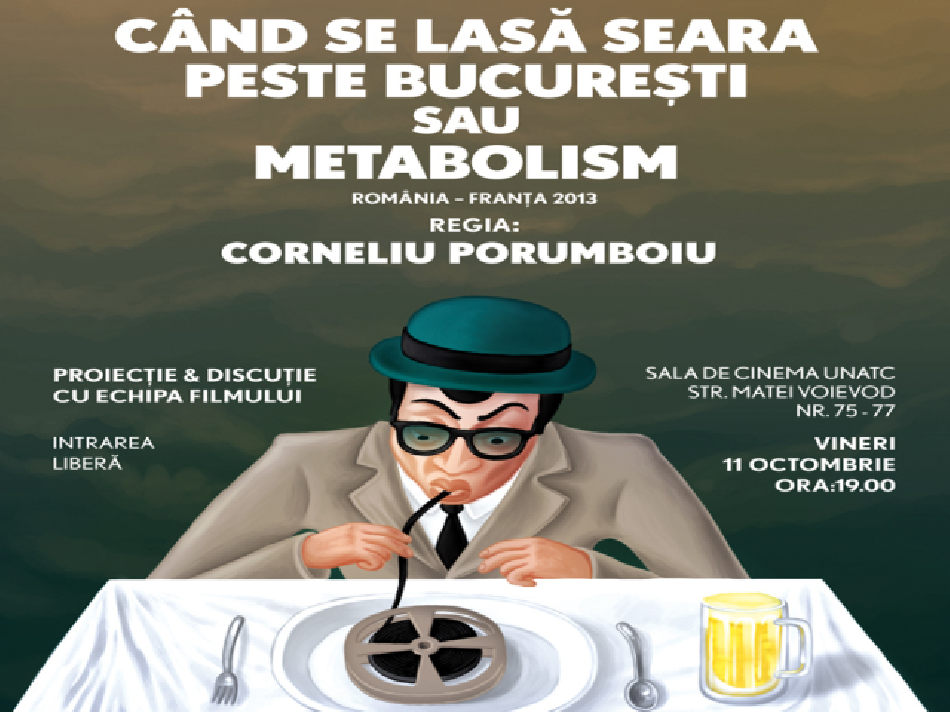
When Evening Falls on Bucharest or Metabolism (Corneliu Porumboiu, Romania, 2013)


I am a fan of Corneliu Poromboiu. His 12:08 East of Bucharest would be one of my starters choices for people wanting to get into world cinema, and I've written extensively on Police, Adjective before. He is one of the most inquisitive directors working today, constantly examining the meanings of time, words, spaces, etc. When Evening Falls... is an interesting addition to his ouvre, as it adds a bundle of questions on it's own. But as a film in itself, it was a slight dissapointment.


The film concerns the director Paul having an affair with his actress Alina. Most of the film is them talking. In the first scene, shot in one take from the inside of a car, Paul explains to Alina the importance of filming on 35 mm. With 35 mm you could only shoot for 11 minutes, while on digital, you can shoot for much longer. The new rules impact the way you make movies. I've seen reviews taken this exchange, and implying that the film supports this view. But as hopefully anyone can see, it's a bit of a bullshit argument, since nearly no films have shotlengths of over 11 min, so if that's the main difference, then the change to digital would hardly mean that much. As it is, the relationship between the form of the film, and the content, is more complex than simply form following function.

There is a later argument, which is usuable as an example. In this, Paul explains, that since the Chinese eat with chopsticks, then their food becomes more sophisticated than European food, as everything has to be in smaller pieces. This is what Deleuze and Guattari calls Assemblages. Chinese food is not just food, it is an assemblage with how you eat it, and further on how people eat are an assemblage with their cultural outlook on life. When Paul positions that his film is informed by it's use of 35 mm, then he is proposing an assemblage between an almost mystical quality inherent in celluloid, and his directorial choices. However, we, the audience, see through this explanation: He is putting a superfluous nude scene into the film due to his lust for Alina. His film is Assembled to his Libido. Towards the end of the film, after several bouts of lovemaking, Paul proclaims that he has to cut down on Alina's role, to make the political points of the film clearer. After all, something has to change in Romania. This is the surpreme artistic ideological assemblage: The mystical power of 35 mm -> flowing through Paul -> causing societal change. But then again: In reality he just wants to get laid.


This stuff, I found funny. I also found it funny to make a film about connections, and then use a quite rigid long-take aesthetic. Since normally, long-takes are supposed to be inherently impressive, not really in their connections. Paul explains the importance of the long-take in capturing reality, but the film shows how much stays out of the realm of the camera, most explicitly with the unseen person constantly phoning Alina - probably her romanic partner. In this way, we see how the filmed space is assembled to, and derives it's power from, the unfilmed space surrounding it. Also, scenes in the film do connect internally. There are a number of car scenes, there are two dinner scenes, the nude scene they rehearse is mirrored askance in a funny way later on. It doesn't really add up, though. There are fewer than 20 shots in the film, which isn't really enough to create a good Assemblage. Also, with this austere style, Porumboiu loses the short scenes which were really usually the strongest moments of his films: There is nothing comparable to the footvolleyball in Police, Adjective or the streetlights in 12:08. A further minus: The arguments of the film are pretty lopsided. His earlier films were polyphonic: There were several characters with different opinions debating in 12:08, and Police, Adjective concluded with a very famous discussion on grammar. In this new one, the discussion is constantly between Paul and Alina, and at one point Alina admits that since he is directing her, she does not feel it is an equal relationship. Therefore, Paul dominates the film. His main opponent is the style and plot of the film itself, which does undercut him quite a lot. Especially the penultimate shot of the film, mentioned a lot in writeups, funny and surprising. But that only undermines the arguments, it doesn't really bring forth an argument itself.

I like the fact that they've switched the titles in France.

This was a bit of a dissapointment. As I've said, Porumboiu might be one of the most inquisitive directors in cinema, but this time he has failed to bring his inquisition to any interesting endpoint. I like his argument, but I don't feel he takes it anywhere particularly interesting. Also, while the long-take style is cool, and many scenes are beautiful, as a whole, the style is not strong enough to support the film on it's own. And an addendum: Porumpoiu claims to have been inspired by Hong Sang-soo - whose latest I wrote about earlier this festival - on this film, which sorta makes sense. But Hong has made six films in the time since Porumboiu made his last. Hong can afford to make minor films, they Assemble into a lot. A minor Porumboiu is still interesting, and I would recommend everyone to get aquainted with his filmography. But after waiting four years, I wanted something grander and more assertive. Hopefully, the next one will come soon!

When Evening Falls on Bucharest or Metabolism is shown again Wed 4/9 at 21:30

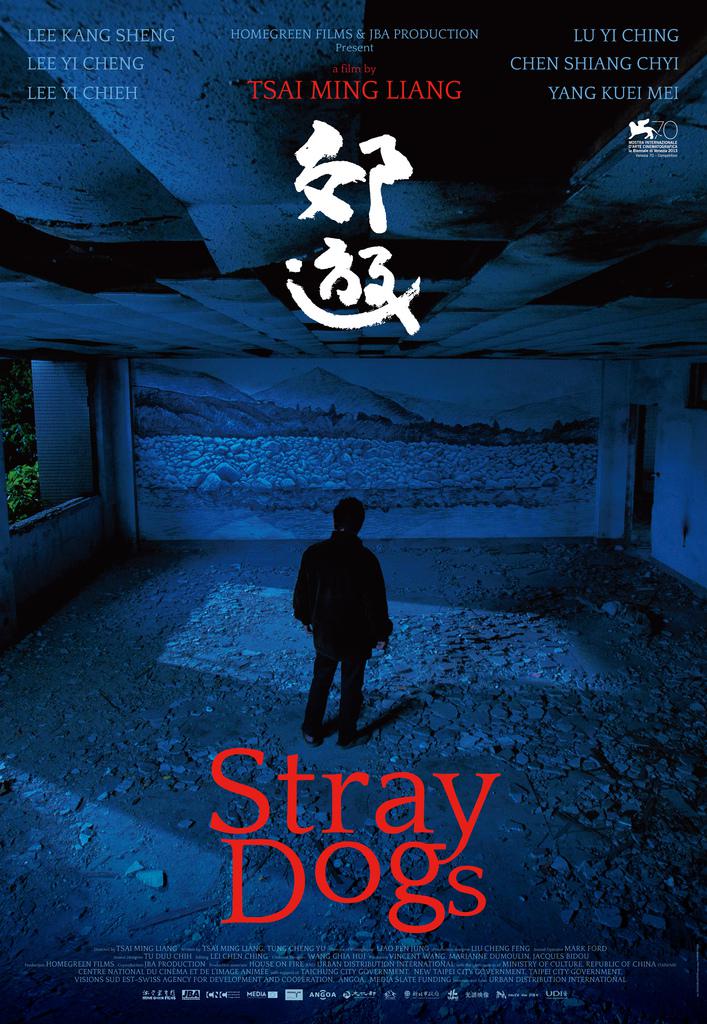
Stray Dogs (Tsai Ming-liang, Taiwan, 2013)


First of all: This was a massive masterpiece, and everyone should go see it. As soon as possible. Tsai Ming-liang is one of the grand masters of cinema, who has made personal and important features for over twenty years, winning the Golden Lion in 1994 for Vive l'Amour. This latest of his debuted at Venice last fall, where it won the Grand Jury Prize, sort of the second place. I tried to catch all of his films in preparation to this one, but didn't manage to see them all. I did see a few of his later ones, I Don't Want to Sleep Alone and the two shorts Walker and Journey to the West, which I'll discuss a bit below.

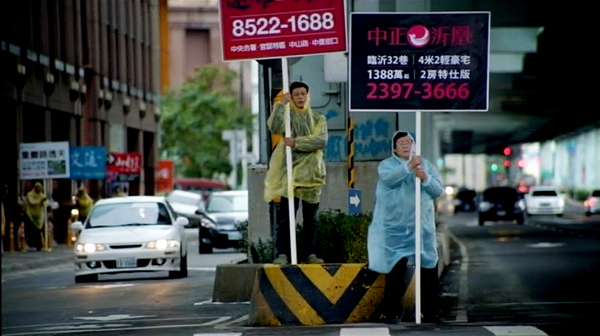
This was mainly a film about Taipei. Tsai's muse Lee Kang-sheng plays a single father, who makes his money holding a sign on the street, advertising for new appartments. But this isn't really a plotbased film, it's all about the images. And what images! The film is a breakthrough in digital cinema. It is completely unapologetic about it's digital-ness, at times it looks cheap like a soap opera. But Tsai manages to make this aesthetic look like a conscious aestethic in itself, and not just the cheap solution due to lack of 35 mm. The cheapness is furthered by some slightly wobbly camera-movements, and scenes that seem like they are shot guerilla-style. Lee parks his kids at a supermarket every day, and the camera captures them from afar, as if it is hiding. But then a shot is taken down below from a refrigerated counter, and the supermarket is mentioned as a sponsor in the credits. The shots of Lee with his sign looks guerilla style as well, but it is obviously very set up. The sign-men stand with their backs to a one-way street, so they are obviously set up for the benefit of the camera - and Tsai doesn't care that we can figure this out.


What are those guys in the back doing? Nobody can see their signs that way...

The sense of guerilla-ness is important though: This is Nomadic cinema. Yup, yet another Deleuzian term. For Deleuze, the Nomad is the person opening the stratified space, living between the lines. Sort of like a stray dog. In the city, the closest thing to a Nomad would be the homeless, which is what Lee and family are. They are using the city in a different way, using supermarkets as daycare, public bathrooms as their own, and abandoned buildings as their home. This has been a theme in some of Tsai's latest films: I Don't Want to Sleep Alone concerned a Taiwanese immigrant in Kuala Lumpur - Lee again - and his trials in creating his own spaces. The two short films Walker and Journey to the West are different, concerning a monk walking slowly, but with this ritualistic way of being, the monk creates a new temporality in the city for him to use.


But while the nomadic theme has been taken up earlier by Tsai, this is the first of his films where I get the feeling of a Nomadic image. The camera is a Nomad itself, as mentioned diving into refrigerated counters, but also hiding in corners and climbing on top of sinks. Oh, the compositions of this film! They are completely askew and offkilter, mirroring the way the characters has to find their spaces in the creaks and nannies of the city. One shot is a closeup of Lee singing an old patriotic song about the empire, but his face is a bit too much to the left of the frame, and the right is taken up by an overpass curving quite weirdly. The lines and planes of this film does not look like the lines and planes of your common film. In one of the very best scenes, Lee finds his way into a modern luxury appartment, and while it seems completely believable as a real appartment, Tsai manages to make it look 100% like a funhouse.


This is essential filmmaking, along with the Walker-shorts a good bet for the most essential filmmaking of the decade. The best film I've seen since Weerasethakul's Uncle Boonmee. I've never seen images like this. What Tsai manages to do with Taipei is complete comparable to what Rossellini did with opened Rome, or Antonioni with Sicily or Milano. This will hopefully serve as a beacon on cinema's voyage into digital. Yes, it's that good. And I haven't even mentioned the colours! Or the cabbage! Or the one short dive into melodrama: Tsai is not afraid to provide lacunes in his style, which Porumboiu's latest so sorely lacks. Or the, well, inscrutability of so much of what goes on. Which means I can't wait to see it again, and strongly considers catching it again at the festival. But I feel like I must mention the duration of the shots: This is slow cinema. Not a lot happen. As I find it completely captivating, it doesn't bother me one bit. But it's slow. Here's the thing, though, and SPOILERS for the ending of the film, so you might want to skip this last paragraph: 

The penultimate shot of the film is held for 13 min on Lee and the mysterious mother figure, who is played by three different women. The woman is in front, Lee is in the back, slightly out of focus, and they are staring at something, which we can guess is probably a mural we've seen earlier. Lee drinks a bit. Then, after an eternity, he moves forward and puts his head on her shoulder. Slight pause, then CUT to the couple seen from behind, with the mural in front of them. If this was a normal, very good film, then this would be the end. Duration causing tension, and the release feeling almost trascendental. I Don't Want to Sleep Alone ends in a sorta similar manner. But this time, the scene doesn't end. They keep standing and looking at the mural... and then... the woman leaves! I was devastated, the sight of Lee's back, alone in the room, is one of the saddest things I've ever seen. And basically everything in this film is as surprising and impactful as this ending.


Again and to sum up: This is a must-see masterpiece of modern filmmaking. To be watched and re-watched for decades to come.

Stray Dogs is shown again Sun 4/13 at 21:30. I'm strongly considering seeing it again.

onsdag den 16. november 2011

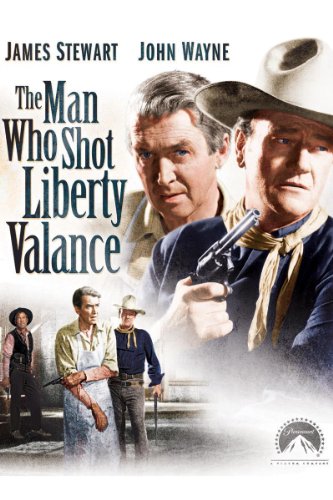
The Man Who Shot Liberty Valance (62) & Police, Adjective (09) : Cynicism II

Systems of Half-truths
Sloterdijk's Critique of Cynical Reason is a sprawling book. It's split up in two parts: Sightings: Five Preliminary Reflections, a long introductory section, and Cynicism in World Process. As with many philosophical works, you could probably read the introductory section and leave it at that... Part two discusses aspects of Cynicism in great detail, split up into Physiognomic, Phenomenological, Logical and Historical sections, but a lot of it is more examples of Cynicism and Cynicists than it is theoretical discussion. On the other hand, it does include thurough ruminations on the Kynical potentials of farts, genitals, Machiavelli, Judaism, Weimar Germany etc.

What I'm trying to get at this week is something I haven't noticed Sloterdijk discussing explicitly (but then again, I'm a blogger, not an expert on Sloterdijk), but which he seems to get at in the parts on the Phenomenological and Logical Cynicisms. These parts are concerned with how cynicism is used in governing institutions and with the knowledge and half-truths these systems use to uphold themselves, respectively. And these two parts go through subchapters on the military, the government, sexuality, medicine, the church and knowledge-gathering institutions in the same order (I'll get into a few of these subchapters in later weeks). My point is, that it would be wrong to take a simplified look at our society today, and simply say, that it is upheld by an ideology, and in the chasm between that ideology and the real truth it where cynicism is born. No, there isn't a simple cynicism in our society (as a matter of fact, what would probably be seen as reaction to the foundational ideology of our day is called Exchange Cynicism by Sloterdijk, and he only sees it as important enough to count among the 'secondary cynicisms'). There are a multitude. If anything, cynicism is rather born out of the chasm between the need to hatch oneself to a subsystem of society and it's selflegitimizing half-knowledge, and our understanding that this sub-system of knowledge is just one amongst others, with no objective way of deciding which truth-system is actually true in different situations. It's not a way of reconciling lie with truth, but rather half-truth with half-truth.

To discuss these themes, I'll go through two films. The first one is The Man Who Shot Liberty Valance from 1962 by John Ford, and it chronicles the establishing of American Cynicism. The other one is Police, Adjective from 2009 by Corneliu Porumboiu, which is concerned with Cynicism in post-communist Eastern Europe.

Pre-Ideology: The Man Who Shot Liberty Valance (62)

When I thought about doing some posts on Cynicism, this film imediately came to mind. Mostly because of that famous final statement: This is the west, sir. When the legend becomes fact, print the legend. As such, it seemed like a perfect example of how the ideology of the American nation is based on Cynicism. Some might think, that the film shows how a young honestly idealistic lawyer has to succumb to lying to establish his carreer, but it's not that simple. I'll try and show how Ransom Studdard is actually throughout the film an avatar of half-lies and ideology, and the film more shows the world accepting the lie, rather than creating it. Rather than being a film about the creation of ideology, it is, in fact, a film about the creation of Cynicism.


Studdard goes to the West because of ideology: He tells us that he had taken Horace Greelys advice 'Go west young man, go west. And seek fame, fortune, adventure' We hear this in voiceover at the beginning of his flashback, and it is imediately juxtaposed with the actuality of the west, as his stagecoach is held up by masked gunmen. We learn that Studdard is a student of law, one of those systems of halftruths I've just written about. As Liberty Valance rips out the pages of his lawbook and says: 'I'll teach you law. Western law' we get a summation of what the persons represent. Studdard is truth as it should be. Liberty Valance is truth as it is. That Studdard isn't representing truth is perhaps most clear in his dicussion with Hallie about the Cactus Rose she has just been given by Doniphon. 'Isn't that the prettiest thing you ever did see?' 'Yes, it's very pretty... Hallie, did you ever see a real rose?' 'No. But maybe someday, if they ever dam the river, we'll have lots of water. And all kinds of flowers' The irony comes from Studdard dismissing the rose in front of him as 'unreal', and calling a dream-rose located somewhere else, or somewhere in the future, the actual real rose. Studdard seems to think that his world, the world of the big city, a civilized world of law and democracy, is truth, and that the Western world he is in is just a temporary deviation from the world as it should be. When Studdard begins teaching a small class, his lessons seems to be mainly concerned with getting the students to repeat exactly what he believes in. Nora answers: 'A Republic is a state in which the people are the boss. That means us.' There is also a pretty on-the-nose comment on American history when Pompey, who is black, can't remember the part of the Declaration of Independence that goes 'All Men are created equally' prompting Studdard to reply: 'A lot of people forget about that part'. On the nose, but probably quite progressive for 62. And it shows that even 'self-evident' truths could be bended in the history of America.

What the film never forgets is, that in a democracy, truth and right is contested and ever changing. To begin with, Studdard admits that the marshall of Shinbone probably can't do anything about the hold-up, since it is a territorial offence. But his lawbooks says that in fact the marshall can arrest Valance when he returns to town. That the marshall in reality can't arrest him, since Valance would shoot him down, is not something Studdard realizes. He takes the Law as right, more than the world. The plot of the film revolves around the decision of whether the territory Shinbone is located in should become a state or not. The big ranch-owners want to remain a territory while the little people want to attain statehood, with the order that would come from that. We instinctively root for the downtrodden majority, but the film reminds us, that not just the ranchers but also the Native Americans want the area to remain open and ungoverned. Who is actually right in this question? And yet, it's not just democratic votes that determines this question. The clearest example of this is of course the shooting of Liberty Valance, and how the resulting legend influences the carreer of Studdard, but before that, in the scene in the town-hall, Studdard acts very undemocratically, when he reads out the names of himself and Liberty Valance quite normally, and then enthusiastically reads out the name of Peabody.

Throughout the film, Studdard is an ideologue. The film is not the story of the creation of an ideology to ground the creation of the nation. It is the story of the creation of a conscious exploitation of this ideology. It is about the establishment of Cynicism in America.

Post-Ideology: Police, Adjective (09)
The way American Westerns seem to be the primary group of films to grapple with the creation of American Ideology, in the same way the new wave of Romanian Cinema seems to me the primary group grappling with the dis-mantling of Communist Ideology. While none of the directors are as brilliant and singular (at least as of yet) as a Sokurov or a Tarr, precisely the singularity and personality of these two great auteurs means their works work on a more abstract and diffuse level. Romanian cinema, on the other hand, seems quite concerned with Romania.


While I just assumed everyone would have a basic idea of the plot to John Ford's western (it's pretty much in the title), it's probably in it's place to present a small recap of this kind of obscure film (spoilers of course). Cristi is a policeman working in a small Romanian city. He has just returned from his honeymoon abroad, where he has seen how the law is different in other countries, and it makes him question the rules he is meant to uphold. He has been assigned to a case concerning a young man who apparantly deals marihuana, but Cristi suspects that his witness is accusing the young man for personal reasons, and he fears that the punishment of the young boy would be disproportionate to the crime. The film mostly just follows Cristi. Not just as he stands around watching the young man and his friends, but also in his home, where he eats a dinner by himself one night, and another night discusses a song with his wife. In the end, Cristi is called into the office of his boss, where he expresses his concerns that an unjust law of society shouldn't trump his own feeling of a 'moral law', and is forced by his boss to read the definition of several words in a dictionary, none of which provides any proof for the importance of 'moral law'. After that, the arrest takes place off-screen, and the film ends. It is a very slow film, but also very riveting.

The reason I thought of this film as a companion to Liberty Valance, is the way both films are concerned with books and rules and law. In the scene where Cristi and his wife discusses the song, Cristi claims that the lyrics doesn't make sense, while his wife sees them as making sense on a symbolic or imagery level. She can't really choose. Here we get the discussion of whether language should be stringent and bound by common rules of meaningmaking, or if a subjective and sorta artistic (I'm not sure I would describe the very kitschy lovesong as 'art'...) can reach a more profound truth, sorta the same discussion I noted in Solaris. Yet the differences between this film and the Western mirror the differences between democracy and authoritarianism. While the key scenes in Liberty Valance is the ones where we see how the characters use and bend the voting system to their advantage, the key scene in Police Adjective is the one where Cristi is being forced to read out the definition of words. As I said, in democracy, truth is contested, while in an authoritarian system, it's decided from on top. Even when Studdard references laws that are bigger than his surroundings - as he does when they discuss whether or not the hold-up was a territorial offence - he does so in a searching and inquisitive manner. In Police, Adjective, Cristi's boss Captain Anghelache uses the authority of the book to support his authority as a boss.

The cynical moment in the film is where the film gets it's title. As Cristi reads about Police, he gets to the two uses of Police as an adjective: The Police Novel (as it's apparantly known in Romania) and: About police states or regimes which are supported by the police and which exercise control through repressive methods' This, however, immediately prompts Anghelache to reply: 'Ridiculous! All states depend on the police' Through this reply, he suddenly admits that the book could be wrong, yet this admission doesn't make him change his stance on the arrest. This is authoritarian Cynicism, where the tyrant know full well that the rulers has stopped serving the law, and instead uses the law to serve the rulers themselves.

So to sum up: Cynicism is not just usable to explain how big ideologies like Liberalism or Communism can continue to function. It also helps to overlook more structural issues. In a democracy, truth is contested and subservient to the views of the majority, while in an authoritarian system, truth is subservient to the views of those in power. The Cynicist realizes this, yet he continues to believe in his place in the system.

Next week: Pedagogy as a possible example of benevolent cynicism. With Dostoyevsky's Brothers Karamasov and Lars von Trier's Melancholia.

[Part I: Introduction and Mad Men]
[Part III: Brothers Karamazov and Melancholia]
[Part IV: Apocalypse Now]
[Part V: Inception]
[Part VI: Inglourious Basterds]