Viser opslag med etiketten Taiwan. Vis alle opslag

tirsdag den 10. februar 2015

GIFF day 10: Jauja, Exit, Butter on the Latch

Jauja (Lisandro Alonso, Argentina, 2014)

In discussion of film, as in so many artforms, money is often the enemy. Boo on Hollywood, capitalist purveyor of superficial entertainment. Yay on those artists on the fringes, using small crews and cheap practices to make much more daring, personal art. People like Lav Diaz, who can make eight hours of black-and-white film in a year, or Pedro Costa, who portrayed the poor people of Fontainhas with digital camera and a small crew. Or like Lisandro Alonso from Argentina, who's film Los Muertos was just a depiction of a man travelling from jail to where he used to live. That one, the only Alonso I have seen, was great and beautiful, using amateur actors, natural light, nature photography. This one is a bit more professional, with Viggo Mortenson playing the main role, and the film being a historical drama with costumes and guns and stuff. It still retains a sense of the austere, of the amateurish, of the personal and daring. I felt like it spoke to me very personally. Which, at least at times, was awful.


Mortensen portrays Dinesen, a Danish soldier who is emigrating to Argentina with his teenage daughter. Mortensen is a great actor, and carries himself with a natural strenght that fits the role very well, but he's still awful: He simply can't speak Danish. Almost every linereading of his is a pain to get through. And Viillbjørk Malling Agger is pretty awful as his daughter, Ingeborg, as well. She is supposed to be a young dreaming girl who don't know what she's doing, but she always seems like a young actress who don't know what she's doing. It's horrible. Here's the thing though: I'm absolutely certain that they are in no way worse than the Spanish-speaking actors in this film – or the amateaurs filling the screen in films by Diaz or Costa – but it's just so extremely clear to me when they speak Danish, how awful their linereadings are. It's a really interesting experience, because people don't make films like this in Danish, so I've never been subjected to it before.

And then there is the flipside. As with so many of this kind of film, the story in Jauja is skeletal and allusive. And many of these allusions point to Danish history and culture. I don't want to spoil it, but connoisseurs of Danish literary history will know about the famous nineteenth soldier Dinesen, and who his daughter turned out to be. Not that the story matches up with their lives. Ingeborg runs off with a young Argentinian soldier, and Dinesen takes off after her. Into the wilderness everybody goes, the young couple being followed by crazy deserter Zuluanga, Zuluanga in turn followed by Dinesen, and Dinesen being shadowed by the indigenuous people of the Patagonia. The only thing that doesn't move into the wilderness is official Argentina itself, as they all have to go to an official ball... All these elements are portrayed in the most simple way, along with sealions, rocks and streams, ending up like a poem or one of those famous paintings by Brueghel. Or, as I think is the point of the film, like one of the short stories by the famous Danish writer who's father was named Dinesen. In that way, the film becomes about European culture contrasted with what lies outside, the interactions between those places, in a way that is all the more interesting for me as a Dane, knowing the life stories that the film never includes. It was a singular experience, both awful and intriguing at the same time.

Exit (Hsiang Chienn, Taiwan, 2014)


I watched this film because the program claimed that it 'smelled like Tsai Ming-liang'. It made me wonder what on earth that could mean. Because, in a way it's very true. A Taiwanese film about lonely people trying to connect, delivered without much language, and with a focus on the architecture they live in, that seems very much like Tsai's films like The Hole or Vive l'Amour. But the style wasn't Tsai'ian at all. Tsai films with a steady camera, calmly observing. Almost every shot in this film was handheld and slightly shaking, filled with closeups. Here's the thing: Tsai's films are great because his chosen style is amazing to transmit his chosen themes. So working through the same themes in a different style? It means the film says kinda the same things, just in a less effective way.


So the film removes the style from Tsai, which is the most important part of Tsai, then substitutes it with the style most common from American indie, a style that I really don't like. The story for the film is also kinda seen before. A middle aged woman, living alone in an appartment in Taipei, both her husband and her daughter having moved elsewhere to make more money. She dreams of dancing tango, and takes care of her ailing mother, who is in the hospital. In the hospital, she notices a man in the bed across her mother, who has clearly been in a horrible accident, and now can no longer hear, and has bandages over his eyes. The tender way she begins to take care of him is pretty sweet, but also nothing out of the ordinary.

And yet. I didn't think much of the narrative, and I dismissed the style. And yet I kinda like the film? I guess I have to admit it does do something with style – since as the film is pretty close to being plotless, that can't really be what spoke to me. I have to admit, that a film with as little dialogue as this, that manages to keep interest, is doing something right. The architecture IS beautifully used. There is a dream sequence that is beautifully done, perhaps even more effective for how much it stands out from the rest of the film. The ending of the film includes some shots held for a veeeeery long time, which I always like. And even if 'the lonely woman' is a trope in this kind of cinema of modern ennui, I don't think I've ever seen this particular middleaged woman before. This kind of film doesn't normally deal with menopause. And I can't recall another film where maxipads played such a big symbolical role...

Butter on the Latch (Josephine Decker, USA, 2014)

Watch this trailer to the end!

Another Josephine Decker! Thou Wast Mild and Lovely was one of the biggest surprises from the festival, so I was quite excited to see this one, her debut feature. It's not quite as good. In a way, it's the same style, a mix of indie-tropes, visuel poesy, and glimpses of horror, but the indietrope drawn on at the start of Butter on the Latch is one of my most hated of all the tropes. I hate when a young debuting film director, wherever they come from, debuts with a story of how young smart creative people in their own town live. Some of it can be really good – Hi, Lena Dunham! - but no matter how great it is, it loses a couple of points in my book. This film begins in New York, with young smart New Yorkers, yapping and yapping about theater plays and nightlife. Mixed with glimpses of something better, but it still started the film at a disadvantage.

Then the film luckily moves to somewhere more unique. A Balkan-music workshop in the Californian woods. Now, I say that is unique, in a way it's as hipster as can be. But it's still visually and aurally unique. At that point, the film finds the same kind of poetry that it found on a farm in Kentucky in ...Lovely. I don't really like the improvised dialogue scenes, they're good for what they are, they're just too indie once again. And I'm not a big fan of horror-tropes either. But Decker simply has a visual style, that is so extremely promising. She builds up a scary scene with quick cutting and weird angles, and then at it's conclusion switches to calm steady shot >< reverse shot, and the effect is even more unnerving. There's an absolutely fabulous sequence, set to Morton Feldman's Three Voices, of women dancing in the woods, where at one point a woman does something with her eyes which is one of the freakiest things I've ever seen. And again, I like that there is a female perspective on everything, with the relationship between friends Sarah and Isolde being the core of the film.

If you have the time, check out at least the start of this beautiful piece of music. American film is way too bad at drawing on modern American classical composers like Feldman, or Steve Reich or John Adams. It's always Philip Glass.

Most of all: Even if this film is weaker than the other, I'm just really really happy to have a favorite new American filmmaker. I joked some time ago, that my favorite American films of the last few years were Frozen and The LEGO Movie, and even though that isn't entirely true – I like some documentaries – it's not far off either. With American film, it's hard to be neutral. Even among arthouse, the country is so overrepresented in the cinemas and on critics list, that when the country's output only make up like 10-20% of what I consider my favorite films, it seems snobbish, perhaps even radical. I like American film quite a bit. I'm okay with Linklater and Wes Andersson, but I rarely adore what they do. Every now and then I like a weird film like Shane Carruth's Upstream Color, or Andrew Bujalski's Computer Chess. I like old masters like Terrance Malick or James Benning. I don't need to pick favorites among my favorite French films each year, if something great comes along, I take. it. But all over the film-sphere, it's American this, American that. And I frankly like that there is a new American voice, whom I'm invested in, that I really want to see succeed, and is really excited about following through further feature film escapades. Feels good. Firmly on Team Decker.

søndag den 6. april 2014

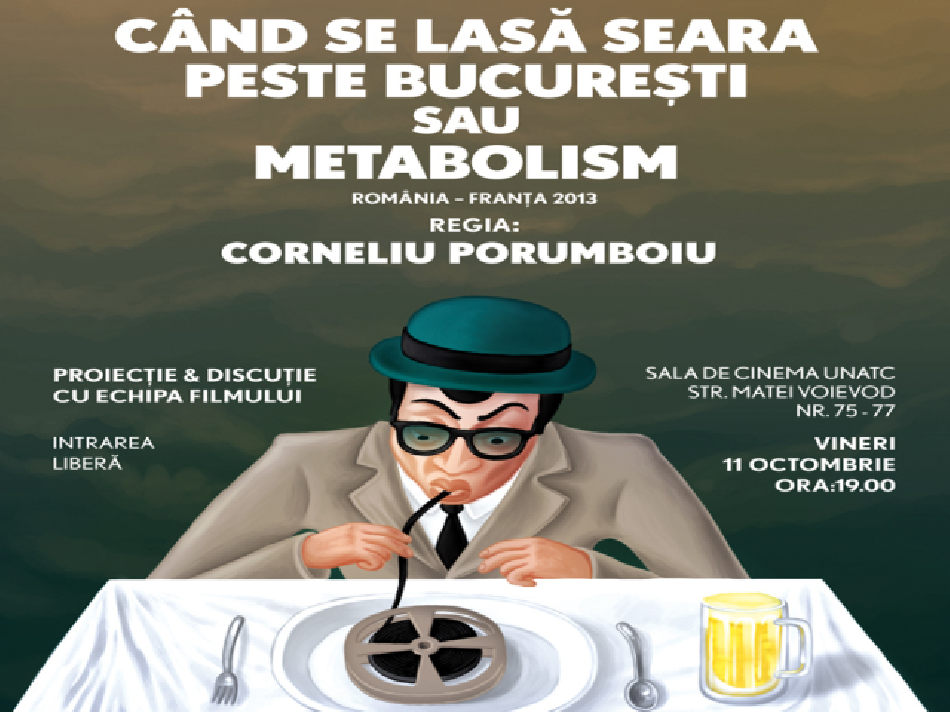
CPHPIX day 3: When Evening Falls on Bucharest or Metabolism, Stray Dogs

With today's two writeups, I'm going to mention Deleuze for both. Because why not.

When Evening Falls on Bucharest or Metabolism (Corneliu Porumboiu, Romania, 2013)


I am a fan of Corneliu Poromboiu. His 12:08 East of Bucharest would be one of my starters choices for people wanting to get into world cinema, and I've written extensively on Police, Adjective before. He is one of the most inquisitive directors working today, constantly examining the meanings of time, words, spaces, etc. When Evening Falls... is an interesting addition to his ouvre, as it adds a bundle of questions on it's own. But as a film in itself, it was a slight dissapointment.


The film concerns the director Paul having an affair with his actress Alina. Most of the film is them talking. In the first scene, shot in one take from the inside of a car, Paul explains to Alina the importance of filming on 35 mm. With 35 mm you could only shoot for 11 minutes, while on digital, you can shoot for much longer. The new rules impact the way you make movies. I've seen reviews taken this exchange, and implying that the film supports this view. But as hopefully anyone can see, it's a bit of a bullshit argument, since nearly no films have shotlengths of over 11 min, so if that's the main difference, then the change to digital would hardly mean that much. As it is, the relationship between the form of the film, and the content, is more complex than simply form following function.

There is a later argument, which is usuable as an example. In this, Paul explains, that since the Chinese eat with chopsticks, then their food becomes more sophisticated than European food, as everything has to be in smaller pieces. This is what Deleuze and Guattari calls Assemblages. Chinese food is not just food, it is an assemblage with how you eat it, and further on how people eat are an assemblage with their cultural outlook on life. When Paul positions that his film is informed by it's use of 35 mm, then he is proposing an assemblage between an almost mystical quality inherent in celluloid, and his directorial choices. However, we, the audience, see through this explanation: He is putting a superfluous nude scene into the film due to his lust for Alina. His film is Assembled to his Libido. Towards the end of the film, after several bouts of lovemaking, Paul proclaims that he has to cut down on Alina's role, to make the political points of the film clearer. After all, something has to change in Romania. This is the surpreme artistic ideological assemblage: The mystical power of 35 mm -> flowing through Paul -> causing societal change. But then again: In reality he just wants to get laid.


This stuff, I found funny. I also found it funny to make a film about connections, and then use a quite rigid long-take aesthetic. Since normally, long-takes are supposed to be inherently impressive, not really in their connections. Paul explains the importance of the long-take in capturing reality, but the film shows how much stays out of the realm of the camera, most explicitly with the unseen person constantly phoning Alina - probably her romanic partner. In this way, we see how the filmed space is assembled to, and derives it's power from, the unfilmed space surrounding it. Also, scenes in the film do connect internally. There are a number of car scenes, there are two dinner scenes, the nude scene they rehearse is mirrored askance in a funny way later on. It doesn't really add up, though. There are fewer than 20 shots in the film, which isn't really enough to create a good Assemblage. Also, with this austere style, Porumboiu loses the short scenes which were really usually the strongest moments of his films: There is nothing comparable to the footvolleyball in Police, Adjective or the streetlights in 12:08. A further minus: The arguments of the film are pretty lopsided. His earlier films were polyphonic: There were several characters with different opinions debating in 12:08, and Police, Adjective concluded with a very famous discussion on grammar. In this new one, the discussion is constantly between Paul and Alina, and at one point Alina admits that since he is directing her, she does not feel it is an equal relationship. Therefore, Paul dominates the film. His main opponent is the style and plot of the film itself, which does undercut him quite a lot. Especially the penultimate shot of the film, mentioned a lot in writeups, funny and surprising. But that only undermines the arguments, it doesn't really bring forth an argument itself.

I like the fact that they've switched the titles in France.

This was a bit of a dissapointment. As I've said, Porumboiu might be one of the most inquisitive directors in cinema, but this time he has failed to bring his inquisition to any interesting endpoint. I like his argument, but I don't feel he takes it anywhere particularly interesting. Also, while the long-take style is cool, and many scenes are beautiful, as a whole, the style is not strong enough to support the film on it's own. And an addendum: Porumpoiu claims to have been inspired by Hong Sang-soo - whose latest I wrote about earlier this festival - on this film, which sorta makes sense. But Hong has made six films in the time since Porumboiu made his last. Hong can afford to make minor films, they Assemble into a lot. A minor Porumboiu is still interesting, and I would recommend everyone to get aquainted with his filmography. But after waiting four years, I wanted something grander and more assertive. Hopefully, the next one will come soon!

When Evening Falls on Bucharest or Metabolism is shown again Wed 4/9 at 21:30

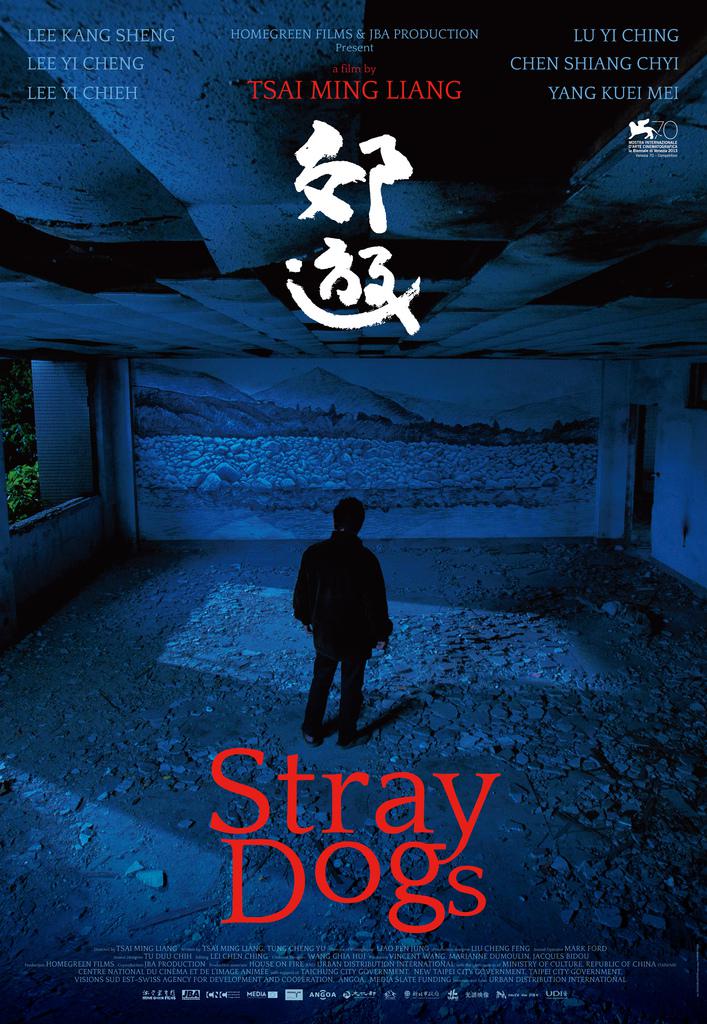
Stray Dogs (Tsai Ming-liang, Taiwan, 2013)


First of all: This was a massive masterpiece, and everyone should go see it. As soon as possible. Tsai Ming-liang is one of the grand masters of cinema, who has made personal and important features for over twenty years, winning the Golden Lion in 1994 for Vive l'Amour. This latest of his debuted at Venice last fall, where it won the Grand Jury Prize, sort of the second place. I tried to catch all of his films in preparation to this one, but didn't manage to see them all. I did see a few of his later ones, I Don't Want to Sleep Alone and the two shorts Walker and Journey to the West, which I'll discuss a bit below.

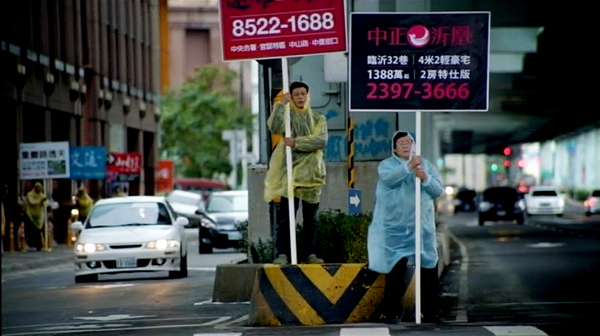
This was mainly a film about Taipei. Tsai's muse Lee Kang-sheng plays a single father, who makes his money holding a sign on the street, advertising for new appartments. But this isn't really a plotbased film, it's all about the images. And what images! The film is a breakthrough in digital cinema. It is completely unapologetic about it's digital-ness, at times it looks cheap like a soap opera. But Tsai manages to make this aesthetic look like a conscious aestethic in itself, and not just the cheap solution due to lack of 35 mm. The cheapness is furthered by some slightly wobbly camera-movements, and scenes that seem like they are shot guerilla-style. Lee parks his kids at a supermarket every day, and the camera captures them from afar, as if it is hiding. But then a shot is taken down below from a refrigerated counter, and the supermarket is mentioned as a sponsor in the credits. The shots of Lee with his sign looks guerilla style as well, but it is obviously very set up. The sign-men stand with their backs to a one-way street, so they are obviously set up for the benefit of the camera - and Tsai doesn't care that we can figure this out.


What are those guys in the back doing? Nobody can see their signs that way...

The sense of guerilla-ness is important though: This is Nomadic cinema. Yup, yet another Deleuzian term. For Deleuze, the Nomad is the person opening the stratified space, living between the lines. Sort of like a stray dog. In the city, the closest thing to a Nomad would be the homeless, which is what Lee and family are. They are using the city in a different way, using supermarkets as daycare, public bathrooms as their own, and abandoned buildings as their home. This has been a theme in some of Tsai's latest films: I Don't Want to Sleep Alone concerned a Taiwanese immigrant in Kuala Lumpur - Lee again - and his trials in creating his own spaces. The two short films Walker and Journey to the West are different, concerning a monk walking slowly, but with this ritualistic way of being, the monk creates a new temporality in the city for him to use.


But while the nomadic theme has been taken up earlier by Tsai, this is the first of his films where I get the feeling of a Nomadic image. The camera is a Nomad itself, as mentioned diving into refrigerated counters, but also hiding in corners and climbing on top of sinks. Oh, the compositions of this film! They are completely askew and offkilter, mirroring the way the characters has to find their spaces in the creaks and nannies of the city. One shot is a closeup of Lee singing an old patriotic song about the empire, but his face is a bit too much to the left of the frame, and the right is taken up by an overpass curving quite weirdly. The lines and planes of this film does not look like the lines and planes of your common film. In one of the very best scenes, Lee finds his way into a modern luxury appartment, and while it seems completely believable as a real appartment, Tsai manages to make it look 100% like a funhouse.


This is essential filmmaking, along with the Walker-shorts a good bet for the most essential filmmaking of the decade. The best film I've seen since Weerasethakul's Uncle Boonmee. I've never seen images like this. What Tsai manages to do with Taipei is complete comparable to what Rossellini did with opened Rome, or Antonioni with Sicily or Milano. This will hopefully serve as a beacon on cinema's voyage into digital. Yes, it's that good. And I haven't even mentioned the colours! Or the cabbage! Or the one short dive into melodrama: Tsai is not afraid to provide lacunes in his style, which Porumboiu's latest so sorely lacks. Or the, well, inscrutability of so much of what goes on. Which means I can't wait to see it again, and strongly considers catching it again at the festival. But I feel like I must mention the duration of the shots: This is slow cinema. Not a lot happen. As I find it completely captivating, it doesn't bother me one bit. But it's slow. Here's the thing, though, and SPOILERS for the ending of the film, so you might want to skip this last paragraph: 

The penultimate shot of the film is held for 13 min on Lee and the mysterious mother figure, who is played by three different women. The woman is in front, Lee is in the back, slightly out of focus, and they are staring at something, which we can guess is probably a mural we've seen earlier. Lee drinks a bit. Then, after an eternity, he moves forward and puts his head on her shoulder. Slight pause, then CUT to the couple seen from behind, with the mural in front of them. If this was a normal, very good film, then this would be the end. Duration causing tension, and the release feeling almost trascendental. I Don't Want to Sleep Alone ends in a sorta similar manner. But this time, the scene doesn't end. They keep standing and looking at the mural... and then... the woman leaves! I was devastated, the sight of Lee's back, alone in the room, is one of the saddest things I've ever seen. And basically everything in this film is as surprising and impactful as this ending.


Again and to sum up: This is a must-see masterpiece of modern filmmaking. To be watched and re-watched for decades to come.

Stray Dogs is shown again Sun 4/13 at 21:30. I'm strongly considering seeing it again.