Viser opslag med etiketten Jean-Luc Godard. Vis alle opslag

søndag den 25. januar 2015

GIFF day 2: La Sapienza, Goodbye to Language, Daughter... Mother... Daughter...

La Sapienza (Eugène Green, France/Italy, 2014)

My plan this morning was to go and see Dominik Graf's three-hour Schiller-biopic, Beloved Sisters. But it turned out I misread the programme, and when I was ready to leave it had already been playing for an hour. I had a Plan B: Field of Dogs, according to the program a visionary retelling of Dante's Divine Comedy. But that one was sold out. So instead I went and saw this one, which played at the local business school, 100 m from where I was. There were a lot of tickets, and it was about architecture, which interests me. So that seemed a fine Plan C.

It was an amazing experience. The plot of the film is simple: A French architect named Alexandre travels to Rome with his wife to look at architecture by the great Borromini. On the way there, in Schwitzerland, they run into a young brother and sister. He wants to study architecture and she is sick. The rest of the film is the men looking at churches and the women talking. But the style... The style was like the rigorous modernist cinema of old, except in digital, and with a deadpan humour that never allowed things to get too serious. The actors walked around and declamated their lines like in the cinema of the great French filmmaker Robert Bresson. Many shots of only feet and hands of people also seemed Bressonesque. The rigourously composed symmetrical shots and long discussions with actors at times looking directly into the camera reminded me of the late-late-late period from 106-year-old-and-still-going filmmaker Manoel de Oliveira. With it's discussions of architecture and multilingual characters especially Oliveiras very great A Talking Picture (2003). And a large percentage of the images is just the camera looking at architecture, filming modern appartment buildings and factories from a distance, and contrasting it with loving closeups of the detailed, light-filled beauty of the old churches.
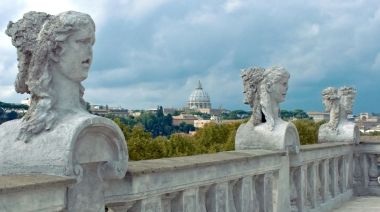

There is a tiny problem: The film depicts people fed up with functionalistic, modernist life and compares that to the baroque beauty found in Roman architecture, but the style of the film is kinda modernist and functionalistic as well. That is in and of itself not the biggest problem, and the film does critique it's own style as it goes along, slowly accumulating enough over-the-top characters, details and weird interludes, to carry on a sense of baroque-ness. And as the characters achieves the titular 'sapience' (which is a word for wisdom in some way, I don't really know) the style changes, becoming more rounded. But there was another big film recently about intellectuals looking for meaning amongst the old buildings of Rome: Paolo Sorrentino's The Great Beauty. And while La Sapienza works with the same outmoded, modernist form that he critiques, Sorrention's cinema seems to strive towards a new cinematic language, perhaps more fitting to the critique. The GIFF-programmers wittingly describe La Sapienza as a 'rectangle-drama', a great description of a certain type of cinema. In contrast, Sorrentino's film is all curves, broken lines, movements, fluidity. When Alexandre describes a facade by his beloved Borromini as being 'always in motion', his description sounds more like Sorrentino than the static shot we get from Green. And also, Sorrentino's film was one of the biggest arthouse successes in recent years, and even won a Foreign Language Oscar, one of the few times that prize has gone to a truly brilliant film. There is no way Eugene Green's film will get even close to that attention. So in a way, this whole film might be a bit... superfluous...

But on the other hand. I watched this film with many, many people in a big theater, and the people laughed, smiled, and had a good time. Two of the other three showings are already sold out. I was also surprised to find, that director Eugene Green is an old and experienced artist, having worked extensively in theater and only directed four theatrical features before, but those films premiering at Cannes and Locarno. It took no more than ten minutes before I mentally made a note of checking everything else I could find by this weird and idiosyncratic director. I had no idea what I was getting. I will perhaps never get the chance to watch this or the rest of the directors filmography again, at least not on the big screen. This was a unique experience, one I didn't anticipate at all. And surprises like this are the reason I love film festivals so very very much!

Goodbye to Language (Jean-Luc Godard, France, 2014)


Ah, Godard. Trying to handle a late-period Godard film after only one viewing is a foolish task. And this one was in 3D, so there were twice as many layers. I'm mainly confused, and grasping at straws, trying to connect as much of this montage of sounds, words, works cited and images into something adding up to something. I saw and wrote about his first 3D short Les Trois Dés-Astres last year at PIX, so I might begin there. That one depicted 3D as a disaster for cinema, yet another in a lineage of failures for the medium (ranging from the Holocaut to the domination of Hollywood, because those two things can obviously be compared). Perhaps Goodbye to Language is about saying goodbye to the old language of film? The screen flashes Ah, Dieux at times, and the final time I understood it to be a pun on Adieu, but perhaps also on Un, Deux (if you say it with an accent?) There are of course a bunch of clips from old films, but not really anyone I recognized. And the main story is something about a woman and a man, and another woman and a man, and the women are naked a lot of the time, and the men are disparaging and don't really think much of the women. 'Women can't create evil', they say (or something to that effect). Then there's a scene with Mary Shelley, writing Frankenstein, reminding us that a woman wrote perhaps the first piece of horror-fiction. So there is that. I don't know, I don't at all get what the plot was about. There was a great dog named Roxy, though, I liked the dog!

So much stuff on language. Over the end credits, a couple is 'speaking' in dog-language with a baby. There are a bunch of philosophical quotes on language. The two parts of the film are called 'Nature' and 'Metaphor', perhaps suggesting that the second part turns the first part into an understandable language? Except the two parts apparantly mirror each other quite a lot, and none of them are easy to figure out. There's a discussion of language and atrocity, one of the women tells a story of an SS officer yelling at a kid at the entrance to the gas chamber, that 'There is no why'. In the beginning of the film, a professor comments on the subtitle of Solshenitsyn's The Gulag Archipelago: A Literary Investigation. What lies beyond language is atrocity. Horror. But also childhood, and nature, shown on screen through the many many scenes featuring the dog Roxy. There is also a scene where a painter tries to explain how to show depth through water colour, mirroring the way Godard himself tries to figure out the grammar of this weird new technology.

And Godard struggles with turning 3D into a language. As with many of his more recent films, he uses low-grade video and digital, and those blurry images create sheets of colour when the image is given depth. The film checks out the ticks of this new medium, for instance filming out of the windshield of a car on a rainy night, which creates floating specks of neon-light where the water-drops mirror streetlight. There are a couple of times where the filmmakers must have turned one of the two cameras needed to film in 3D to the side, making the image simply split, and forcing me to blink each eye to watch two films at once, until the camera turns back and the image connects again. There are other sequences where the effect simply doesn't work for me, where the foreground is too far away from the background, and all of a sudden what was a couple tablelegs turns into a ghostly seethrough presence. And at times there are only abstract dots and lines onscreen. Basic filmic grammar is also broken, as the camera turns upside down, the shadow of the cameraman is seen on the ground, the plot is achronological, etc.

Haven't got a clue. I read the book Jean-Luc Godard: Cinema Historian by Michael Witt recently, and that book noted how perhaps Godard should be thought of as a mixed-media artist than a filmmaker, since for the longest time he has been working with collages of existing media, as well as video, installation, text, sound, etc. This film definitely blurs the limits of the new 3D medium, and is to a large extent about those limits. That is what I got from it on the first try. That, and an ever so slight headache.

Daughter... Mother... Daughter... (Panahbarkhoda Rezaee, Iran, 2014)


When watching a bunch of films over a short period, there will probably always be some that don't get full attention. I was tired, and the Godard mindfuck kept swirling round my brain. Also, this was a sloooow film, without dialogue, but with a beautiful soundtrack of music, nature sounds, and poetic narration in Iranian. Always the sounds of birds cheeping, water running, and a train passing by from time to time. It was hypnotic in a way. It put the person next to me to sleep several times throughout the seventy minutes.

It was a film on boredom, on being trapped in a life without any hope for a future. Grandmother spins yarn all the time, spinning spinning spinning. Mother walks around the wheat-fields, longing for her husband who took the train to get away. Daugher is sick and struggling to breathe, lying in bed all day, listening to the sounds of nature, dreaming of seeing the sky. There is a son, but he also leaves early on. The women are stuck - as many women probably are in Iran. Most of the film is longheld shots of each woman standing or sitting or laying alone, and then the narrator says something about them. We never hear any names. At times the women watch tv together, and we get old black and white clips, or perhaps it's new clips made to look old, I don't know. Death is never far from the family, and at times the women look ghostly covered as they are completely in black, walking the barren landscape. A shot of light streaming over the mountains is amazing, perhaps showing grace. There is only a single shot where the women interact, where the mother strokes the hair of the daughter, and then they cry. It's very cathartic, after having watched so much film without anybody showing any emotion at all.

This was artfilm. Very lowbudget I think. High res digital pictures, no cameramovements at all, all sound added afterwards, only four people in the film. I love seeing such a small and personal projects, and I liked listening to the Iranian poesy. Had it been much longer than 70 minutes, it would probably have been too much, though... Also, googling the director, his name is apparantly spelled a bunch of different ways in the west, and his other features have names like A Cradle for Mother and even Daugher... Father... Daughter... Now I'm intrigued, and would like to see if his films might make more sense through accumulation.

Note on language, apropos Godard: I like Iranian cinema, I've seen quite a lot of Iranian films, which means I've seen a bunch of Iranian writing rolling over screen at the beginning and end of a film, and it has always seemed like curves and not like words. But all of a sudden, tonight, in the blink of an eye, I could make out letters. Not that I understood anything, it just looked like a language all of sudden. Weird how that works.

Also Seen:
Another film from competion, Susanna Lenken's debut feature My Skinny Sister, which I will write about elsewhere. A fine debut, a great depiction of two young sisters.

fredag den 18. april 2014

CPHPIX day 11+12: 3x3D, Like Father Like Son, Young & Beautiful, The Congress

So things are pretty busy now. I've also moved. And so, I've combined days 11 and 12 into one post. I only saw four films in those two days - and rewatched one - so it'll fit.

3x3D (Peter Greenaway, Edgar Pêra, Jean-Luc Godard, Portugal, 2013)


Omnibus films are weird. There seems to be made a surprising amount of them, and they aren't really shown that much. This collection was funded by the Portuguese city of Guimarães, European Cultural Capital of 2012, and is apparantly the second such project, after 2012's Centro Histórico with short films by Pedro Costa, Manoel de Oliveira, Victor Erice and Aki Kaurismäki. I think this one has had a higher profile, wonder if it's due to the inclusion of Godard or 3D...

The first segment was Peter Greenaway's Just in Time. It seems like a tourist advertising for the city of Guimarães, cirkling around a castle in the center, while figures from Portuguese history stands around and their is blocks of text everywhere. I had to look for reviews to get the segment-titles, and was dissapointed to find out that almost every reviewer pointed out what I thought was a clever and precise description: This was like a cross between Sokurov's Russian Ark and an old CD-ROM from the mid-nineties. It's like if Russian Ark wasn't a filmic achievement, and didn't really have a point of view, nor, frankly, any deep interest, in the history it depicts. It's all just facts and figures. I still kinda liked it. For one, it was quite like the other Greenaway I saw this year, Goltzius and the Pelican Company. European history, pictures in pictures, text and action on different planes in the picture. The fact that it mostly looked like a tester for a new kind of Image Software didn't bother me as much when I saw it as a test-run for a development in his filmic language. It doesn't make it good, but perhaps he learned some stuff he can use in a real film? The other thing is that I just find Portuguese history fascinating. It might be the country in Europe I know least about. It all seems like a weird mirror-house version of what I know of western-European history. I love stuff like de Oliveira's historic films and Raul Ruiz' very great Mysteries of Lisbon. This worked as an exhibition. It wasn't a good film, though.

Then came Edgar Pêra's Cine-sapiens. Apparantly, in Cannes this was the third segment, and a big part of the crowd walked out. At this screening, it had switched places with the Godard segment. Which was smart, save the best for last. I don't know who Edgar Pêra is, and I don't know if I care to find out. This was a rumination on the cinema of spectacle, with reenactments of Al Jolson in the Jazz Singer, bringing sound to the masses for the first time, scenes from Wizard of Oz, and mixed with a general b-movie asthetic. All held in a movietheater filled with spectators and set to overenounciated voiceover. The 3D effects were so extreme and in-your-face that it made my head hurt, and it was all just a cacophany of noise and spectacle. I understand why people got up and left, it was a bit headache-inducing. It's not as bad as people made it out to be. It's trash, but it's about trash. It's the one segment I would never want to see again, but I wasn't about to leave.

And then there is Godard. Good ol' Godard. Getting money from Guimarães to make a 3D film, what does he do? He makes Les Trois Dés-Astres, yet another of those cine-essays he has made since Histoire(s) du Cinema, begun in the late eighties. Mainly about the same as the rest of his essays, and 90% on anything else than 3D. Whenever he circles back to 3D it's on the format as a pointless gimmick, or as a disaster, as the title alludes to. It pretentious, it's way too much to take in in a single viewing. But I love this whole project. I love re-watching a segment and getting more of it as I work my way through film-history. Some of the juxtapositions are really touching. It might just be a guy in a dress dancing in slow-motion, cutting to a man shooting a mirror, but knowing it's the oprichnik scene from Eisenstein's Ivan the Terrible, and the mirror-house scene from Welles' Lady of Shanghai, two troubled productions, which the directors lost to people above them on the ladder, it becomes a statement on the films lost to the pressures of the surrounding world. And then the swirling drag-oprichnik becomes even more terrifying, and the man shooting at mirrors becomes even more sad. It connects frames and movements from film-history into this kaleidoscopic and fragmented tale, combined with citations from general culture. Godard is omnivorous though, and I didn't get that much of it. He cuts segments from 3D-films in there, modern rubbish like Final Destination and The Three Musketeers - again something I found out about through reviews, did not recognize any of this, still don't really know what was what. I want to rewatch this again, several times. But I don't want to have to sit through the other two segments that many times... 

This was interesting to see, but it's a film that is really annoying in the way it has to be seen as a whole, in a 3D-cinema, when really there is only one part that was great, and that part would work better on a tv-screen, with the ability to rewind and rewatch.

Like Father, Like Son (Hirokazu Kore-eda, Japan, 2013)


This was the cutest film I saw all festival. It had small boys with wide-open eyes, and parents learning to love them. It had indoor camping, rolling around in play-castles, fourhanded piano-playing and a father using his electric guitar as an improvised gun. It was funny, sweet, poignant, heart-warming. In other words: Not my kind of thing.

The plot is as follows: Two families are told that their six-year-old boys were switched at birth. Should they switch? What makes a son a son and a father a father, blood or time spent together? One family is rich, the father is busy, the boy is a single child and their home looks like a hotel room. The other family is poor, disorganized, always late, but warm and loving and even bathes together. The two families are rendered with telling detalis, and only slightly stereotyped. The film is exquisitely photographed, with a slowly moving camera and effective cuts, such as the cut from Keita trying to play the simple piano-song he's been struggling to learn, to the accomplished playing of a prodigy, putting in stark relief his lack of talent. Kore-eda catches beautiful sunsets, as well as the landscape between the two families on their constant travels back and forth. It's a total crowd-pleaser, extremely well-made. But I don't think it adds up to much.

I don't mean to sound like a grouch - although I probably am a grouch. It's not that I don't like the director, I thought his Still Walking was a much more succesful attempt at this kind of family drama. But here, he is dealing with a very painful situation, constantly described by the characters as being as such, with a lot of dilemmas. And at the start, the characters are discussing these dilemmas: What about the social divide between the two families, which boy should get the support-structure of the rich family? People explain that they need to make a descision quickly since the first year of school is starting - and the rich family has gotten their son a space in a very good school, putting him on the track to a rich career. And when a film raises all these questions, then I get annoyed when it then decides to shy away from them. We never hear about social status or education or anything. The second half of the film becomes only about love and parenthood and spending time together. Which is all well and good, but it's also the easy way out. And while you can say that in a situation like this there would be no easy answers, I think we can also say that some things should be no-brainers, and the film tries to get it's happy ending through reaching one of those answers where I thought: Well, duh... And then it concludes on such a glouriously beautiful camera-movement, which will take your breath away. This is the film in a nutshell. Way too safe, but also made by someone who is extremely good at what he does.

As the last film of the day, I rewatched Stray Dogs. Still a massive masterpiece. Read more about it here.

Young & Beautiful (Francois Ozon, France, 2013)


The most dangerous animal in the world is the 17-year old girl. Yeah, I know what you're saying: What about the tiger or the tiger-shark? But they don't prowl among us. Ok, the malaria-mosquito, but the most dangerous animal in the northern hemisphere is obviously the 17-year old girl. Sometimes, they even go undercover, claiming to be 18 or even 19, and then they get you, with their... And you can't go to a summer festival without them all running around all happy and drunk, what with their hotpants and their tanktops and their....

Is their anything sadder in the world than elder men fretting about the sexuality of 17-year old girls? And yet, last year at Cannes, two films in competition, Blue is the Warmest Colour (Abdellatif Kechiche, 53) and Young & Beautiful (Francois Ozon, 46) on this endlessly fascinating topic for middleaged men. I liked Blue is the Warmest Colour, though wouldn't have given it the Palm. But what this one was doing at Cannes is baffling to me. Boring filmic language, absolutely nothing out of the ordinary. Play's it safe every step of the way, except the young girl is quite naked, and really, haven't we progressed beyond the point where that is newsworthy? I've seen so many better films from that years Un Certain Regard section, more daring, more new, quite simply better. Seeing something like this, it becomes clear that Cannes should cut the crap and just make a quota for female-directed films, since 1) It's simply not true that there aren't better female-directed films than this and 2) This only makes it into competition if someone somewhere felt that the line-up needed a bit more French middlebrow pap. As a film, there is nothing to it. As a look into how we regard young female sexuality, there are some fun points.

Young Isabelle loses her virginity on a summer vacation, and then she decides to prostitute herself. We never really get an answer why. I'm pretty sure a female director could have said something more interesting about Isabelle. What Ozon knows about - and, laudably, where he puts a lot of focus - is the way the surrounding world sees a young girl trying to figure out her sexuality. The very first scenes follows Isabelle though a pair of glasses as she sunbathes topless on a beach. It's her younger brother, who is also beginning to be interested in girls. Her step-dad can't stop walking in on her naked - though she does so with him as well, it's more about a lack of privacy, than anything inapropriate on his part. The most fascinating part of the film for me was what happened after the news of her prostituting herself spreads out. All of a sudden, every character in the film acts differently. The news that she might be available for sex with elder men means that even her own mother is unsure of leaving her alone with her husband. A 17-year old girl is a powerful thing. During the last stretch of the film, Isabelle takes a lover her own age, and a few romantic montages made me fearful that this would be the most bullshit ending this festival. But it turns out that he is as dull and useless as 17-year old boys always are. I won't spoil the actual ending - or the surprising earlier scene it's connected to - but suffice to say, that it's better than her becoming domesticated by a 'normal' relationship would have been. I actually liked it. Didn't make me see what on earth it was doing at in competition at Cannes, but at least it could have been worse...

The Congress (Ari Folman, Israel, 2013)


... it could have been The Congress. Yup, on the 12th day, I ran into a film that was complete and utter crap, something that made me embarrassed for everyone involved, including us in the audience. Really, this was the one and only time a film this year has kinda made me angry. It's not that it's dull, though it is. Nor is it that it's a bunch of pretentious bollocks, though it is. No, what kills this film stone-dead, and makes it one of the most embarrasing ones I've seen in a looong time, is the insanely high regard the film has for itself.

This is the type of film, where we see a young boy flying a kite, and it's ok and fine, but then we later hear the boy explain how incredibly beautiful the earlier scene was. This is the type of film, where a character describes the films visual style as 'a genius designer on bad acid'. This is the type of film, where a character tells another character a boring and overwritten story designed to make her laugh and cry, and she obviously reacts exactly as planned, while strings are rising to a crescendo. This is the type of film that has the main character speak 'truth to power', in an incredibly stupid set-up, and her bullshit platitudes are treated as so dangerous and hard-hitting that the powers angrily get her out of the way. This was bullshit. Just an embarassment.

I kinda liked Ari Folman's earlier film, Waltz With Bashir. It was weirdly paced, and felt almost lethargic at times, but that seemed fair, as it delved into war atrocities and PTSD. But it just might be, that Folman is an incredibly bad director. The first part of this film is live-action, and it's so dreadfully dull. Everyone talks so slowly, and bites every line over in half. And the pictures don't have a third of the beauty to make the boring story - on the actress Robin Wright getting the offer to 'scan' herself, to let the studious use her likeness in future films - work. And then it's twenty years later, and the film becomes animated, and we are at the Futurist Congress, and the studios are selling drugs to make people live in a cartoon world, and at this point it's all very hard to work out, and there is no point in doing so, because you hit the wall of cod bullshit so early and so often. The whole film is a missive against the entertainments industry, offering only escapism and doing nothing to actually help the world. And the failure of the film is to only offer itself as an alternative, and making that seem a hundred times worse. This is useless.