onsdag den 16. november 2011

The Man Who Shot Liberty Valance (62) & Police, Adjective (09) : Cynicism II

Systems of Half-truths
Sloterdijk's Critique of Cynical Reason is a sprawling book. It's split up in two parts: Sightings: Five Preliminary Reflections, a long introductory section, and Cynicism in World Process. As with many philosophical works, you could probably read the introductory section and leave it at that... Part two discusses aspects of Cynicism in great detail, split up into Physiognomic, Phenomenological, Logical and Historical sections, but a lot of it is more examples of Cynicism and Cynicists than it is theoretical discussion. On the other hand, it does include thurough ruminations on the Kynical potentials of farts, genitals, Machiavelli, Judaism, Weimar Germany etc.

What I'm trying to get at this week is something I haven't noticed Sloterdijk discussing explicitly (but then again, I'm a blogger, not an expert on Sloterdijk), but which he seems to get at in the parts on the Phenomenological and Logical Cynicisms. These parts are concerned with how cynicism is used in governing institutions and with the knowledge and half-truths these systems use to uphold themselves, respectively. And these two parts go through subchapters on the military, the government, sexuality, medicine, the church and knowledge-gathering institutions in the same order (I'll get into a few of these subchapters in later weeks). My point is, that it would be wrong to take a simplified look at our society today, and simply say, that it is upheld by an ideology, and in the chasm between that ideology and the real truth it where cynicism is born. No, there isn't a simple cynicism in our society (as a matter of fact, what would probably be seen as reaction to the foundational ideology of our day is called Exchange Cynicism by Sloterdijk, and he only sees it as important enough to count among the 'secondary cynicisms'). There are a multitude. If anything, cynicism is rather born out of the chasm between the need to hatch oneself to a subsystem of society and it's selflegitimizing half-knowledge, and our understanding that this sub-system of knowledge is just one amongst others, with no objective way of deciding which truth-system is actually true in different situations. It's not a way of reconciling lie with truth, but rather half-truth with half-truth.

To discuss these themes, I'll go through two films. The first one is The Man Who Shot Liberty Valance from 1962 by John Ford, and it chronicles the establishing of American Cynicism. The other one is Police, Adjective from 2009 by Corneliu Porumboiu, which is concerned with Cynicism in post-communist Eastern Europe.

Pre-Ideology: The Man Who Shot Liberty Valance (62)
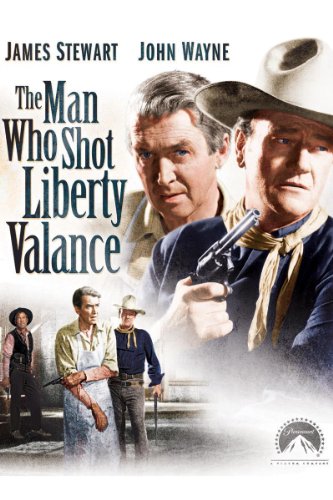
When I thought about doing some posts on Cynicism, this film imediately came to mind. Mostly because of that famous final statement: This is the west, sir. When the legend becomes fact, print the legend. As such, it seemed like a perfect example of how the ideology of the American nation is based on Cynicism. Some might think, that the film shows how a young honestly idealistic lawyer has to succumb to lying to establish his carreer, but it's not that simple. I'll try and show how Ransom Studdard is actually throughout the film an avatar of half-lies and ideology, and the film more shows the world accepting the lie, rather than creating it. Rather than being a film about the creation of ideology, it is, in fact, a film about the creation of Cynicism.


Studdard goes to the West because of ideology: He tells us that he had taken Horace Greelys advice 'Go west young man, go west. And seek fame, fortune, adventure' We hear this in voiceover at the beginning of his flashback, and it is imediately juxtaposed with the actuality of the west, as his stagecoach is held up by masked gunmen. We learn that Studdard is a student of law, one of those systems of halftruths I've just written about. As Liberty Valance rips out the pages of his lawbook and says: 'I'll teach you law. Western law' we get a summation of what the persons represent. Studdard is truth as it should be. Liberty Valance is truth as it is. That Studdard isn't representing truth is perhaps most clear in his dicussion with Hallie about the Cactus Rose she has just been given by Doniphon. 'Isn't that the prettiest thing you ever did see?' 'Yes, it's very pretty... Hallie, did you ever see a real rose?' 'No. But maybe someday, if they ever dam the river, we'll have lots of water. And all kinds of flowers' The irony comes from Studdard dismissing the rose in front of him as 'unreal', and calling a dream-rose located somewhere else, or somewhere in the future, the actual real rose. Studdard seems to think that his world, the world of the big city, a civilized world of law and democracy, is truth, and that the Western world he is in is just a temporary deviation from the world as it should be. When Studdard begins teaching a small class, his lessons seems to be mainly concerned with getting the students to repeat exactly what he believes in. Nora answers: 'A Republic is a state in which the people are the boss. That means us.' There is also a pretty on-the-nose comment on American history when Pompey, who is black, can't remember the part of the Declaration of Independence that goes 'All Men are created equally' prompting Studdard to reply: 'A lot of people forget about that part'. On the nose, but probably quite progressive for 62. And it shows that even 'self-evident' truths could be bended in the history of America.

What the film never forgets is, that in a democracy, truth and right is contested and ever changing. To begin with, Studdard admits that the marshall of Shinbone probably can't do anything about the hold-up, since it is a territorial offence. But his lawbooks says that in fact the marshall can arrest Valance when he returns to town. That the marshall in reality can't arrest him, since Valance would shoot him down, is not something Studdard realizes. He takes the Law as right, more than the world. The plot of the film revolves around the decision of whether the territory Shinbone is located in should become a state or not. The big ranch-owners want to remain a territory while the little people want to attain statehood, with the order that would come from that. We instinctively root for the downtrodden majority, but the film reminds us, that not just the ranchers but also the Native Americans want the area to remain open and ungoverned. Who is actually right in this question? And yet, it's not just democratic votes that determines this question. The clearest example of this is of course the shooting of Liberty Valance, and how the resulting legend influences the carreer of Studdard, but before that, in the scene in the town-hall, Studdard acts very undemocratically, when he reads out the names of himself and Liberty Valance quite normally, and then enthusiastically reads out the name of Peabody.

Throughout the film, Studdard is an ideologue. The film is not the story of the creation of an ideology to ground the creation of the nation. It is the story of the creation of a conscious exploitation of this ideology. It is about the establishment of Cynicism in America.

Post-Ideology: Police, Adjective (09)
The way American Westerns seem to be the primary group of films to grapple with the creation of American Ideology, in the same way the new wave of Romanian Cinema seems to me the primary group grappling with the dis-mantling of Communist Ideology. While none of the directors are as brilliant and singular (at least as of yet) as a Sokurov or a Tarr, precisely the singularity and personality of these two great auteurs means their works work on a more abstract and diffuse level. Romanian cinema, on the other hand, seems quite concerned with Romania.


While I just assumed everyone would have a basic idea of the plot to John Ford's western (it's pretty much in the title), it's probably in it's place to present a small recap of this kind of obscure film (spoilers of course). Cristi is a policeman working in a small Romanian city. He has just returned from his honeymoon abroad, where he has seen how the law is different in other countries, and it makes him question the rules he is meant to uphold. He has been assigned to a case concerning a young man who apparantly deals marihuana, but Cristi suspects that his witness is accusing the young man for personal reasons, and he fears that the punishment of the young boy would be disproportionate to the crime. The film mostly just follows Cristi. Not just as he stands around watching the young man and his friends, but also in his home, where he eats a dinner by himself one night, and another night discusses a song with his wife. In the end, Cristi is called into the office of his boss, where he expresses his concerns that an unjust law of society shouldn't trump his own feeling of a 'moral law', and is forced by his boss to read the definition of several words in a dictionary, none of which provides any proof for the importance of 'moral law'. After that, the arrest takes place off-screen, and the film ends. It is a very slow film, but also very riveting.

The reason I thought of this film as a companion to Liberty Valance, is the way both films are concerned with books and rules and law. In the scene where Cristi and his wife discusses the song, Cristi claims that the lyrics doesn't make sense, while his wife sees them as making sense on a symbolic or imagery level. She can't really choose. Here we get the discussion of whether language should be stringent and bound by common rules of meaningmaking, or if a subjective and sorta artistic (I'm not sure I would describe the very kitschy lovesong as 'art'...) can reach a more profound truth, sorta the same discussion I noted in Solaris. Yet the differences between this film and the Western mirror the differences between democracy and authoritarianism. While the key scenes in Liberty Valance is the ones where we see how the characters use and bend the voting system to their advantage, the key scene in Police Adjective is the one where Cristi is being forced to read out the definition of words. As I said, in democracy, truth is contested, while in an authoritarian system, it's decided from on top. Even when Studdard references laws that are bigger than his surroundings - as he does when they discuss whether or not the hold-up was a territorial offence - he does so in a searching and inquisitive manner. In Police, Adjective, Cristi's boss Captain Anghelache uses the authority of the book to support his authority as a boss.

The cynical moment in the film is where the film gets it's title. As Cristi reads about Police, he gets to the two uses of Police as an adjective: The Police Novel (as it's apparantly known in Romania) and: About police states or regimes which are supported by the police and which exercise control through repressive methods' This, however, immediately prompts Anghelache to reply: 'Ridiculous! All states depend on the police' Through this reply, he suddenly admits that the book could be wrong, yet this admission doesn't make him change his stance on the arrest. This is authoritarian Cynicism, where the tyrant know full well that the rulers has stopped serving the law, and instead uses the law to serve the rulers themselves.

So to sum up: Cynicism is not just usable to explain how big ideologies like Liberalism or Communism can continue to function. It also helps to overlook more structural issues. In a democracy, truth is contested and subservient to the views of the majority, while in an authoritarian system, truth is subservient to the views of those in power. The Cynicist realizes this, yet he continues to believe in his place in the system.

Next week: Pedagogy as a possible example of benevolent cynicism. With Dostoyevsky's Brothers Karamasov and Lars von Trier's Melancholia.

[Part I: Introduction and Mad Men]
[Part III: Brothers Karamazov and Melancholia]
[Part IV: Apocalypse Now]
[Part V: Inception]
[Part VI: Inglourious Basterds]

onsdag den 9. november 2011

Cynicism I : Sloterdijk and Don Draper


An experiment. Over the next couple of weeks, I'll try and publish a number of posts connected by a single theme. Hopefully, there will be a new one up every wednesday until mid-December. This will mean that I'll hopefully get something written, but it will also allow me to discuss different aspects of the theme in question. Each post will be on a different cultural object, which will be used to try and discuss a different part of the theme. A lot of it will be translations, or based on translations, or ideas I've thrown out and discussed in different places at times, and there will probably be a lot of repetions. I don't really have time for writing something completely new every week. Hopefully, some people will want to read it, if so I'll probably try this again with a new theme next spring. The theme this time is, as the title of this piece says, Peter Sloterdijk's notion of Cynicism. If you have comments or suggestions for other artworks or cultural objects that could be relevant for this theme, feel free to comment or send me suggestions. I have already planned and collected notes for this theme, and as I said, I don't really have time to write about something completely new to me, but I'd love to find other examples.

I mean to speak of cynicism the way it is described in Peter Sloterdijk's book Critique of Cynical Reason from 1983. He positions Cynicism as the dominant mode of thought in postmodern society. It is 'enlightened false consciousness'. It is the fourth untruth, after lies, errors and ideology. It means lying even though you know you are lying, because the lie serves a purpose, mainly to maintain your position in society, whether it is a dominant or a subservent one. The term can be used to explain why the process of history seems to have stalled. In leftwing circles, class-struggle was seen as an objectively true aspect of society, and as soon as the majority of people understood this, they would enter the struggle and bring about the communist revolution. The trouble then begins when time goes on, and the vast majority of people fail to become communists. Two answers seem possible: 1) The communist analysis of society was wrong. 2) People have remained too dumb to realize the reality of our society. Now of course, when choosing that other answer, people can make up all kinds of different sub-explanations, about hegemonic ideology or how powerful society has turned out to be, or about governmentality or whatnot, but the fact remains, that the theory says the the theorist has realized something which the majority of the people has failed to do. For me at least, as the decades go on, I sense a growing contempt for the people in the writings I've read. But Sloterdijk is very helpful in this regard. One of his chapters is titled: Enlightened Prevention of Enlightenment. People aren't dumb, they simply choose to believe in what is best for them, not what is right. Of course, this sort of Intellectual Vanguardism is not just found in Communism, but can be seen throughout Enlightenment theory from Kant onward. More on that in the coming weeks.

Sloterdijk writes about Cynicism in many different shapes and figures. He then finds another cynicism, an older, original kind of cynicism, which he calls Kynicism. It's is the philosophy of the old Greek Diogenes. Is is cheekiness, it is philosophizing with your body, it is making fun of everything, it is laughter, sticking out your toungue, it is farting or masturbating in public. I'm not going to write too much about this anti-cynicism over the weeks, but the term reminds me quite a lot of Bakhtin's notion of the carnivalesque (a similarity noted by Sloterdijk), and a writer such as Pynchon seems sublimely Kynical.

Anyways, that was a very short and simple introduction. I don't mean to give a complete and exhaustive presentation of the many aspects and implications of Sloterdijks book. I'm just going to use the notion as a lense to look at some cultural works. To start with, I want to take a short look at the character, whom I think is the emblematic character of the post-millenial age, and who is also obviously a master-cynic: Don Draper from Mad Men. I don't mean to say that he is the best character ever created. I'm not even sure he is the best character on tv at the moment. But I believe that he almost perfectly encapsulates the time he was created in, rather than the time he actually lives in. To say that he is a cynic seems painfuly obvious. That he is living on a lie is the whole point of the first few seasons. And of course, his job is to sell lies and halftruths. Sloterdijk's book is much concerned with a very long historical perspective, so he does not devote all that many pages to the present, but I for one can't find a more cynical profession than the ad-man. It's most clear in the first season, as later seasons seem concerned about finding cracks in the cynical armor of our heroes. We see the cynicism in the first episode, in the making of an ad-campaign for Lucky Strikes, where a 'truth', the psychological 'truth' of our death-drive, is thrown in the garbagecan as the buyers are uncomfortable with it. Instead, we get another kind of truth: 'It's toasted', a half-truth that is true enought, but doesn't mention that every other cigarette is of course toasted as well. And we see it again in the marvelous final pitch of the season, the famous one with the 'Caroussel' from Kodak. 'Nostalgia litterally means: The pain from an old wound. It's a twinge in your heart far more powerful than memory alone' says Draper. Nostalgia is not based on actual memory, not on actual history. As Draper makes his pitch, amazingly affecting pictures from his own family life are shown on the screen. There are many layers in this speech, but an important thing to keep in mind is, that it is based on a completely made up image of the Draper family. We know it is just a pitch to sell a product, we know that Draper is a philanderer and not a very good familyman, we know that he in no way feels nostalgic about his - real - past, there was even in episode three a scene in which we saw Don Draper film a party at his house, where the film seemed to cover up a lot of really uncomfortable incidents. We know, that in every way, the speech is a lie. And yet it works. Not just on us, but on the client, on Harry Crane, who has to get up and leave the room with tears in his eyes - as he has just drunkenly cheated on his wife, he is the one who most easily feels the nostalgic pain - and even on Don Draper himself, who seems to be so caught up in his own idea of a perfect family life, that he fantasizes on the train about coming home early and taking on a weekend trip with them, an offer he turned down earlier that day. It is a lie, but it works on everyone, even the liar. It is true cynicism in effect.


That was a short and boring introduction. With that out of the way, hopefully the next posts will be better. Next wednesday: Laws of Logic, Logics of Lies, and stuff on the ideologies of the 20th century, with John Ford's The Man who Shot Liberty Valance and Corneliu Porumboiu's Police, Adjective.


[Part II: The Man Who Shot Liberty Valance & Police, Adjective]
[Part III: Brothers Karamazov and Melancholia]
[Part IV: Apocalypse Now]
[Part V: Inception]
[Part VI: Inglourious Basterds]

torsdag den 20. oktober 2011

Tarkovsky - Solaris (72)


This is a translation of an old piece I wrote on Solaris. It's just a sketch for a reading of the film, it is in no way extensive. It might be idiosyncratic, it might be obvious. I have a feeling Tarkovsky himself wouldn't have liked the focus I'm choosing. But I think it makes sense. And I've spend a lot of time with Eastern European culture recently, and I think about the same themes and problems with a lot of it. So I'm going to talk a bit about Eastern European culture at the end. But first: Solaris. Spoilers of course. I'm not going to write a synopsis, that can be found at wikipedia.


I really like this trailer. Makes the film seem like an actionmovie, which is quite the acomplishment...

There are three scenes in Solaris, where the characters sit down and watch a film-in-the-film. One of them is Kelvin watching recordings made by his old friend Gibarian. I'm not going to talk about that one, but focus on the two other ones. The first important - for my argument - instance of filmwatching takes place from ca 10:19-23:40. The pilot Burton has come out to Kelvin's cabin, to show an old recording of an investigation. The young Burton is asked about what he saw on Solaris. The interesting detail for my argument is the way the scene is filmed. It seems to be some sort of futuristic automatic camera. Every time another person speaks, the camera cuts to a new angle and a small 'ping' is heard. The camera always tries to catch the person in the middle of the frame, and in mid-distance. This is an official recording, of an official investigation. I will take this as an attempt of an 'objective' observer. The camera also mirrors the content of the scene, where Burton's claims that he saw it all 'with my own eyes' are brushed aside as the objective camera on the plane doesn't support what he's saying.

The second scene occurs from 19:19-21:45 of my two disc version. Kelvin sits down and watches old films with the new version of his wife Hari. It is old homerecordings of Kelvin and his family. The camera zooms in and out and moves about. The people in the picture stare awkwardly at the camera, and you can easily feel the connection between 'observer' and 'observed'. I will take this camera as an example of a subjective observer. In the last part of the movie, we see the old, dead Hari in frame, and we realize that the new Hari has been constructed out of Kelvin's memories of these old films.


In a key scene from 27:12-29:50 we find Burton and Kelvin discussing the mission to Solaris. In this scene, we learn how Kelvin views science pre-Solaris. His view is that science should be done without involving feelings. It should be done by objective observers, the ideal would be automatic observers such as the cameras in the clip from the investigation. The discussion makes Burton leave in anger, while he yells that Kelvin is an 'accountant, not a scientist'. In my reading, the rest of the film describes how Kelvin the accountant has to reevaluate his views on science because of his confrontation with Solaris. Hari and the other constructs therefore symbolizes the subjectivity of the scientists, which in the end inevitably affects there work. At the end of the film, Solaris agrees to stop making constructs aboard the space station for some reason, but does this mean objectivity is possible? If that is the case, then Kelvin turns his back to it, and ends the film on an island on the planet, in a construct of his childhood home. But what are the implications of this turning the back on objectivity? One the one hand, it could be said to weigh subjective art higher than objective science, and every one of the deeply personal and uniquely Tarkovskyan shots of the film supports this view, as does the long takes dwelling over the art of Brueghel and others. But what about the context of Soviet 1972? Isn't Marxism built upon an attempt at an 'objectively scientific' model of history? If so, you could say that this is a fundamentally anti-Marxist film. Not because it's against Marxist ideology, but because it attacks the attempts at making objective foundations to build an ideology on. If Solaris talks against objective science in general, doesn't it then contain a multitude of social and political implications? Isn't it then a deeply political film?


But there are many problems with this explanation of the film. For instance, most people will probably see Hari as much more than just a symbol of subjectivity, she is too rich a character to be reduced to that. Furthermore, Tarkovsky himself would probably be very much against this reading of his film. He was against symbols, and he was against focusing too much on social and political questions. But let's look at Hari for instance, why can't she be reduced to a symbol of subjectivity? In my mind, it's because the film is so focused on how Kelvin percieves Hari. She is a symbol, but she is also Kelvins wife, and the film is much more focused on this personal relation. This is typical for a film by Tarkovsky, they are usually concerned with the personal consequences of situations. In Ivans Childhood, the horror of war is depicted through how it affects a single child. In The Mirror, the war is only shown through the memories of a single man. And in The Sacrifice, the end of the world depends on a very personal relation... Tarkovsky focuses on humans beings, not on society as a whole. But that doesn't mean he cannot be seen as being political. It says more about how primitive political discussions often become. Apparantly, Italian Marxists criticized Ivans Childhood as being too bourgois in focusing on the tragedy of one. But what value has politics if it isn't concerned with bettering life for singular human beings? For me, a huge part of the point of left-wing politics is in pointing out how liberalism so often devolves into freedom for a few individuals, at the cost of less freedom and more pain for the vast majority of people. Yet very many left-wing people seem to forget this at times. Tarkovsky is political at times, but he never treats politics as abstractly as so many politicians does. No matter how abstract he can be - and he can undoubtedly be very abstract - it's always rooted in people.


And I have similar problems with how people view a lot of Soviet/Easterneuropean artists. From the films of Tarkovsky and Tarr, to the theoretical writings of Mandelstam or Bakhtin. People are understandably wary of putting too much of a political framework over their works, but a lot of their stuff has wideranging political implications. A huge part of the problem is, that the context they were created in / are occupied with, was so primitive and simplistic. The only proper (or allowed) political response to Stalin and the Soviet Dictatorship was praise back then, and is condemnation today, so the space for artistic expressions is quite narrow. If you say that a piece of art from this context is political, people would think that it means that they are concerned with their political context. Yet Bakhtin's writings has a huge antiauthoritirians potential, which cannot be reduced to him being against Stalinism.
So while I completely understand why people wouldn't want to let this stuff be 'infected' by their contemporary context, perhaps we're so far removed from that context today, that we can take the discussion of political and social implications of Soviet/post-Soviet art on another level? The thing is, exactly because this art is working on a more fundamental level than just critiquing its day, it's still relevant today. Solaris for instance: Is it possible to observe the world from an objective position? Or will every observer also see the ghosts of his/her past? Is the objective position even preferable? Doesn't the subjective camera that Tarkovsky uses give is a fundamentally deeper understanding of what goes on, than the objective camera used in the interrogation scene. It's fundamentally philosophical questions, and that Tarkovsky focuses on how these questions has consequences for a single human being does not mean, that these questions aren't important in a larger context.

tirsdag den 27. september 2011

Gotye - Somebody That I Used to Know


I first discovered this video on a music board. Underneath the video, the person who had posted it had written something along the lines of: 'Weird, this is not normally the kind of music I listen to.' When I heard this song my first thought was: 'This sounds like a mix of Sting and Phil Collins' After listening to this song over and over afterwards, I began to think about how weird these responses actually were. It sometimes seems to me, that obssesive music-listeners such as myself and so many other bloggers, reviewers, critics and music-board-discussioners might actually be the ones who understand music the least. When you hear this number, obviously your not supposed to think about how it fits in with all the other stuff in your record collection, or which other bands it reminds you off. You're supposed to think of people that you used to know...


Music can communicate in a weird way. In this song, almost nothing of the communication to the listener depends on the lyrics. From the title and the opening lines: 'Now and then I think of when we were together' there is not a single line that is anything special, with several of them actually being quite cringeworthy, the lowpoint for me being 'But that was love and it's an ache I still remember' But something happens in the delivery. The way Gotye whispers the explanatory verses highlights their insignificance, and makes his emotional outpouring in the chorus that much more effective. He seems to understand pretty clearly what happened, it was all inevitable and probably for the best. 'BUT YOU DIDN'T HAVE TO CUT ME OFF!' And what a marvel that chorus is. The drawn out 'cu-u-ut me off' and 'sto-o-op so low' (they are another example of an emotional outburst being shown through the melody jumping up, what I recently described as a 'scream', though that term isn't really accurate) that contrasts the next lines, where as many syllables as possible are crammed together to provide evidence for the wrongdoings of the ex. It's not poetry, but it is a pretty convincing picture of the mix of emotions and attempts of finding that one bulletproof explanation that would clearly put the guilt on the other part, that so often goes on after a breakup. So who cares about poetry? And then Kimbra enters the picture and obliterates the image of the wronged guy with the lines 'Now and then I think of all the times you screwed me over'

And then there is the musical context. This is what makes the song so universal, I think. As I heard this song more and more, it reminded me of more and more people I used to know. Breakups, potential relationships that never were, friends with whom I grew apart, dead relatives. Actually, the lyrics are quite specific, and describe a circumstance I've never been in, the line 'Have your friends collect your records and then change your number' especially describing something I can't really relate to. But while the lyrics paint a picture of a single breakup, the arrangement makes the song seem much more universal. That unrelenting guitarloop that provides the foundation for the song, the allmost childlike hook-line on the xylophone, the marching drums that enters the song during Kimbra's guest-verse. All of it creates a picture of inevitability, of life marching forward and onward, leaving situations forever changed, the past impossible to recreate, and making once extremely important people into, yup, somebody that you used to know. This is one of those weird creations, not just a song, definitely not poetry set to music. It's more like a carefully sculpted soundscape in which a small play takes place. The play creates a believable personal story, and the soundscape makes that story seem universal. Both parts are equally important.

Though this song is probably pretty obscure in most parts of the world, it was a huge hit in Australia, Belgium and the Netherlands. As with many popular songs, it might therefore be treated to different versions, liveversions, remixes, demos and acoustic versions. While some of these imaginary versions might be very, very good, to some extent they would be evidence of a misunderstood attitude towards pop. At times, people talk about 'stripping' a song to it's 'core', removing all the ornamentary arrangements from it to check if the melody and lyrics can stand on their own. Yet, in this song they really can't. Play this song on an acoustic guitar, and you're left with an average description of a breakup. But this isn't supposed to be looked at this way. This is not a core and stuff on the surface. This is a lot of different but equal parts, that relates to each other, sometimes supporting each other, sometimes opposing each other (i.e., they are in dialogue). It is a glorious, contradictory mess, that utterly fails to coalesce into a single statement. Which is part of the reason it's so great.

Here is an article on the creation of the song. Not surprisingly, it took a lot of effort to get it just right.

onsdag den 21. september 2011

Dialogism vs Dialectism

At times, I need to write down the theoretical boring stuff, that somewhat are at the foundation of most of what I write. Write them down again, that is. Phrasing and rephrasing will hopefully help me get to the core of these things. Plus, as far as I can see, hardly anyone ever reads these theoretical posts anyway, so the risk of someone being bored by the repetition is hardly that large. I tried to explain something with my introduction to this blog, now I'm kinda trying to explain it again. And it probably won't be the last time either...

This time, it's because I read an interesting piece on Modern Classical Music some time ago. Actually, I found it because Simon Reynolds wrote about it. If you need a primer on what I think is perhaps the most essential discussion facing the art-world at the moment, go read it. It's on the question of heterogenity and 'too much freedom'. To put it simply and less eloquent than Reynolds and Davidson: The artists of today has too many choices, too much inspiration, so their art ends up eclectic but somehow inessential. It's all new and exciting, but it doesn't really do anything. This is all fair game, and I agree, that a lot of modern art, litterature, music and film seem to be new for new-ness sake, without anything essential to say. Where I think they are unfair, though, is what Davidson indicates when he ends his piece by saying: What they badly need is a machine to rage against and a set of bracing creative constraints. I think this is unfair, because it's a conclusion that doesn't follow from his earlier points. Davidson doesn't write a lot about what is missing, but the one time he does, he states on two works, that: Both works abound in sonic beauty, yet they lack, say, Messiaen’s violent awe at a landscape’s revelations. But this isn't describing something Messiaen was against, this is something he was in awe of, it would be more precise to describe it as something he was for.

And I find this emblematic when a lot of - older - people write about what I kinda think is my generation (warning, I'm going to set up a strawman here...). They say we aren't against anything, without really backing it up. It's unfair, because it paints us as lazy. How, with the state of affairs of today, can we be so passive? Neoliberalism, two wars, economical breakdown, tea party, so many things to be against, and we are not fighting against any of it. Well, back in their days, they were truly political and trying to change the world. But as I said, it's not that we lack things to be against, what we lack is true, strong alternatives. We lack something to be for. And obviously, I'm for a lot of things. I'm for love, truth, treating other people decently, warm cups of tea, Romanian Cinema, writing about stuff on the internet. Yet most of what I'm for is either rather vague or rather personal... Hardly any of it can function as the basis for what many in the elder generation is looking for: Collective Action. I think young people of today is for and against as many things as their predecessors, but since each has their own little thing going, it hardly looks like a lot.

Mikhail Bakhtin, the guy I spoke about in the introduction, also used the word Dialogism to explain himself. In his great essay Discourse in the Novel, he explained the way novels work. They are heterogeneus, mixing together all different kinds of words, speech, language. But a novel does not mix things to make the linguistic strands do battle with each other, but just to have them relate to each other. This way, the novel in itself works against authoritarianism, which is always trying to make language as homogenous as possible. Therefore dialogism is naturally opposed to any kind of authoritarian power, it will perhaps always be a force of freedom of possibility. Yet what Bakhtin never stated explixitly - and probably couldn't have done if he wanted to, he was writing this in Soviet Russia, after all - is that Dialogism is also seemingly opposed to Dialectism. Dialectism was described by Hegel as being the force behind history. A thesis meets it's antithesis and they melt together into a synthesis of the two. Karl Marx then wrote a political version of that, where the proletariat and the bourgoisie was supposed to struggle, and then a communist society would be born out of that (this is obviously massively simplified). But in that way, dialogism undercuts the mindset and philosphy behind marxism and class-struggle.

At times, it feels like that's what these - older - commentators abhor in the new generation. To be perfectly frank, it often seems as if they are angry/dissapointed that we are ambivalent about marxism. Yet we do still believe in socialism, I do at least, it's just that I feel that if it becomes the only allowed alternative to the establishment, well then that is almost just as suffocating. I don't believe in dialectism anymore, and I don't really believe in any big ideas. And I don't believe in importance. What I believe in is small but great ideas. And feelings. Some people think that dialogism amounts to little more than postmodernist relativism, just taking all kinds of stuff and mixing them together. And while that is definitely a danger, it doesn't have to be that way.


Last year, my two favorite albums was Slow Six - Tomorrow Becomes You and Yellow Swans - Going Places. The first of these could have been included in Davidsons piece: They are from New York, they are classically trained, and they play a somewhat new hybrid of a lot of things. Going Places was a very abstract noise record, that was first on Popmatters list of 'Best Experimental Records 2010'. Yet, if you go to these two records looking for importance, forward thinking and avant-garde newness, well then you'll probably leave dissapointed. Slow Six are basically Do Make Say Think with violins instead of guitars, and while that - and the influence from Steve Reich - make them somewhat original, the album would hardly be anything special if that was all they had. No, what I love about this album is that it seems to describe love and longing quite profoundly, in a somewhat original way. The pieces switch between being polyrythmic and in weird meters, and more 'normal' parts. They sort of switch between playing against each other and with each other, for me illustrating a struggle for people to find and fall in sync with each other. And Yellow Swans is all about leaving the known world behind, and finding your footing again somewhere else, illustrated by songtitles such as Opt Out and New Life.


What these albums do, is to Opt Out in the search for originality and avantgarde importance. They are not grounded in any kind of idea of the 'future', they are not grounded in any struggle against anything. They are grounded in feelings, and the elements on the album have been chosen to best support these feelings. This is art without creative constraints or rage against anything. This is mixing and matching bits and pieces, all in service of something grounded in feelings. That might be a basis for dialogic art to grow out of, though these records are probably too homogenous to be there yet. All in all, though, this is something I'm very much for.

Bakhtin's essay on 'Discourse in the Novel' can be found in the collection 'The Dialogic Imagination: Four Essays by M.M. Bakhtin', 1981, Texas University Press. Edited by Michael Holquist and translated by Caryl Emerson and Michael Holquist. It can be bought here, here or here.

fredag den 9. september 2011

Sufjan, The-Dream, The Shins & The Wrens - How to Scream Believably!

So, I've been bogged down in a discussion over 'authenticity' in music these last few days. That weird, rockistic term, which no one really knows what means, and yet people still sort of feel it is useful. I kinda don't. I simply don't get what it means. My problem with the two words 'authenticity' and 'honesty' is, that they don't just relate to the music. That a record is 'authentic' or 'honest', seamingly means that the link between artist and art is in a certain way. Therefore, you have to include the artist in the discussion, if you use those words. So instead, I've begun to think that the word 'believability' is better. I mean, every piece of art is an attempt to express something in a certain way, judging it on how it relates to the artist seems wrong somehow. I'd rather judge it on how much I believe in the construction presented to me. Even though most songs are somewhat dishonest (Extreme examples: David Bowie wasn't really from Mars, Jeff Mangum hasn't had sex with Anne Frank, Stephen Merritt is not 69 People. Less extreme examples: Many songwriters keep writing that they have just fallen in love, even though they have been married for a long time.), many of them still seem believable, even though what they say is hardly possible... I still find it hard to explain what I mean, so I've found four examples. Four songs, where the vocalists does almost the same thing, two of which I find believable, and two of which I don't.


The first example is a song I've written about before, actually just last month. I thought about contrasting it with the next example back then as well, but I decided it would be out of place. It's the same moment, that high-pitched 'Oh my God' at 1:20-1:30. I simply don't believe in it. The problems are, that it's presented as if the singers are meant to sound surprised. The song talks about the victims, and then all of a sudden goes 'Oh my God', as if the singers couldn't stand it any more. Here, it clashes completely with the fact, that there are two singers singing in harmony. So the two of them was shocked in exactly the same way, at exactly the same time... I don't find it believable.


I'd wanted to contrast it with the song above, Right Side of My Brain by The-Dream from his album Love vs Money. The thing he does, he does twice, from 2:00-3:00 and from 3:30-3:45. He tries to do the same thing as Sufjan, use two voices explosively to show how he is overwhelmed by emotion, and even though I know it is just as constructed as the Sufjan-song, it works for me. The key is how he introduces the second voice as doing it's own thing. When it enters the song, it just answers the first voice a bit, but then it all of a sudden becomes a higher version of the melody. It sounds like two different parts of his psyche, all of a sudden united in anguish, not the same part doubled. And I know it's impossible, it's the same voice overdubbed, it's not 'honest' or 'authentic', yet it still works. For me, at least.


The third example is by The Shins. The moment in question occurs at 0:54 (if you knew the song, you'd probably already figured that out...). This actually doesn't have much to do with the song in question, the 'scream' is nicely foreshadowed in the instrumentation, which a moment before becomes a bit noisier. Yet this moment still annoys me, and it has to do with the way the song is posited on the album it's from. See, this is the opening song of the album Chutes Too Narrow from 2003. So this is how The Shins introduces themselves and their world to the listener, with a weird scream coming out and surprising anyone. On it's own, the song kinda works, but as an introduction, I find it annoyingly quirky. It crosses the line I spoke of in the Sufjan-piece and becomes clever because it doesn't know how to be honest. And that cleverness makes it seem too constructed, too calculated, and again, I stop believing in it.


This song above, This Is Not What You Have Planned by the Wrens is on it's own probably more quirky and annoying than the Shins-one, what with the weird way it's recorded and the way the singer clears his throat at the start. The key point is that this song is located at the end of the album in question, The Meadowlands, also 2003. So because of the way it's located on the album, it's positioned as meaning Go Away! instead of Welcome. And all of a sudden, I believe in it. It doesn't sound as calculated, it sounds frustrated and depressed. Both of these songs are off-putting, but the one by The Wrens is believably off-putting.

So what I've been trying to do, is to discuss why some tracks are believable and some are not, focusing only on the way the music is constructed, on the level of a single song or a whole album. I've done this to keep it on the level of discussing craft and composition. Some people use the words 'honesty' and 'authenticity' to give value to entire genres - i.e. music recorded live with acoustic guitars is more 'authentic' than music with samplers and autotuned vocals - and while it is undoubtedly statistically true, that the percentage of numbers that seem believable is high in some genres and not as high in others, there are no tools that can't be used to create believable music. It's all a question of talent and craft.

mandag den 8. august 2011

Sufjan Stevens - Illinoise : An Attempt at a Reconsideratione


In 2005, a young singer-songwriter made the first real misstep of his career. His albums were normally created around concepts, but until then, he had mostly managed to anchor these concepts in something personal, such as his homestate Michigan or his Christian faith. But when he made that aformentioned album about Michigan, he had stated that he was going to devote an abum to every state in the US, and so he dutifully set about creating an album on Illinois. As such, for the first time the concept seemed impersonal, it seemed to be something he felt obligated to do, rather than something he truly felt about, and the resulting album seemed researched and studied rather than felt, it felt much too constructed, and in the end, it simply rang false. Yet something weird happened: This album, his first one that would have to be called a failure, became his big breakthrough album. The critics, led by an internet publication coincidentally located in the state he was singing about, all declared it a masterpiece, and his fame increased tremendously. To the credit of this young artist, he didn't do what most would probably had done, which was to continue making albums that had proven popular even if it wasn't artistically succesful. Instead, he took a prolonged break, worked on other stuff, reworked an older album, which reminded people of how anomalous his breakthrough record actually was, and then returned with an album that was a complete departure from his popular style, plus statements saying that his 50 State Project was always kind of a joke. But, while the artist himself has seemingly recognized the lackluster results coming out of the undertaking, the public at large still hasn't realized this, with the aforementioned internet publication placing the album as the highest charting release of 2005 on their recently made list of albums from the last decade. Well then, this is an attempt at a reexamination. It will probably completely reverse the discourse on this album all over the world. Or it might be read by like, 20 people, and then be hidden on page 11 of Google, following blogs gushing over why Chicago is the best song ever. One of those two. Oh, in case the title of this post didn't tip you off, the album in question is Sufjan Stevens' Come On: Feel the Illinoise from 2005.


Actually, I've kinda already explained that the problem is the studied and impersonal nature of the record, but just to give an example: The second half of the title-track-suite is called 'The Ghost of Carl Sandburg Visits Me In a Dream', and it opens with the lyrics 'I cried myself to sleep last night / And the ghost of Carl, he approached my window' Well, if this album wasn't a concept album on Illinois, I might believe this, but now it just seems incredibly coincidental. No, he probably wasn't visited by Carl Sandburg, he probably read his books as research. And so, he probably didn't cry himself to sleep as well, he is just really exagerating. It just rings false. Perhaps, Stevens was aware of this problem, the song repeats the question 'Are you writing from the heart?' And no, coming after a quirky and funny rumination on progress and the Word Fair in Chicago in 1893, he seems to write more from books than from his heart.


The biggest misstep on the album, however, is the following song, John Wayne Gacy, Jr, about the infamous mass murderer. Well, when you are going to make art out of a tragedy, and in a best case scenario make money out of that art as well, honesty and purpose becomes even more important. If a song about seeing the ghost of Carl Sandburg rings false, it just seems silly. When the same thing happens to a song about killing young men, it unfortunately seems like exploitation. And the song on Gacy rings false. Again, it suffers from being located on a concept album about Illinois, that alone means the concreteness of the tragedy is disminished. But when Stevens actually tries to describe the humanity of his victims, he does it with the vague and inconcrete lines: 'Twenty-seven people, even more / They were boys with their cars, summer jobs / Oh my God' That high pitched Oh my God is probably the worst moment in his entire carreer, completely unearned and phony, fake outrage invoking more anger than anguish in me. When Jeff Mangum set out to make In the Aeroplane Over the Sea, he managed to make his ruminations on the murder of Anne Frank seem personal and from the heart, even though he alowed the creepishness of the concept to take center stage. This is the opposite of that. It reminds me of rubbish Oscar-bate based around Holocaust or mental illness, or something else that will make the studios and the stars seem more human. It's just horrible. And the ending of the song is even worse. After describing the murderer and the murders, Stevens reaches this conclusion: 'And in my best behavior / I am really just like him / Look beneath the floorboards / For the secrets I have hid' So many themes are touched upon in this song, and Stevens thinks the lesson we should take away from this, is that secrets are bad. This is such a weird conclusion, it both seems so safe in how it skirts away from for example the repressed homosexuality of Gacy, the mood concerning homosexuality at the time, which probably made Gacy repress himself that much more, the death penalty etc. And yet it is also infuriating in it's equating between secrecy and murder.


But two duds does not a failed album make. No, the problem with this album is, that the framework means, that the whole ends up less than the sum of it's parts. To illustrate, take Casimir Pulaski Day. It's a great song, an absolutely heartbreaking description of the death of a girlfriend from cancer, and how it makes the narrator question why God would let it happen. The last line, when the instrumentation cuts out and Stevens sing 'And he takes and he takes and he takes' is immensely powerful. It's a wonderful song, and it has absolutely nothing to do with Illinois, except that the woman dies on the titular state holiday. Well, the song is meant to inspire heartbreak and religious introspection, but I'll bet the most common response is to go on wikipedia and read about the Polish general mentioned in the title. The framework ends up hurting the song ever so slightly, it might not seem like much, but on the other hand the ties to the concepts doesn't add anything. The detail that the death takes place on this date does not make the story seem more real, on the contrary, it seems awfully coincidental. But again, on it's own, it is a great song. In context, it suffers. Just like that, I'm not saying Illinois doesn't include some great music, some great songs, an abundance of great ideas. But as an Album, it fails. Again, that might seem like stating the obvious, seeing as the album contains 22 tracks in 74 minutes, but this is Indie-rock we're talking about, a genre that has always prided itself on being album oriented, being both grander and yet more personal than glossy popmusic, and so it seems weird that an impersonal concept album that so obviously fails as a concept album just gets a free pass. I too, of course, adore Chicago and Decatur and some of the other stuff, they belong on a list of the best tracks of the decade, but the album itself has nothing to do on such a list.


Well, enough with the moderation. On with the thrashing and the implying. On to the thorny issue of Representation. The idea that, when you set out to make an album about a whole state, you have a responsibility to represent people of all kinds, ethnicities, sexuality, religious inclination, and not just paint an entire state like white surbubanites, with a few dead poets thrown into the mix for kicks. And, well, I actually don't really agree with this idea. I mean, I'm criticizing the album for being impersonal, it would be hypocritical to then on the other hand criticizing the album for not including enough other personalities... So for me, the hardly significant amount of blackness, in both the music and the lyrics, seems more archaic and weird than offending to me. But here we are, just 6 years later, and Illinois has been used as the foundation for the career of the first black president of the US, and is the homestate of the biggest rapper in the world (Kanye), and this album represents the feel of the state through banjo and Reich'ian minimalism. I've never been to the state, but it does strike me as odd. Of course, the archaicness is by design, the album is mostly concerned with stories from the past, and while the front cover invites us to 'Feel the Illinoise', that seems more toungue-in-cheek than a claim to accurately capture the spirit of the state.


This video shows how diminished the song can become: It's all just mentions and allusions, signifying nothing. I love those harmonies, though...

No, actually the album becomes much more problematic when Stevens actually touches on problems and issues, for nearly all of the time he leaves it at just touching them, and immediately skirts away to safer pastures. I've mentioned how John Wayne Gacy, Jr ends up blaming secrecy for the murders, but there are other examples. Take the second track, the instrumental 'The Black Hawk War, Or, How To Demolish An Entire Civilization And Still Feel Good About Yourself In The Morning, Or, We Apologize For The Inconvenience But You're Going To Have To Leave Now, Or I Have Fought The Big Knives And Will Continue To Fight Them' It's the ony mention on how the state is actually based on getting rid of it's original inhabitants, and it's played for laugh. Never mind that the track seems almost triumphant - it seems to describe a birth, the birth of the album, the birth of the state, and it seems to build on the first song, which describes something indeterminate and formless. In other words, it's way too clever for it's own good - the problem is, that the Native American experience is actually excluded from the rest of the album, and just mentioning them in a songtitle - no matter how long - just smacks of tokenism. The same problem arises when the next to last song is entitled: 'Riffs and Variations on a Single Note for Jelly Roll, Earl Hines, Louis Armstrong, Baby Dodds, and the King of Swing, to Name a Few' All fair and good, but actually incorporating their experience and their music into the album would have shown much more respect. Another example was apparantly changed before release, as I found reference in a review on Uncut to a track that was called 'To The Workers Of The Rock River Valley Region, I Have An Idea Concerning Your Predicament, And It Involves An Inner Tube, Bath Mats, And 21 Able-Bodied Men', which on the final tracklist has been cut after 'predicament'. Which is for the best, as it yet again just skirts over real problems and uses them for a joke. The problems in the aforementioned region seems to be outsourcing of industrial labor and high unemployment, but the more realisticaly titled 'To the Workers of the Rock River Valley Region, I Have an Idea Concerning Your Predicament, and it Involves Higher Taxes for the Richest, Socialized Health-Care, and Massive Investments In Public Education' would probably have been somewhat divisive. Also, while I really like that the upbeat Jacksonville, which seemingly praises the spirit of progress and of America, is followed by a ruminative coda, which to me seems to reflect on the fact that America, while undoubtedly in the running for best country in the world, still is fraught with problems, conflicts, and peope living on the margins. But then it is called 'A Short Reprise For Mary Todd, Who Went Insane, But For Very Good Reasons'. Mary Todd was the widow of Abraham Lincoln, and it just seems offensive to me to actually invoke the history of the Civil War, with all the horrific stuff connected to it, and seemingly asking us to remember the plight of the white women of that time. In this instance, black history is completely kept out of sight. To sum up, the word that best describes how Stevens deals with political and social issues in Illinois is perhaps 'escapism'. He mentions them, and then immediately skirts away, or plays it for laughs. It would actually have been better for me, if he just kept to describing his own childhood and relationship with the state, instead of touching on these issues now and then, but doing nothing with them.

But why, if this album is bookish, studied, impersonal, escapistic, and filled with unfortunate politics, why has it become a touchstone on the indiescene in the last decade? Well, parts of the discourse sorrounding the album is just wrong. In the blurb on the album in Pitchforks list of Albums of the Decade, the conclusion reads: 'Stevens' self-confidence manifests itself in having enough belief in his own voice to tell everyone else's story-- all geographical namedrops aside, Illinois could've been relocated anywhere and it would still be nothing short of universal.' With this, the studiedness and the impersonaity of the album suddenly becomes a strength. And well, it's just wrong. This album simply couldn't have been relocated to Denmark, for instance, it sounds extremely American, the serial-killers, the bible study, the banjo and the sense of expanse. Nope, this is a midwest abum through and through, and it suffers from sitting between the two chairs of the personal and the universal, without actually achieving either. But then why is this album so popular?

In The Recognitions, William Gaddis' massive proto-postmodern tome on Art, Falseness and Boho's - definitely one of the best books I've never managed to finish - several characters mouth musings on the same theme, first stated as: 'Most people are clever because they don't know how to be honest' (p. 252) This is of course exceedingly true of the indierock scene, where a knowledge of styles and diffusive, allusive lyrics are very common. It is perhaps the cleverest music style, and unfortunately often the least honest. At times the contradictions in the music makes it capture the times, and makes it that much more relatable, at times it makes it able to rise above the clichés and prejudices of the day. At other times it just seems phony. Illinois rings false in my ears, but it still seems like the most purely enjoyable of Stevens' recordings. Michigan is filled with real anguish concerning the plight of the working class in a postindustrial age, and I feel uncomfortable with the Christianity on Seven Swans. Those two albums are uncomfortable listens. A few songs aside, Illinois makes me feel sophisticated and clever. But is that really the best indie-rock can aspire two? That Illinois, the only feel-good failure in the discography of this great, inventive singer-songwriter, has become the consensual pick for Stevens' magnum opus, unfortunately speaks volumes about the problems of the scene as a whole. At least in my humble, yet perhaps obsessive, opinion.